Tag: Azuma Kagami

  • Kamakura III – The Jokyu War

    We’ve already talked about Imperial decline during the Heian Period. Over many centuries, central control eroded, until eventually the provinces proved to be ungovernable. Eventually, the power of the Imperial Court was usurped by Minamoto no Yoritomo, who established the Kamakura Shogunate in Kamakura, obviously.

    You may not be surprised to hear that the Emperor wasn’t best pleased with this turn of events. Although the actual power of the Emperor had been largely theoretical for decades, there had always been a veneer of ‘Imperial’ authority. The rise of the first Shogunate, however, did away with that.

    With supreme military power firmly in Yoritomo’s hands, there was little the Emperor could do to change the status quo. However, as we’ve discussed, Yoritomo’s heirs proved not to be the model of their father. By the dawn of the 13th Century, the Kamakura ‘Shogunate’ was in fact ruled by regents, or Shikken, from the Hojo Clan.

    In 1219, the regent was Hojo Yoshitoki, who shared power with his influential sister Hojo Masako, the so-called ‘Nun Shogun’. That year, Masako’s son, Sanemoto, the third Shogun, was assassinated, bringing an end to the line of Minamoto Shoguns (Yoritomo and his two sons). Although the Hojo were already in effective control, the end of the ‘legitimate’ line of Shoguns presented an apparent opportunity for their enemies to challenge them.

    Emperor Go-Toba

    In a period where Emperors were often well-decorated figureheads, Go-Toba stood out. He was highly educated, as most courtiers were, but he had also shown skill at martial arts, earning him respect and loyalty from warrior families in the west and north. Unfortunately for him, the Throne still drew its income from its land holdings, and when the Shogunate appointed officials to oversee those holdings, the money taken in taxes often didn’t find its way to the Emperor.

    Emperor Go-Toba, whose attempts to restore Imperial power would start the Jokyu War.

    After Sanemoto’s assassination in 1219, the Hojo approached Go-Toba about the possibility of one of the Emperor’s sons becoming the next Shogun. Go-Toba attempted to negotiate, seeking the removal of Shogunate officials from Imperial holdings.

    The Shogunate sent a force of 1000 men under Yoshitoki’s brother in an attempt to intimidate the Emperor. Go-Toba wasn’t easily scared, however, and negotiations broke down, although the Emperor would offer a concession; he would allow a member of the Imperial family to become Shogun, as long as it wasn’t a prince of the main royal line.

    The Hojo were satisfied with this, and Kujo Yoritsune, who was only a little over a year old, was chosen as the fourth Shogun. However, because Yoritsune was a baby, the position of the Hojo as regents was secure, and, for a time at least, peace endured.

    The elevation of a member of the Imperial house to the position of Shogun did nothing about the underlying issues, however, and in July 1219, just a few months after the previous negotiations, the military governor of the area around Kyoto, (who had been appointed by the Shogun) was attacked and killed by warriors acting on the Emperor’s orders.

    Some records say that the governor had been planning to launch a coup and make himself Shogun, with Go-Toba, made aware of the plot, acting to stop the plot before it came to fruition. Other sources, however, point out how unlikely it is for Go-Toba to have had a Shogunate official killed as a favour to the Shogun, and it is more likely that the governor either discovered, or was made aware of, the Emperor’s plans, and was removed accordingly.

    The unfortunate fellow apparently took his own life when his residence (which was within the grounds of the Imperial Palace) was surrounded and burned by Imperial loyalists, and whatever the reasons, this was a direct attack by forces representing the Emperor on those representing the Shogun. The Emperor then asked the Shogunate, Court Officials, and local temples and shrines to donate money to help rebuild the burned residence, and, perhaps unsurprisingly, most of them refused to pay up.

    During rebuilding work, rumours spread that Go-Toba was quietly gathering allies and raising an army. It was also alleged that he had asked shrines and temples around the capital to invoke the power of the gods on the Emperor’s behalf, which was quite the provocation, apparently.

    War Begins

    Then, in Spring 1221, Go-Toba gathered troops in the capital under the pretext of protecting religious sites and ceremonies. On May 15th, he dropped the pretext; however, when forces loyal to the Imperial Side attacked the offices of the Shogun in Kyoto, burning them and killing the officials, which, as declarations of war go, is pretty definitive.

    On the same day, Go-Toba issued a formal Imperial decree, ordering all the warriors of the nation to arrest Yoshitoki, who was declared an outlaw and enemy of the court. Within a few days, warriors from across western Japan had risen against the Shogun, and Go-Toba believed, rather flippantly, that the issuance of an Imperial decree would fatally undermine the Shogunate.

    This is one of those times that later writers absolutely love to dramatise. It’s all honour, loyalty, duty unto death, etc. but the reality is that, despite an Imperial Decree, and a counter-decree from Hojo Masako, the majority of the warriors across the nation (those who were directly tied to either side through blood or obligation) sided with whoever they thought would benefit them the most if they won.

    In those calculations, the Shogunate had the advantage; the Shogun had the right to distribute land, and most of the warrior families expected to be rewarded with the lands and titles of those who had sided with the Emperor and the court, who was generally believed to have been likely to favour himself and his courtiers, in the event of their victory.

    So, for all their vaunted ‘honour’, the Samurai would (and not for the last time) side with those they thought would give them the best deal, and by the time they marched, the armies loyal to the Shogun are said to have numbered nearly 200,000.
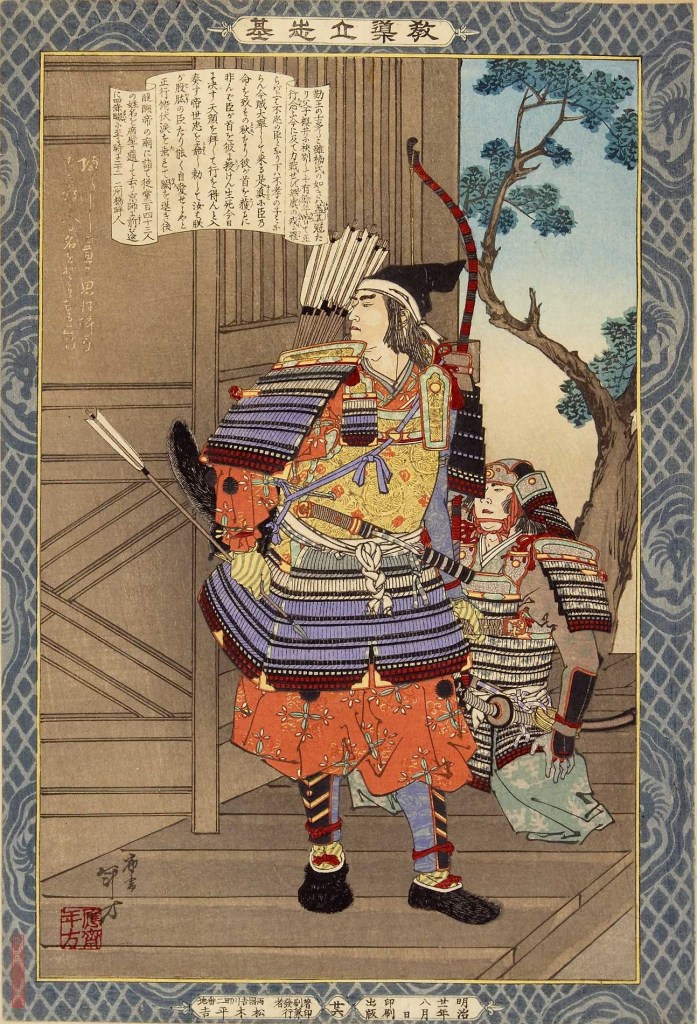
    A later illustration of a Samurai as they might have appeared during the Jokyu War.

    The Shogunate army was actually three separate forces, with 40,000 men heading by a northern route, another force of 50,000 heading through the mountains, and the third, largest force of 100,000, following the main Tokaido Road, with all three marching on Kyoto.

    The Imperial side seems to have been caught off guard by first the size, then the speed of the Shogunate forces. It appears that the Emperor had believed his decree would be enough to secure mass defections, and when the opposite occurred, the forces loyal to the throne were out of position and hugely outnumbered.

    Resistance was scattered and ineffective, with some sources suggesting that the main army took just 22 days to complete the march from Kamakura to Kyoto, which might be an exaggeration, but goes some way to highlighting how badly prepared the Imperial Army was.

    Though the court was able to gather warriors from Western Japan, the numbers were nowhere near what they had expected, and besides, the rapid advance of the Shogunate army meant that reinforcements wouldn’t have been able to reach the capital in time.

    In desperation, Go-Toba went to Mt Hiei, on the outskirts of Kyoto, and pleaded with the famed warrior monks for support. The monks, partly out of opposition to the Emperor, and partly due to their fear of the strength of the Shogun, refused to help, and Go-Toba was left with an army of around 18,000 to defend the capital.

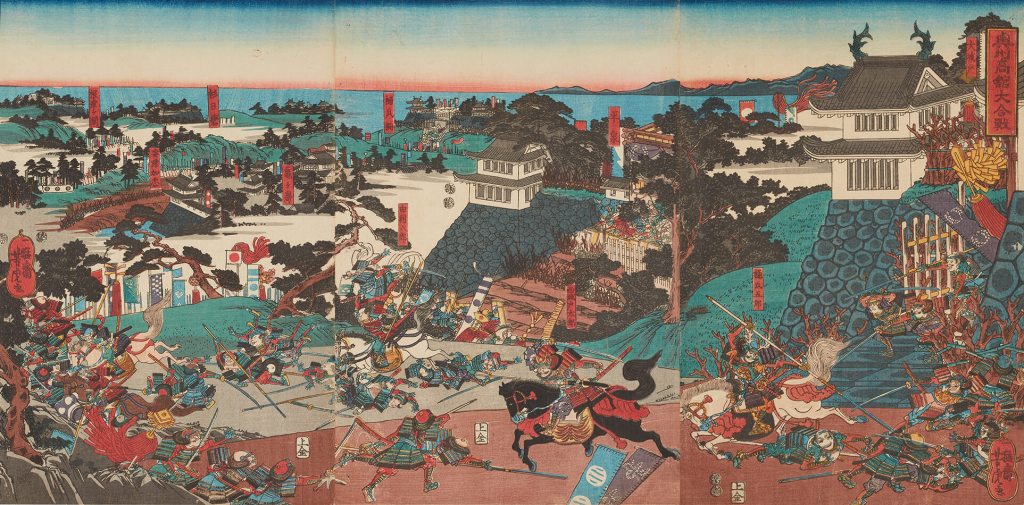
    Outnumbered 5 to 1, Imperial forces took position near Uji, and on June 13th, another Battle of Uji (the third in 50 years) took place. Despite brave resistance, the Imperial side was overwhelmed, and on June 15th, Shogunate forces were in Kyoto. What followed was an orgy of violence, as the houses of Imperial officials and supporters were ransacked and burned, and the citizens suffered at the hands of the rampaging army.

    As Kyoto burned, Go-Toba sent a message to the Shogunate army, withdrawing the Imperial order to arrest Yoshitoki, and blaming the whole thing on his ministers and advisors. Abandoned by the Emperor, some of his supporters fought on in vain, but the final defeat was inevitable, and by July, serious fighting was over, with a few fugitives evading capture until October.

    In the aftermath, Go-Toba was exiled, and eventually replaced as Emperor by Go-Horikawa, and the estates of those who had been killed fighting for the Court, or proscribed afterwards, were distributed to the Shogun’s supporters. Direct control was established over Kyoto, and any semblance of independent military strength was ended; every warrior was now the direct vassal of the Emperor, or else.

    The Shogunate also took control of the purse strings for the court. Prior to the war, the Emperor had held land in his own right and drawn income from it, but now, those lands were ruled directly by the Shogun, and the government in Kamakura could now decide how much, if any, cash the Emperor would get.

    The end of the Jokyu War would mark the zenith of Shogunate, and therefore Hojo power, and for a time, they would rule more or less unchallenged, but some 60 years later, a new threat would emerge.

    Since the dawn of the 13th Century, a previously fractured and quarrelsome people had been united under a single ruler and gone on to conquer an empire the likes of which had never been seen. Though this great conqueror was long dead, his sons and grandsons had continued his work, and in 1260, a new ruler was enthroned, one who would go on to make himself master of China and Korea before seeking new conquests across the sea.

    In 1274, Kublai Khan, grandson of the Great Genghis, had ambitions to make himself master of the world, and he cast his eyes on Japan.

    The Mongols were coming.

    Sources
    https://ja.wikipedia.org/wiki/%E6%89%BF%E4%B9%85%E3%81%AE%E4%B9%B1
    https://en.wikipedia.org/wiki/Kamakura_shogunate
    https://en.wikipedia.org/wiki/Azuma_Kagami
    https://en.wikipedia.org/wiki/J%C5%8Dky%C5%AB_War
    https://en.wikipedia.org/wiki/Emperor_Go-Toba
    https://ja.wikipedia.org/wiki/%E5%BE%8C%E9%B3%A5%E7%BE%BD%E5%A4%A9%E7%9A%87
  • Kamakura I – A Good Start

    According to historians, the Kamakura Period (named for the eponymous city in modern Kanagawa Prefecture) began in 1185. You probably know by now that history is never that neat. For starters, Minamoto no Yoritomo, the ‘first’ Shogun of this period, wasn’t actually granted the title until 1192.

    Despite some unclear dates, the reality is that Imperial power had been in decline for centuries. The rising warrior class (Samurai) had had effective control of the provinces for years, and one clan, the Taira, would rise to take effective control of the government, though their leader, Taira no Kiyomori, would not take the title of Shogun and nominally ruled through the Emperor.

    Taira control came to an end at the Battle of Dan-no-Ura in 1185, and they were replaced by the Minamoto. We’ve already discussed them, but in summary, the Minamoto, much like the Taira, were a sprawling extended family whose wealth and power did not come from Imperial prestige or titles, but control of the land and the armed men who protected it.

    After Dan-no-Ura and the end of the Genpei War, the Minamoto were in control, but here’s where history takes a turn. Previously, clans like the Soga, Fujiwara, and Taira had taken control of the capital, and they exerted influence on the court through political appointments, marriages, and the occasional use of force. The clans would sometimes become powerful enough to reduce Imperial rule to a mere concept, but the illusion of Imperial power was always formally maintained.

    The Minamoto were different. Firstly, they didn’t base themselves in the capital, even after their victory over the Taira. The Minamoto base, and centre of their power, was at Kamakura, and that is where they remained. After 1185, Yoritomo would pay lip service to the Emperor, but he began appointing his own provincial administrators, cutting the court out of the process entirely.

    In 1189, Yoritomo undertook an invasion of the northern provinces of Dewa and Mutsu. These provinces were ruled by the remnants of the Northern Fujiwara clan and had been largely independent since the outbreak of the Genpei War in 1180. It was also an area that harboured Minamoto rivals to Yoritomo.

    Before the outbreak of what would become known as the Oshu War, Yoritomo sought the permission of the Imperial Court to lead the army against the ‘rebels’. This was a formality, but technically the Emperor still had the right to select the General of ‘his’ army.

    However, Yoritomo didn’t wait for permission to be granted. Instead, he summoned warriors from across Japan, and they answered the call from as far away as Satsuma Province in southern Kyushu (in modern-day Kagoshima Prefecture). Throughout the summer, the Imperial Court made a lot of noise, trying to dissuade warriors from joining Yoritomo, but it did no good. If Japan had been waiting for a sign that power had definitively shifted, then this was it.

    The Oshu War in 1189 put an end to even the pretence of Imperial authority over the warrior class.

    The Oshu War lasted around 40 days, and Yoritomo achieved a complete victory. The Court, apparently trying to save face, offered its formal congratulations and a retroactive ‘permission’ for the war. Though the formalities had been observed, no one was fooled; Yoritomo was the boss now.

    Yoritomo’s main rival at court was the Emperor Go-Shirakawa, who had abdicated in 1158 and ruled as an insei or cloistered Emperor, influencing events at court for years. Though the two men would cooperate occasionally, especially against the Taira, it wasn’t long before the relationship broke down. Luckily for Yoritomo, and unluckily for Imperial power, Go-Shirakawa died in 1192, and the last real opposition to Minamoto dominance died with him.

    It is debated as to whether or not Go-Shirakawa actually sought to prevent Yoritomo from taking the title of Shogun, but the timing is certainly interesting. Go-Shirakawa died in April 1192, and Yoritomo was raised to Shogun in July, giving some credence to the idea that the only obstacle had been the Emperor.

    The title of Shogun, more appropriately, Seii taishōgun, is literally translated as Commander-in-Chief of the Expeditionary Force Against the Barbarians (which is a bit of a mouthful, I agree), and had always been a temporary title before. In the Yamato Period and early Heian, the Emperor would issue a ceremonial sword to a General before sending him against the Empire’s enemies (usually the Emishi Tribes in what is now northern Japan).

    The title seems to have fallen out of use in the 10th century as the Emishi had ceased to be a threat, and there was no longer any need for a Supreme Commander. Yoritomo’s assumption of the title reflected the new reality. His was not a government that was based on divine origins, or the glitz and glamour of Imperial ceremony. He had taken power through military strength, and he would rule Japan in the same way.

    Though Yoritomo was obviously a capable commander and administrator, he also took advantage of powerful alliances in and around his home provinces. His marriage to Hojo Masako (an important figure in her own right) brought him the support of the powerful Hojo Clan, who would go on to play an important role in the Kamakura Government.

    The strength (and, ironically, the eventually fatal weakness) of the Kamakura government was its decentralisation. Japan had been divided into provinces during the Taika Reforms over 500 years earlier, with each province being further divided into districts.

    The system had relied on officials appointed by the Imperial Court to run it, and when Yoritomo took over, he replaced Imperial Officials with Gokenin. This new system was pretty much the same as the one it had replaced, with officials appointed by the Shogun to oversee lands that they didn’t own.

    The home of a Gokenin from later in the period.

    The power of the Shogun came from the exclusive right to appoint these officials, but over time, they become de-facto hereditary, meaning that later Kamakura-based Shoguns would face exactly the same problem as the Emperors had, nominal vassals who were in reality heavily militarised, semi-independent principalities, who were not interested in obeying the government.

    The Great Hunt

    All that was in the future, and Yoritomo was focused on establishing the power of his regime in the short term. In the summer of 1193, Yoritomo called all his retainers to a great hunt in Suruga Province, not far from his capital. The so-called ‘Fuji no Makigari” (Hunt near Mt Fuji) was apparently attended by upwards of 700,000. Though that does seem implausibly high (and probably is), it does go some way to showing how high-profile an event this was. There were also a few incidents that highlight the complexities of power, both within the family and outside it.

    Firstly, when Yoritomo’s son and heir, Yoriie, killed his first deer, Yoritomo stopped the hunt to call for a celebration. Now, I don’t know if you’ve ever tried to shoot anything with a bow, let alone a deer, but it’s not easy, and Yoriie was only 12, so good for him, right?

    Well, it turns out, not so much, when Yoritomo sent a message to his wife, and the boy’s mother, Hojo Masako, inviting her to the celebration, she sent a message back stating that the son of a Shogun being able to shoot a deer was no reason to celebrate.

    Hojo Masako, the original Tiger Mum.

    Another incident, which wasn’t political exactly, but still a bit weird, was when Kudo Kagemitsu, a famous archer, shot at a deer and missed three times. He would claim to be baffled, and that the deer must have been the one that the Gods of the mountains rode. Which I’m sure it was. It’s a convenient excuse anyway. Kagemitsu would apparently get sick and collapse that very evening, and Yoritomo even considered calling off the hunt, but he didn’t, and they carried on for another week, so there’s that.

    The third incident is certainly the most serious, and has a name that probably explains itself: The Revenge of the Soga Brothers.

    These Soga aren’t the same as the Soga who had first dominated the Imperial Court in the Yamato Period; instead, they were a clan based in Sagami Province (most of modern-day Kanagawa) near Odawara. The target of the Soga’s vengeance was Kudo Suketsune, who had accidentally killed their father in a dispute over land, or a woman, or something. It’s complicated, but Samurai love a vendetta, and even though Suketsune’s death had been an accident, the Soga Bros, Sukenari and Tokimune, swore revenge.

    Now, the exact details of the attack are recorded in the Soga Monogatari, which is of unknown authorship, and tends to sensationalise quite a lot of what happened, and the Azuma Kagami, which is heavily biased towards the Kamakura government. Both sources share some similarities and some differences, but the basic outline is that the brothers attacked and killed Suketsune either at an inn or in a mansion, where he was attended by one or possibly two prostitutes.

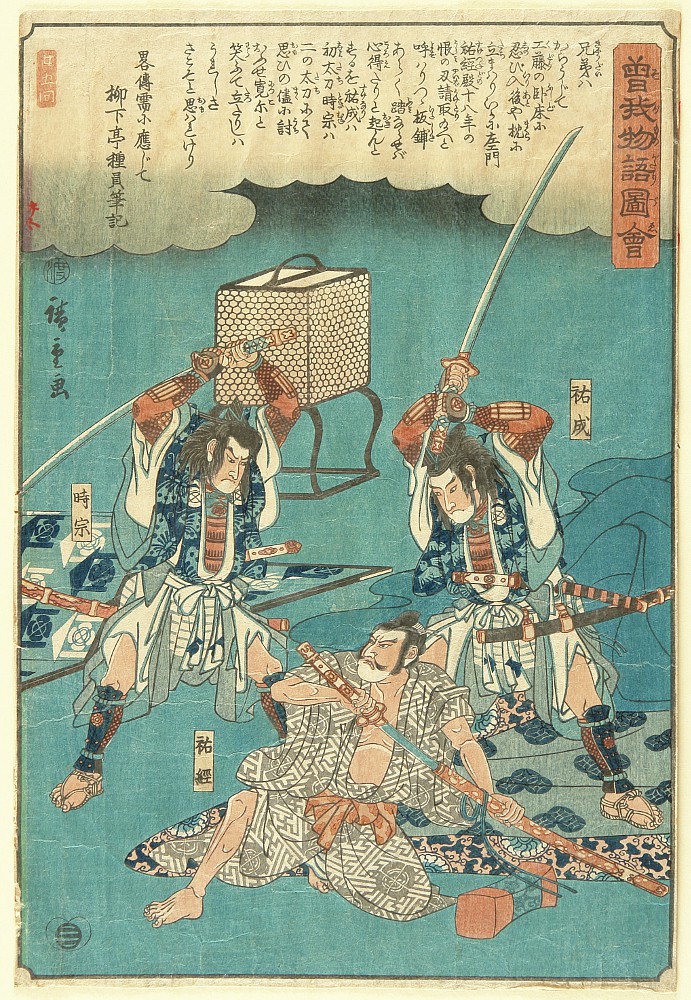
    The Soga Brothers take their revenge.

    The sources agree that the brothers killed Suketsune with their swords, but the Soga Monogatari says they also killed one of the prostitutes, or maybe just cut her legs off, which I guess was fine?

    Both sources agree that the brothers attacked and killed many warriors, with the Azuma Kagami suggesting that this was part of an attack on the Shogun, whilst the Monogatari says it was all about killing as many enemies as possible, to make their mark on history.

    Both sources also agree that Sukenari, the elder brother, was cut down in the melee, but Tokimune was captured, and subject to interrogation, before being put to death.

    This story was romanticised as heck later on, especially during the Edo Period, and why not? After all, what’s more inspiring than a story about a pair of brothers who avenge their murdered father before going on to slaughter a bunch of people who had nothing to do with it?

    Whether or not the Soga Brothers actually attempted to kill the Shogun, this episode highlights the often chaotic and bloody reality of a government run by warriors.

    Yoritomo would become a monk, and then almost immediately die in February 1199, leaving his son Yoriie as the second Shogun. Yoriie would immediately come under the influence of his grandfather, Hojo Tokimasa, and mother, the aforementioned Hojo Masako. Pretty soon, the same problems that had plagued the Imperial Court began affecting the Shogun’s court too, but more on that next time.

    Sources
    https://en.wikipedia.org/wiki/Kamakura_shogunate
    https://en.wikipedia.org/wiki/Battle_of_%C5%8Csh%C5%AB
    https://en.wikipedia.org/wiki/Minamoto_no_Yoritomo
    https://ja.wikipedia.org/wiki/%E6%BA%90%E9%A0%BC%E6%9C%9D
    https://en.wikipedia.org/wiki/Shogun
    https://en.wikipedia.org/wiki/Emperor_Go-Shirakawa
    https://en.wikipedia.org/wiki/H%C5%8Dj%C5%8D_Masako
    https://en.wikipedia.org/wiki/Gokenin
    https://en.wikipedia.org/wiki/Fuji_no_Makigari
    https://en.wikipedia.org/wiki/Revenge_of_the_Soga_Brothers
    https://en.wikipedia.org/wiki/Azuma_Kagami
    https://en.wikipedia.org/wiki/Soga_Monogatari