Tag: Battle of Uji

  • Kamakura III – The Jokyu War

    We’ve already talked about Imperial decline during the Heian Period. Over many centuries, central control eroded, until eventually the provinces proved to be ungovernable. Eventually, the power of the Imperial Court was usurped by Minamoto no Yoritomo, who established the Kamakura Shogunate in Kamakura, obviously.

    You may not be surprised to hear that the Emperor wasn’t best pleased with this turn of events. Although the actual power of the Emperor had been largely theoretical for decades, there had always been a veneer of ‘Imperial’ authority. The rise of the first Shogunate, however, did away with that.

    With supreme military power firmly in Yoritomo’s hands, there was little the Emperor could do to change the status quo. However, as we’ve discussed, Yoritomo’s heirs proved not to be the model of their father. By the dawn of the 13th Century, the Kamakura ‘Shogunate’ was in fact ruled by regents, or Shikken, from the Hojo Clan.

    In 1219, the regent was Hojo Yoshitoki, who shared power with his influential sister Hojo Masako, the so-called ‘Nun Shogun’. That year, Masako’s son, Sanemoto, the third Shogun, was assassinated, bringing an end to the line of Minamoto Shoguns (Yoritomo and his two sons). Although the Hojo were already in effective control, the end of the ‘legitimate’ line of Shoguns presented an apparent opportunity for their enemies to challenge them.

    Emperor Go-Toba

    In a period where Emperors were often well-decorated figureheads, Go-Toba stood out. He was highly educated, as most courtiers were, but he had also shown skill at martial arts, earning him respect and loyalty from warrior families in the west and north. Unfortunately for him, the Throne still drew its income from its land holdings, and when the Shogunate appointed officials to oversee those holdings, the money taken in taxes often didn’t find its way to the Emperor.

    Emperor Go-Toba, whose attempts to restore Imperial power would start the Jokyu War.

    After Sanemoto’s assassination in 1219, the Hojo approached Go-Toba about the possibility of one of the Emperor’s sons becoming the next Shogun. Go-Toba attempted to negotiate, seeking the removal of Shogunate officials from Imperial holdings.

    The Shogunate sent a force of 1000 men under Yoshitoki’s brother in an attempt to intimidate the Emperor. Go-Toba wasn’t easily scared, however, and negotiations broke down, although the Emperor would offer a concession; he would allow a member of the Imperial family to become Shogun, as long as it wasn’t a prince of the main royal line.

    The Hojo were satisfied with this, and Kujo Yoritsune, who was only a little over a year old, was chosen as the fourth Shogun. However, because Yoritsune was a baby, the position of the Hojo as regents was secure, and, for a time at least, peace endured.

    The elevation of a member of the Imperial house to the position of Shogun did nothing about the underlying issues, however, and in July 1219, just a few months after the previous negotiations, the military governor of the area around Kyoto, (who had been appointed by the Shogun) was attacked and killed by warriors acting on the Emperor’s orders.

    Some records say that the governor had been planning to launch a coup and make himself Shogun, with Go-Toba, made aware of the plot, acting to stop the plot before it came to fruition. Other sources, however, point out how unlikely it is for Go-Toba to have had a Shogunate official killed as a favour to the Shogun, and it is more likely that the governor either discovered, or was made aware of, the Emperor’s plans, and was removed accordingly.

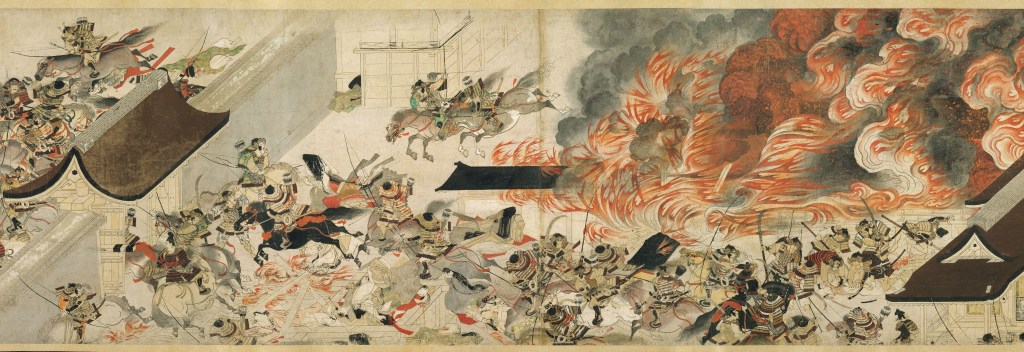
    The unfortunate fellow apparently took his own life when his residence (which was within the grounds of the Imperial Palace) was surrounded and burned by Imperial loyalists, and whatever the reasons, this was a direct attack by forces representing the Emperor on those representing the Shogun. The Emperor then asked the Shogunate, Court Officials, and local temples and shrines to donate money to help rebuild the burned residence, and, perhaps unsurprisingly, most of them refused to pay up.

    During rebuilding work, rumours spread that Go-Toba was quietly gathering allies and raising an army. It was also alleged that he had asked shrines and temples around the capital to invoke the power of the gods on the Emperor’s behalf, which was quite the provocation, apparently.

    War Begins

    Then, in Spring 1221, Go-Toba gathered troops in the capital under the pretext of protecting religious sites and ceremonies. On May 15th, he dropped the pretext; however, when forces loyal to the Imperial Side attacked the offices of the Shogun in Kyoto, burning them and killing the officials, which, as declarations of war go, is pretty definitive.

    On the same day, Go-Toba issued a formal Imperial decree, ordering all the warriors of the nation to arrest Yoshitoki, who was declared an outlaw and enemy of the court. Within a few days, warriors from across western Japan had risen against the Shogun, and Go-Toba believed, rather flippantly, that the issuance of an Imperial decree would fatally undermine the Shogunate.

    This is one of those times that later writers absolutely love to dramatise. It’s all honour, loyalty, duty unto death, etc. but the reality is that, despite an Imperial Decree, and a counter-decree from Hojo Masako, the majority of the warriors across the nation (those who were directly tied to either side through blood or obligation) sided with whoever they thought would benefit them the most if they won.

    In those calculations, the Shogunate had the advantage; the Shogun had the right to distribute land, and most of the warrior families expected to be rewarded with the lands and titles of those who had sided with the Emperor and the court, who was generally believed to have been likely to favour himself and his courtiers, in the event of their victory.

    So, for all their vaunted ‘honour’, the Samurai would (and not for the last time) side with those they thought would give them the best deal, and by the time they marched, the armies loyal to the Shogun are said to have numbered nearly 200,000.
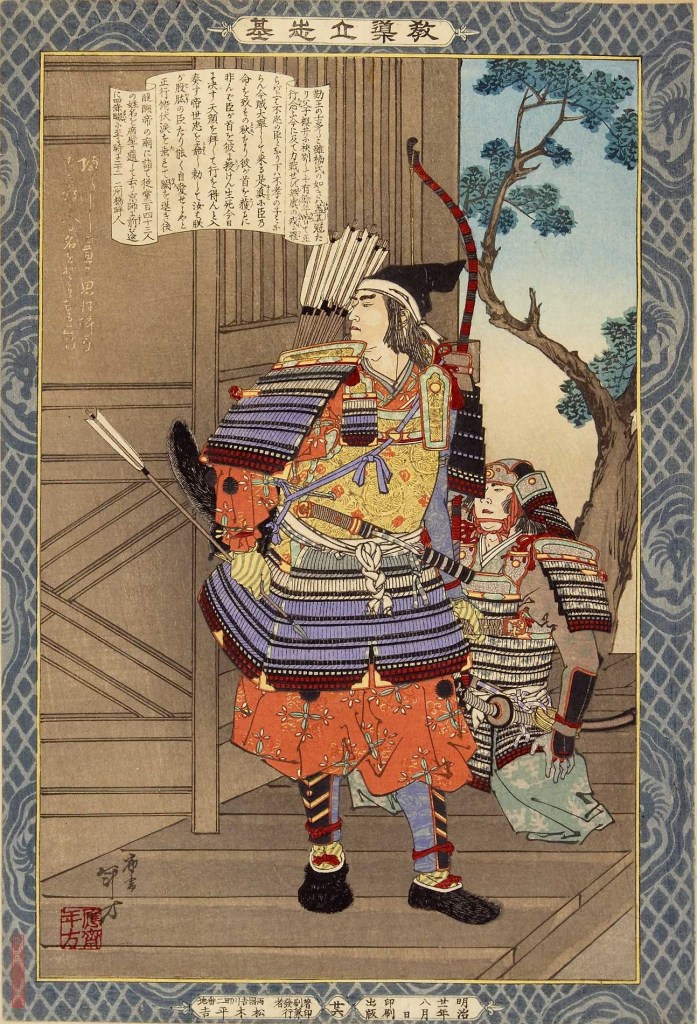
    A later illustration of a Samurai as they might have appeared during the Jokyu War.

    The Shogunate army was actually three separate forces, with 40,000 men heading by a northern route, another force of 50,000 heading through the mountains, and the third, largest force of 100,000, following the main Tokaido Road, with all three marching on Kyoto.

    The Imperial side seems to have been caught off guard by first the size, then the speed of the Shogunate forces. It appears that the Emperor had believed his decree would be enough to secure mass defections, and when the opposite occurred, the forces loyal to the throne were out of position and hugely outnumbered.

    Resistance was scattered and ineffective, with some sources suggesting that the main army took just 22 days to complete the march from Kamakura to Kyoto, which might be an exaggeration, but goes some way to highlighting how badly prepared the Imperial Army was.

    Though the court was able to gather warriors from Western Japan, the numbers were nowhere near what they had expected, and besides, the rapid advance of the Shogunate army meant that reinforcements wouldn’t have been able to reach the capital in time.

    In desperation, Go-Toba went to Mt Hiei, on the outskirts of Kyoto, and pleaded with the famed warrior monks for support. The monks, partly out of opposition to the Emperor, and partly due to their fear of the strength of the Shogun, refused to help, and Go-Toba was left with an army of around 18,000 to defend the capital.

    Outnumbered 5 to 1, Imperial forces took position near Uji, and on June 13th, another Battle of Uji (the third in 50 years) took place. Despite brave resistance, the Imperial side was overwhelmed, and on June 15th, Shogunate forces were in Kyoto. What followed was an orgy of violence, as the houses of Imperial officials and supporters were ransacked and burned, and the citizens suffered at the hands of the rampaging army.

    As Kyoto burned, Go-Toba sent a message to the Shogunate army, withdrawing the Imperial order to arrest Yoshitoki, and blaming the whole thing on his ministers and advisors. Abandoned by the Emperor, some of his supporters fought on in vain, but the final defeat was inevitable, and by July, serious fighting was over, with a few fugitives evading capture until October.

    In the aftermath, Go-Toba was exiled, and eventually replaced as Emperor by Go-Horikawa, and the estates of those who had been killed fighting for the Court, or proscribed afterwards, were distributed to the Shogun’s supporters. Direct control was established over Kyoto, and any semblance of independent military strength was ended; every warrior was now the direct vassal of the Emperor, or else.

    The Shogunate also took control of the purse strings for the court. Prior to the war, the Emperor had held land in his own right and drawn income from it, but now, those lands were ruled directly by the Shogun, and the government in Kamakura could now decide how much, if any, cash the Emperor would get.

    The end of the Jokyu War would mark the zenith of Shogunate, and therefore Hojo power, and for a time, they would rule more or less unchallenged, but some 60 years later, a new threat would emerge.

    Since the dawn of the 13th Century, a previously fractured and quarrelsome people had been united under a single ruler and gone on to conquer an empire the likes of which had never been seen. Though this great conqueror was long dead, his sons and grandsons had continued his work, and in 1260, a new ruler was enthroned, one who would go on to make himself master of China and Korea before seeking new conquests across the sea.

    In 1274, Kublai Khan, grandson of the Great Genghis, had ambitions to make himself master of the world, and he cast his eyes on Japan.

    The Mongols were coming.

    Sources
    https://ja.wikipedia.org/wiki/%E6%89%BF%E4%B9%85%E3%81%AE%E4%B9%B1
    https://en.wikipedia.org/wiki/Kamakura_shogunate
    https://en.wikipedia.org/wiki/Azuma_Kagami
    https://en.wikipedia.org/wiki/J%C5%8Dky%C5%AB_War
    https://en.wikipedia.org/wiki/Emperor_Go-Toba
    https://ja.wikipedia.org/wiki/%E5%BE%8C%E9%B3%A5%E7%BE%BD%E5%A4%A9%E7%9A%87
  • The Genpei War

    Oh yes, here we go, a good old-fashioned war post! All those posts about economic and social decline are finally paying off! Let’s get into it!

    So, as we’ve discussed, by the mid-12th Century, the Imperial Court was in a bad way. Over the centuries, the throne had been dominated by one powerful clan after another, who would marry into the Imperial family again and again in order to maintain that domination, at the cost of turning their gene pool into more of a muddy puddle. Luckily, Heian Era Japan didn’t have a concept of genetics, so I’m sure it was fine.

    The first of these families had been the Soga, who had been overthrown by the Fujiwara in the Isshi Incident in 645. The Fujiwara had had more or less complete control until the Emperors started abdicating to become insei, that is, cloistered Emperors, or an Emperor with all the power of the throne and none of the restraints that the Fujiwara had taken advantage of.

    With the Fujiwara weakened, their enemies started circling. The Hogen Rebellion in 1156 marked the end of Fujiwara power, as the rival Taira and Minamoto families teamed up to take them down. In a betrayal that will surprise no one, the Taira then shafted the Minamoto in the post-rebellion settlement, taking most of the power and the influence over the Emperor for themselves.

    The Minamoto were understandably a bit put out by that, so they launched a rebellion of their own in 1160. The so-called Heiji Rebellion failed, and the Minamoto were effectively wiped out, their leadership either killed or banished to the provinces.

    For the next 20 years, the Taira ruled as the Fujiwara had, but the problem with a violent takeover is that once one group does it, everyone wants to have a go. The Taira, like the Fujiwara before them, became overly enamoured with court life and neglected the provinces.

    This was unfortunate because, as I mentioned earlier, it was the provinces to which the Minamoto had been banished, and they weren’t in a forgiving mood when it came to the Taira.

    The Heiji Rebellion in 1160 marked the triumph of the Taira over their Minamoto rivals, at least temporarily.

    The leader of the Taira at this point was Kiyomori. He had led the Taira forces that had overthrown the Fujiwara and then seen off the Minamoto, and he was probably feeling pretty pleased with himself. Using his influence (and presumably the implicit threat of force), he rose through the ranks at court, eventually becoming Daijo-Daijin, which was basically the head of the government and second only to the Emperor (in theory).

    Now, there had obviously been Daijo-Daijin before Kiyomori, but he was significant because he was the first from the buke or warrior families to rise to that rank. Previously, the formal ranks of the Imperial Bureaucracy had been held by members or allies of the Fujiwara, and Kiyomori was an outsider who was seen as having used martial strength to gain his position, which was true, to be fair.

    In 1171, Kiyomori cemented his power at court by having his daughter, Tokuko, marry Emperor Takakura. Now, none of this was particularly new; the Fujiwara had been doing it for centuries, after all, but Kiyomori was different; he was a thug.

    The Fujiwara, for all their faults, had always played the game properly. They knew the rules, understood court etiquette, wrote beautiful poems, all that stuff. Kiyomori wasn’t like that. He’d taken power through military strength, and that was how he intended to keep hold of it. He wasn’t afraid to throw his weight around, and it was a risky business to oppose him.

    In 1177, in response to an alleged coup (the Shishigatani incident), Kiyomori ordered the arrest of dozens of conspirators. That these conspirators were all people who had reason to be offended by Kiyomori was convenient, and some sources speculate that the plot never existed at all, as it appears to have relied entirely on the testimony of a single monk, who Kiyomori had tortured and then beheaded.

    Regardless of whether it was real or not, Kiyomori had reinforced his power. Those who had ‘opposed’ him were dead or exiled, and he filled the vacant posts with family members and allies, further cementing his power and the fury of the opposition against him.

    In 1178, Tokuko gave birth to a son, Antoku, and Kiyomori decided it’d be a good time to remind everyone at court who was really in charge. The so-called Political Crisis of the Third Year of the Jisho Era (which is a bit easier to say in Japanese, I assure you) was basically a military coup d’etat. Kiyomori brought thousands of his warriors from the provinces to the capital and took over.

    There was no longer any pretence, Kiyomori was dictator in all but name, and shortly after the coup, he had Emperor Takakura abdicate in favour of the two-year-old Antoku, who obviously couldn’t rule himself, at which point Kiyomori kindly stepped in as regent.

    You remember what I said about violent takeovers? Well, Kiyomori was about to learn that lesson. The Taira had driven out the Minamoto, but they hadn’t destroyed them, and for twenty years, Kiyomori had ruled in such a way that he alienated just about everyone.

    In 1180, Prince Mochihito, who had been in line for the throne before Kiyomori raised the infant Antoku in his place, raised his banner in rebellion, calling for the opponents of the Taira to gather an army and march on the capital. Unfortunately, for Mochihito, his plan was discovered, and he was forced to flee, eventually arriving at the temple of Mii-Dera in Nara.

    What follows is largely recorded in The Heike Monogatari, which is a pretty epic read, but is largely a fictionalised account of the war, presenting an idealised version of events, in which heroic warriors do heroic things against impossible (and often implausible) odds.

    What we do know is that Mochihito, outnumbered and overwhelmed, was defeated at the Battle of Uji, just outside modern Kyoto, where he was either killed or executed shortly afterwards. Despite his unsuccessful attempts at raising an army, Mochihito’s call to arms did serve to galvanise the opposition to the Taira.

    Prince Mochihito, whose failed rebellion and death at the Battle of Uji served to inspire the opposition to Taira rule.
    ColBase: 国立博物館所蔵品統合検索システム (Integrated Collections Database of the National Museums, Japan), CC 表示 4.0, https://commons.wikimedia.org/w/index.php?curid=92525963による

    It is at this point that Minamoto no Yoritomo enters the stage, he definitely deserves a post of his own, but the short version is that he was 13 in 1160, and the Taira, perhaps feeling pity over his youth, hadn’t executed him, banishing him to the provinces instead.

    Yoritomo, however, had a long memory, and he had spent the last twenty years gaining strength, first over his own clan, and then the surrounding area. His base was the city of Kamakura, in modern-day Kanagawa Prefecture, and it was a relatively long way from the capital.

    When news of Uji reached him, Yoritomo set off looking for a fight. He called for help from the surrounding clans, and although there seems to have been some support, very few actually showed up to fight. In September 1180, Yoritomo had managed to gather just 300 men, and he was attacked by a force ten times that size at the Battle of Ishibashiyama.

    Despite this defeat, Yoritomo was able to escape by sea to Awa Province (in modern Chiba Prefecture), from where he would continue the fight. Meanwhile, the Taira, under Kiyomori, sought to take revenge against the monks who had hidden Prince Mochihito, and attacked and burned the city of Nara.

    Meanwhile, Yoritomo’s uncle was defeated at the Battle of Sunomatagawa in June 1181. The story goes that the Minamoto tried to sneak across a river at night in order to attack the Taira on the other bank. Apparently, their plan failed because Taira sentries were able to distinguish friend from foe by checking who was wet, or not. That seems like remarkable awareness for a battle in the dark, but regardless, the Minamoto failed to surprise the Taira and were defeated.

    Later that year, Yoritomo’s cousin (and sometimes rival) Yoshinaka raised an army in the north and defeated the Taira army sent to stop him, after which, fighting died down for a while.

    Taira no Kiyomori had died earlier in 1181 (the story goes that his fever was so hot anyone who tried to tend him would be burned), and not long after, a famine broke out that would spread across the nation. You can’t fight if you can’t eat, and so what followed was a two-year lull in the fighting, which I imagine wasn’t much comfort to the starving peasants.

    The fighting would resume in 1183, and the Taira would have some initial success, but at the Battle of Kurikara Pass in June of that year, the Taira were decisively defeated, and the momentum shifted to the Minamoto. It was Yoshinaka (Yoritomo’s cousin) and Yukiie (Yoritomo’s Uncle, but not Yoshinaka’s father, I know, it’s confusing) who actually led the Minamoto to the capital.

    As Kiyomori was dead, it fell to his son Munemori to lead the defence of the city. He did this by taking young Emperor Antoku and fleeing west, as you do. It was at this point that the cloistered Emperor, Go-Shirakawa (yeah, he’s still alive at this point!) threw in his lot with Yoshinaka and the Minamoto, calling on them to pursue and destroy the Taira.

    Unfortunately, Yoshinaka had different plans. Fancying himself the rightful leader of the Minamoto, he engaged in a plot against his cousin, Yoritomo, who was by now marching from the East towards the capital. It seems he was initially joined by Yukiie, who then got cold feet and let details of the plot slip.

    Yoshinaka himself became aware that the plot had been discovered and moved first, setting fire to several parts of the capital and taking Go-Shirakawa hostage. It was at this point that Yoritomo’s brothers, Yoshitsune and Noriyori, arrived with a considerable force. They drove Yoshinaka out of the capital, and then killed him at the Second Battle of Uji , bringing an end to the Minamoto Clan’s feuding (for now.)

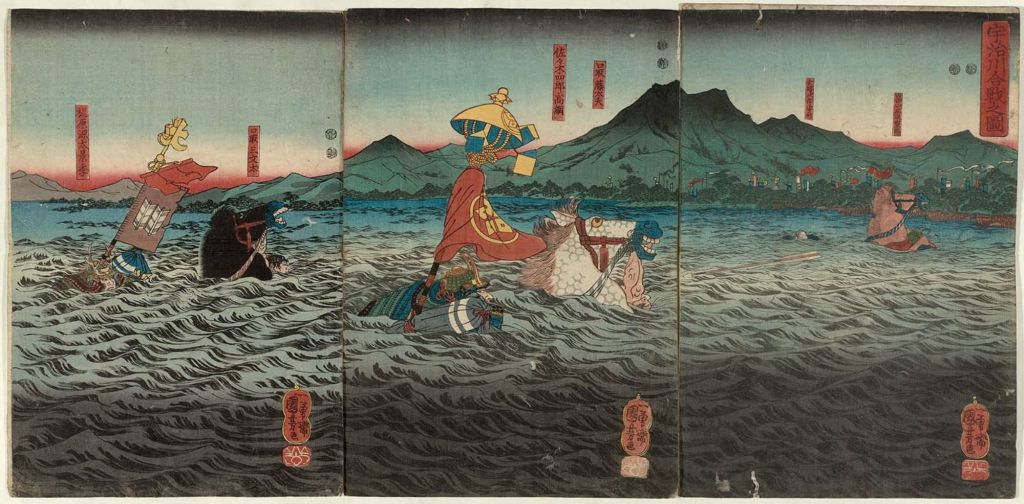
    A scene from the Second Battle of Uji. The bridge had been pulled up, hence the need to swim.

    After this, the momentum was decisively on the side of the Minamoto. They pursued the Taira, who had originally set up camp at Dazaifu, in Kyushu, and fortifying their positions around the Inland Sea, which were the lands the Taira had originally held.

    The Minamoto went on the offensive and defeated the Taira at the Battle of Ichi-no-Tani, near modern-day Kobe, followed up by another victory at Kojima. These successes allowed the Minamoto to drive the Taira out of their strongholds along the coast of the Inland Sea.

    The Taira, in possession of what was apparently the only navy in Japan at the time, and certainly the strongest, retreated to Shikoku, knowing that the Minamoto couldn’t follow. The Minamoto weren’t going to just let the Taira get away, however, and although it took time, they built up their naval strength before launching an attack at Yashima, in modern-day Takamatsu, that took the Taira fortress there, which had also been used as a makeshift palace for Emperor Antoku.

    Driven out of yet another stronghold, the Taira took to their ships and fled. The Minamoto would catch up to them at Dan-no-Ura, in the Straits of Shimonoseki. If you believe the Heike Monogatari (which you shouldn’t), then the Minamoto had 3000 ships to the Taira’s 1000. According to the Azuma Kagami, which is a biased by slightly more believable source, the forces were actually around 800 to 500, which are still considerable forces, but a bit more plausible.

    Despite being outnumbered, the Taira had home advantage and knew the tides and currents better than their foes. They also had the Emperor with them, which they assumed would give their side more legitimacy and encourage their men to fight harder.

    It was a good idea in theory, but it didn’t work. Though the tides were initially in the Taira’s favour, they turned, as tides do, and one of the Taira’s commanders turned as well, as men often do. Surrounded and attacked from all sides, the Taira began committing suicide en masse. One of those who died was six-year-old Antoku. The story goes that his grandmother, Taira no Kiyomori’s widow, took the boy in her arms and jumped with him into the sea. Neither was seen again.

    The Taira also tried to get rid of the Imperial Regalia, tossing them overboard. However, they apparently only managed to dump the mythical Kusanagi Sword and the Yasakani Jewel. The Yata no Kagami, a sacred bronze mirror, was apparently saved when the woman who tried to throw it overboard was killed when she accidentally looked at it.

    All three items were apparently recovered, either on the day of the battle or later, by divers. They are supposedly housed at the Ise Shrine in Mie Prefecture. The fact that no one has been allowed to see the artefacts since Dan-no-Ura is apparently just a coincidence.

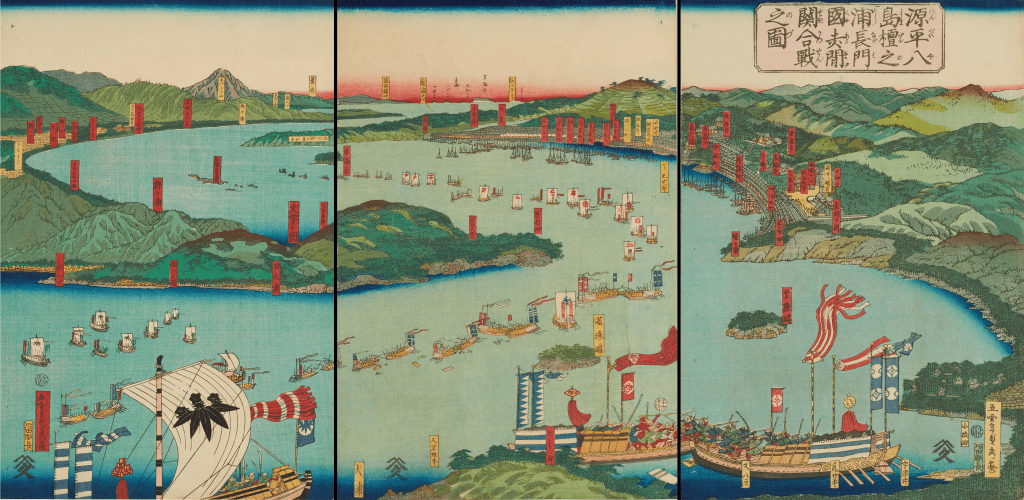
    A later illustration of the Battle of Dan-no-Ura, which brought an end to Taira control of Japan.

    The result of Dan-no-Ura was the end of the Taira as a serious political force. Later that year, the Emperor Go-Shirakawa gave Minamoto no Yoritomo the right to collect taxes and appoint officials, effectively handing control of the state over to him.

    Though it would be some years before Yoritomo would take the formal title, the Genpei War marks the time at which control of Japan shifted from courtiers and Emperors to warriors under a supreme military commander who took a title that had first been used in the earliest days of Imperial rule in Japan, Sei-i Tai Shōgun.

    Cue dramatic music

    Sources
    https://en.wikipedia.org/wiki/Battle_of_Dan-no-ura
    https://en.wikipedia.org/wiki/Battle_of_Uji_(1184)
    https://en.wikipedia.org/wiki/Azuma_Kagami
    https://ja.wikipedia.org/wiki/%E5%B1%8B%E5%B3%B6%E3%81%AE%E6%88%A6%E3%81%84
    https://en.wikipedia.org/wiki/Battle_of_Yashima
    https://ja.wikipedia.org/wiki/%E4%B8%80%E3%83%8E%E8%B0%B7%E3%81%AE%E6%88%A6%E3%81%84
    https://ja.wikipedia.org/wiki/%E8%97%A4%E6%88%B8%E3%81%AE%E6%88%A6%E3%81%84
    https://ja.wikipedia.org/wiki/%E6%BA%90%E8%A1%8C%E5%AE%B6
    https://ja.wikipedia.org/wiki/%E5%80%B6%E5%88%A9%E4%BC%BD%E7%BE%85%E5%B3%A0%E3%81%AE%E6%88%A6%E3%81%84
    https://en.wikipedia.org/wiki/Battle_of_Kurikara_Pass
    https://en.wikipedia.org/wiki/Minamoto_no_Yukiie
    https://en.wikipedia.org/wiki/Minamoto_no_Yoshinaka
    https://en.wikipedia.org/wiki/Battle_of_Sunomata-gawa
    https://en.wikipedia.org/wiki/Battle_of_Ishibashiyama
    https://ja.wikipedia.org/wiki/%E4%BB%A5%E4%BB%81%E7%8E%8B
    https://en.wikipedia.org/wiki/Prince_Mochihito
    https://en.wikipedia.org/wiki/Emperor_Takakura
    https://en.wikipedia.org/wiki/Emperor_Antoku
    https://en.wikipedia.org/wiki/Taira_no_Kiyomori
    https://en.wikipedia.org/wiki/The_Tale_of_the_Heike
    https://en.wikipedia.org/wiki/Battle_of_Uji_(1180)
    https://ja.wikipedia.org/wiki/%E6%B2%BB%E6%89%BF%E3%83%BB%E5%AF%BF%E6%B0%B8%E3%81%AE%E4%B9%B1
    https://ja.wikipedia.org/wiki/%E6%B2%BB%E6%89%BF%E4%B8%89%E5%B9%B4%E3%81%AE%E6%94%BF%E5%A4%89
    https://en.wikipedia.org/wiki/Shishigatani_incident
    https://ja.wikipedia.org/wiki/%E9%B9%BF%E3%82%B1%E8%B0%B7%E3%81%AE%E9%99%B0%E8%AC%80
    https://en.wikipedia.org/wiki/Genpei_War
    https://en.wikipedia.org/wiki/Minamoto_no_Yoritomo