Tag: Japanese feudal lords

  • The Power in the Provinces Part One

    The Power in the Provinces Part One

    We’ve spent a lot of time talking about the breakdown of Shogunate power during the 15th Century. We’ve also discussed the three most powerful clans that were located closest to Kyoto during the Onin War. The Hosokawa, Yamana, and Hatakeyama Clans all played leading roles in the fighting, and in the aftermath, all three were seriously weakened.

    But what about the provinces? We’ve only spoken in very broad terms about what was going on out there, mostly because, to focus on it would require posts that resemble small novels, and keeping track of all those names and places is a task that is beyond most of us.

    In the interests of keeping things moving, then, I have generally neglected to go into much detail; however, since we’re now at the beginning of the Sengoku Jidai, a period of civil war lasting 120 years, we need to take a moment to look at who the main players are now that the Onin War is over.

    Central Japan
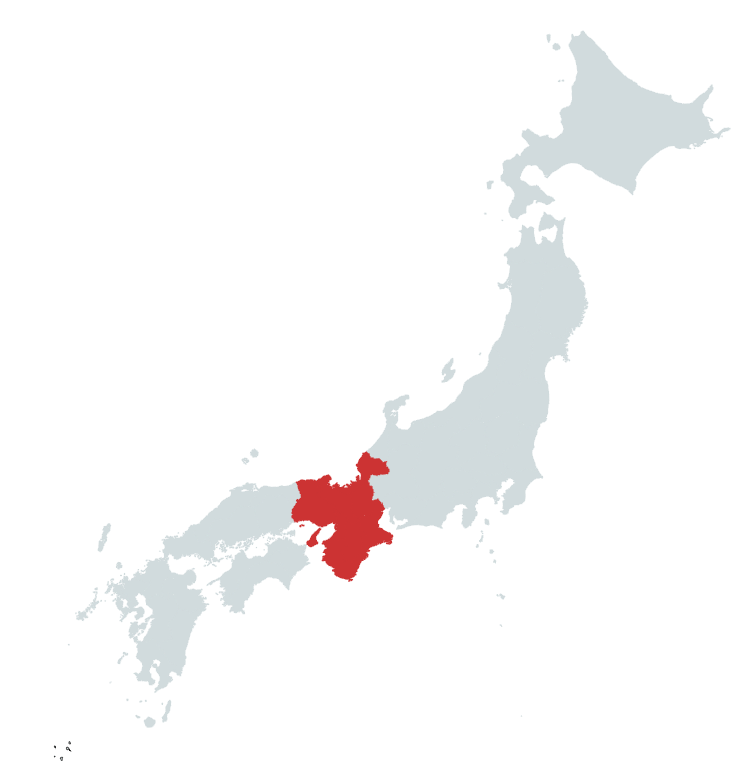
    Central Japan, corresponding mostly to the modern Kansai region, was the political and cultural heart of the nation.

    We’ve spent a lot of time looking at this region recently, so this is just a quick overview of who is still on the field in this part of Japan.

    The Hatakeyama Clan had been one of the main players, but a serious succession dispute fractured the clan and eventually led to the Onin War, as the Hosokawa and Yamana Clans supported rival claimants in a feud that would spiral out of control.

    By the end of the 15th Century, the Hosokawa remained largely in control of Kyoto, but they were already in decline. They would remain powerful, but a succession dispute (yes, another one) would divide the clan in the early 16th Century, and they’d never recover.

    The Yamana Clan had been badly mauled by the Onin War, and from a position as one of Japan’s mightiest clans, they’d eventually lose everything but a single province, which they’d manage to hold until the end of the 16th century, when some poor political decisions would see them forfeit even that.

    The Hatakeyama, for their part, were fragmented repeatedly throughout the late 15th Century, and they’d never recover their former power. However, some descendants would hold positions of power in Kyoto until the 1580s, when they’d run afoul of Oda Nobunaga, a name you should remember.

    Eastern Japan

    Eastern Japan, centred on the Kanto. Although home to Tokyo today, in the 15th Century it was Kamakura that was the centre of power in the region.

    The power in Eastern Japan was centred mostly around the Kanto Plain, with the political capital at Kamakura. In the period preceding the Ashikaga Shogunate, Kamakura had been the de facto capital of Japan, and even after the new Shogunate relocated to Kyoto, Kamakura remained the regional capital, and holding it was a prize in itself.

    The Kanto region was the source of a lot of trouble for the Ashikaga Shoguns, as there was the legacy of the previous Shogunate to contend with, and the strong, often semi-independent Kamakura Kubo to contend with. The kubo was the head of the local government, and they often openly defied the Shogun, who had to rely on the fickle loyalty of other powerful clans in the region to enforce his will.

    The Uesugi
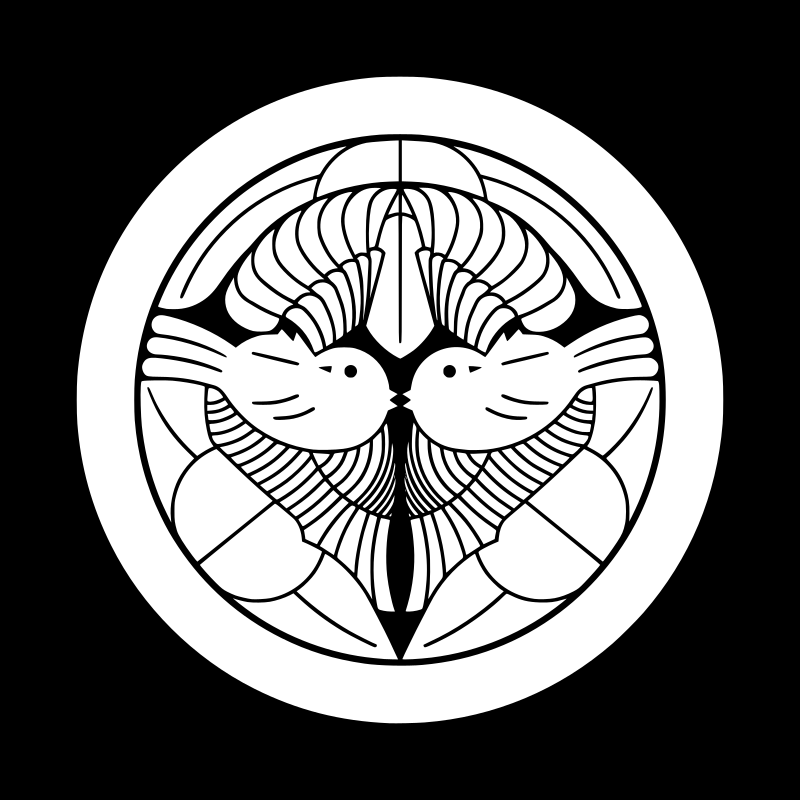
    The Mon (crest) of the Uesugi Clan
    By Mukai – Own work, CC BY-SA 3.0, https://commons.wikimedia.org/w/index.php?curid=8629467

    The dominant power in the Kanto in the 15th Century was arguably the Uesugi Clan. Like many others, the clan claimed descent from the illustrious Fujiwara Clan, and various members of the family would become shugo in and around the Kanto. Their most important role, however, was that of Kanto Kanrei, the Shogun’s deputy in the Kanto, a position that was supposed to complement that of the kubo, but in reality, often served as a check on Kamakura’s power, and frequently, a direct rival.

    Like most clans at this time, the Uesugi were divided into branches, three in this case, that were just as likely to fight as support each other. This infighting predated the Onin War, but the outbreak of general civil war saw the destruction of one branch, and the serious weakening of the other two, so much so that, in the early 16th Century, the Uesugi would lose their position in the Kanto to another rising power, the Hojo.

    The Uesugi would survive, however, and continue to play a major role in the Sengoku Jidai. The clan’s most famous son is arguably Uesugi Kenshin, who would engage in a rivalry with fellow warlord Takeda Shingen that became the stuff of legend. Mythology aside, Kenshin would die without heirs, and a succession crisis would severely weaken the clan.

    Uesugi Kenshin became a Samurai legend, but his death would leave the Uesugi in a weak position.

    Although they would survive, they chose the losing side in the final battles of the Sengoku Jidai and would end up in Yonezawa Domain, in modern Yamagata Prefecture, where they would actually prosper until the abolition of the Domains in the 19th Century.

    The clan endured into the modern day. The current head is Uesugi Kuninori, who was a professor at the Institute of Space and Astronautical Science until he retired in 2006.

    The Hojo

    The Mon of the Hojo Clan, and the later Hojo clan, who took the name and emblem for their own.
    By Mukai – No machine-readable source provided. Own work assumed (based on copyright claims)., CC BY-SA 3.0, https://commons.wikimedia.org/w/index.php?curid=9416600

    The Hojo Clan, or more accurately the Go-Hojo, or Later Hojo, were relative latecomers to the scene. Although they would lay claim to illustrious ancestry (which was the style at the time), their progenitor was Ise Sozui (better known as Hojo Soun), who, despite being revered as the ancestor of the clan, never used the name Hojo himself. Traditionally, Soun was believed to have been a Ronin (masterless samurai) who rose to power seemingly out of nowhere in the aftermath of the Onin War.

    More recent scholarship, however, seems to indicate that Soun’s family, the Ise Clan, had a much longer history and would serve in the Shogun’s government in Kyoto before relocating to the Kanto later.

    Soun arguably deserves a post of his own, but the short version is that, he was originally in the service of the Imagawa Clan, another power in the region, before raising an army of his own and taking Izu Province for himself, establishing his base at Odawara Castle, which he took in 1494, some say, after tricking the previous owners, convincing them to leave on a hunting trip, and arranging their murders.

    It was his son, Ujitsuna, who renamed the clan to Hojo. You may remember that it was the Hojo Clan who acted as regents for the Kamakura Shoguns, rising to such power that they were effectively masters of Japan, before being overthrown by the Ashikaga.

    This new Hojo Clan was no relation to these regents, hence why they are referred to as the “Later” Hojo. Ujitsuna, apparently attempting to add some prestige to his family, adopted the name and mon (family crest) of the former Hojo, and everyone just went with it.

    Hojo Ujitsuna, who understood that there was power in a recognisable name.

    Ujitsuna wasn’t just savvy with brand recognition, however. Throughout the first half of the 16th century, he would guide the Hojo to become the predominant power in the Kanto. He would challenge and eventually drive out the Uesugi, taking control of their castle at Edo, which would eventually become the Imperial Palace in modern Tokyo.

    Throughout the Sengoku Period, the Hojo would continue to be masters of the Kanto, eventually becoming one of the greatest powers in the late 16th century, before they were eventually defeated by Toyotomi Hideyoshi in 1590. A branch of the family would survive as the lord of Sayama Domain (near modern Osaka) until the 19th century, and members of this family would continue playing a role in Japanese politics into the 20th century.

    The Takeda

    The Mon of the Takeda

    The Takeda also claimed descent from the Minamoto Clan, and from the earliest days of the Kamakura Shogunate in the 12th Century, they had established their power base in Kai Province (modern day Yamanashi Prefecture). Though they were a relatively minor player (one amongst many, you might say), the Takeda would develop a difficult relationship with the Uesugi Clan.

    When the Uesugi rose up against the Kamakura Kubo in 1416 (the Zenshu Rebellion), some members of the Takeda sided with the Uesugi, whilst others remained loyal to the government. The Uesugi were eventually defeated, but there was now bad blood between the Takeda and Uesugi that would last for another 120 years.

    The best known Takeda was certainly Takeda Harunobu, better known to history as Takeda Shingen. He is widely regarded as one of the best leaders of the Sengoku Period; indeed, some scholars have speculated that, had it not been for his sudden death in 1573, we might now be talking about Shingen as one of the great unifiers of Japan.

    Takeda Harunobu, better known as Shingen. Arguably one of the Sengoku Period’s best leaders, his sudden death brought an end to his ambition and seriously weakened the Takeda Clan.

    Alas, it wasn’t to be. Shingen was succeeded by his far less capable son, Katsuyori, who would lead the Takeda to disaster at the Battle of Nagashino in 1575, and the clan would cease to have any meaningful power after a final campaign led by Oda Nobunaga in 1582.

    Much like other major clans of the era, the Takeda Clan would live on in much reduced straits, eventually becoming direct vassals of the Tokugawa Shoguns, receiving a stipend of just 500 Koku a year. For reference, a Daimyo (great lord) could only claim that rank if he controlled lands worth 10,000 Koku a year or more. The Takeda had once controlled lands that were estimated to produce 1.2 million Koku, which gives you some idea of how far they had fallen.

    The Rest

    There are still several other regions to cover, and many more clans, but we’ll cover them next time.

    Sources
    https://ja.wikipedia.org/wiki/%E4%B8%8A%E6%9D%89%E9%82%A6%E6%86%B2
    https://ja.wikipedia.org/wiki/%E4%B8%8A%E6%9D%89%E6%B0%8F
    https://ja.wikipedia.org/wiki/%E5%8C%97%E6%9D%A1%E6%97%A9%E9%9B%B2
    https://en.wikipedia.org/wiki/H%C5%8Dj%C5%8D_S%C5%8Dun
    https://ja.wikipedia.org/wiki/%E5%BE%8C%E5%8C%97%E6%9D%A1%E6%B0%8F
    https://ja.wikipedia.org/wiki/%E6%AD%A6%E7%94%B0%E6%B0%8F

  • Kanto, Won’to

    Kanto, Won’to

    As we discussed last time, the relationship between the central government in Kyoto and the Kamakura Kubo, the regional military governor, was often quite strained. The decentralised nature of political power in Japan meant that, whilst the Kubo was nominally subordinate to the Shogun, they often acted as semi-independent rulers.

    The power of the kubo was, in theory, checked by the Kanto Kanrei, the Shogun’s direct deputy in the Kanto Region, who had, for decades by this point, been a member of the Uesugi Clan.

    Like most Samurai families, the Uesugi weren’t a single family, but a loose affiliation of siblings, cousins, and other relatives that shared a name and some common ancestry, but little else, with different branches of the Clan cooperating and opposing each other as the situation demanded.

    The strongest branch of the family at this point, and the one holding the position of Kanrei, was the Yamanouchi Uesugi, so named because of their residence in an area of Kamakura called, you guessed it, Yamanouchi. This particular branch of the family actually took over the position from the branch which had risen in rebellion in 1416 and been defeated.

    The Kanrei in the 1430s was Uesugi Norizane. He found himself in a fairly unenviable position. Although the kanrei was officially the subordinate of the Kamakura Kubo, the Shogun in Kyoto had the final say over who would actually hold the position, meaning that, in practice, the kanrei often found himself beholden to the will of the Shogun over that of his direct superior.

    This was probably fine at a time when Kamakura and Kyoto were in agreement, but by now, this was definitely not the case. As we talked about briefly last time, the Kamakura Kubo, Ashikaga Mochiuji, often followed an independent path, and this defiance led to a serious breakdown in his relationship with the Shogun.

    In 1429, the accession of a new Emperor called for a change in the Era name. This was (and arguably still is) a big deal in Japanese culture; whenever a new Emperor ascends the throne, the Era name is changed. It can also be changed after significant or otherwise tragic events, as those in power seek to figuratively draw a line under the past.

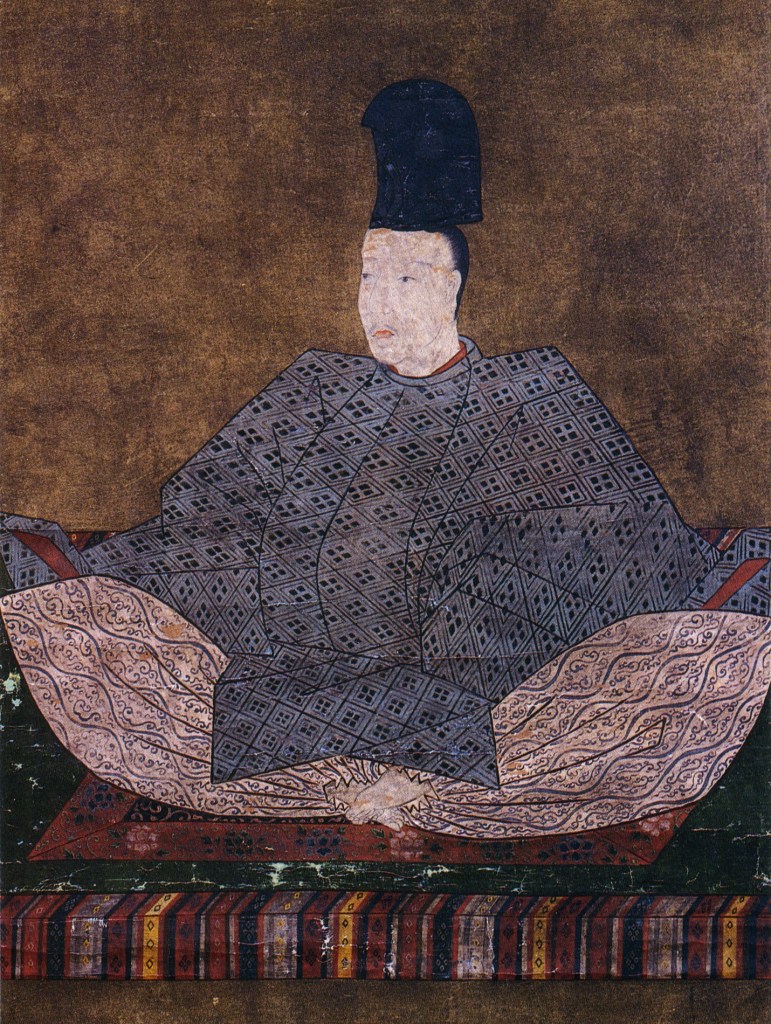
    Emperor Go-Hanazono, whose accession brought about the Era name changed that provoked the showdown between Mochiuji and the Shogun.

    A change of era is often an administrative formality for most, but this time, Mochiuji, being the independent-minded fellow that he was, apparently refused to adopt the new era name. This might seem like a petty decision to us, but it was, in effect, Mochiuji announcing to the world that he didn’t recognise the new era, and by extension, the new Emperor.

    Things got worse following the death of Shogun Yoshimochi in 1431. Mochiuji had expected to be called upon to be the next Shogun, as Yoshimochi had died without heirs. When Ashikaga Yoshinori, a monk, was selected instead, Mochiuji was angry enough to consider marching on Kyoto.

    This is where Uesugi Norizane rejoins our story. He dissuaded his hot-headed master, and no force was sent. In addition, he arranged for formal apologies regarding the Era change and even went so far as to return lands that had been confiscated by Mochiuji to the Shogun.

    Norizane is also recorded as having sent expensive gifts to Kyoto in an attempt to smooth over the considerable animosity that had built up towards Mochiuji there. Norizane was evidently trying to steer a moderate course; he owed his position to the Shogun, but he was nominally subordinate to the Kubo. When these two masters were in opposition, Norizane found himself caught in the middle.

    In 1436, his position got even worse. That year, fighting broke out in Shinano Province between rival factions seeking control of the province. One side called on Mochiuji for help, and he was eager to go, but Norizane intervened, pointing out that Shinano was not one of the provinces that were under the authority of the Kamakura Kubo. Thus, no forces were sent.

    The warlord who had requested Mochiuji’s help was defeated, and in 1437, Mochiuji planned to raise an army and march into Shinano anyway, presumably to avenge his fallen comrade. This time, however, rumours spread that the army was actually to be sent against Norizane.

    Things quickly got out of control after that. Although there was some attempt to negotiate, Norizane fled the Kanto entirely, retreating to the Uesugi stronghold in Echigo Province. There was a brief reconciliation in 1438, but things broke down again quickly afterwards, with Norizane resigning as kanrei.

    This time, Norizane fled to Kozuke Province, and Mochiuji sent an army after him. In response, Norizane called for help from the Shogun, and Yoshinori, who had been waiting for an excuse to deal with the troublesome kubo, readily agreed.

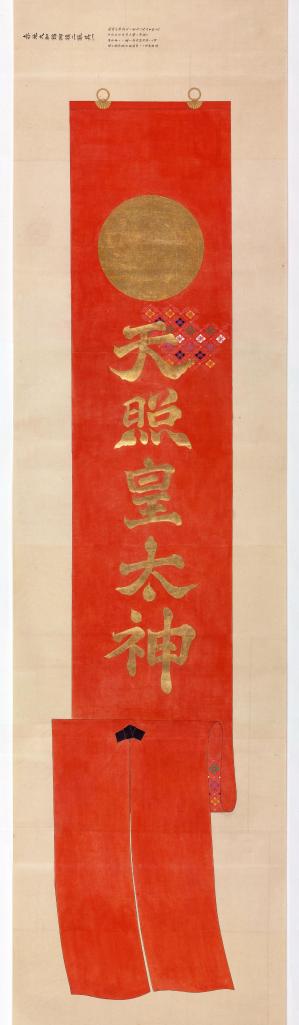
    A coalition of Kanto warlords loyal to the Shogun was assembled, and the Shogun used his influence at court to have an Imperial Banner issued to the army, effectively turning it into an Imperial army, and all those who opposed it into rebels against not only the Shogun but the Emperor himself.

    An example of an Imperial Banner (this one from the 19th Century)

    What impact this had on the morale of Mochiuji and his men isn’t clear, but throughout September and October 1438, their forces were repeatedly defeated, until eventually Mochiuji surrendered and attempted to become.

    Uesugi Norizane, continuing his policy of moderation, pleaded for Mochiuji’s life, and for his son to be allowed to take the position of Kubo. Shogun Yoshinori, however, was in no mood. Mochiuji had been a thorn in his side for decades, and he would not pass up the opportunity to deal with him.

    Mochiuji and his son were forced to commit suicide, and the position of Kamakura Kubo was temporarily abolished. That wouldn’t last long, though, and in 1440, Yoshinori attempted to have his own son appointed as the new kubo.

    Mochiuji (top) commiting suicide after his failed uprising.

    This didn’t sit well with former loyalists of Mochiuji, and a rebellion, led by the Yuki Clan, broke out in the same year, with the stated aim of restoring one of Mochiuji’s sons to their late father’s position.

    In April 1441, the rebellion was defeated, and Mochuji’s surviving children were brought to Kyoto. Yoshinori continued his plans to appoint his son as kubo, but then fate took a turn, as it so often does.

    In June 1441, Yoshinori was invited to a banquet at the residence of the Akamatsu Clan, officially to celebrate the Shogun’s recent victory. When he arrived, the gates were locked, and he was set upon by a band of armed men and cut down.

    The immediate motive of his killer appears to have been either revenge for the confiscation of family property earlier in his reign or the fear of being politically purged. Historians speculate that Yoshinori was becoming increasingly paranoid, with the Imperial Nobility and Samurai class becoming fearful of the possibility of being denounced and facing exile or execution.

    A phrase used by contemporaries to describe this period of Yoshinori’s reign is ‘万人恐怖’ Bannin Kyofu, or Universal Fear, which gives you a good idea of the mood.

    In the immediate aftermath of the killing, rumours of a wider conspiracy abounded, but it soon became clear that the Akamatsu Clan had acted alone; the government’s attention focused on who would be the next Shogun. The most appropriate choice was Yoshinori’s son, Yoshikatsu, but he was just a boy, and it wasn’t until November 1442, 18 months after his father’s death, that Yoshikatsu was elevated to Shogun, despite being just nine.

    With Yoshinori’s death and his replacement by a boy, the strong, often dictatorial power of the Shogun was significantly reduced. Yoshikatsu would rely on a council of powerful lords to handle the realm until he came of age, but that didn’t happen, as Yoshikatsu fell in and died in July 1443, only eight months into his reign. His sudden death led to the spread of several rumours, from a fall from a horse to assassination, but historians generally believe he died of illness, possibly dysentery.

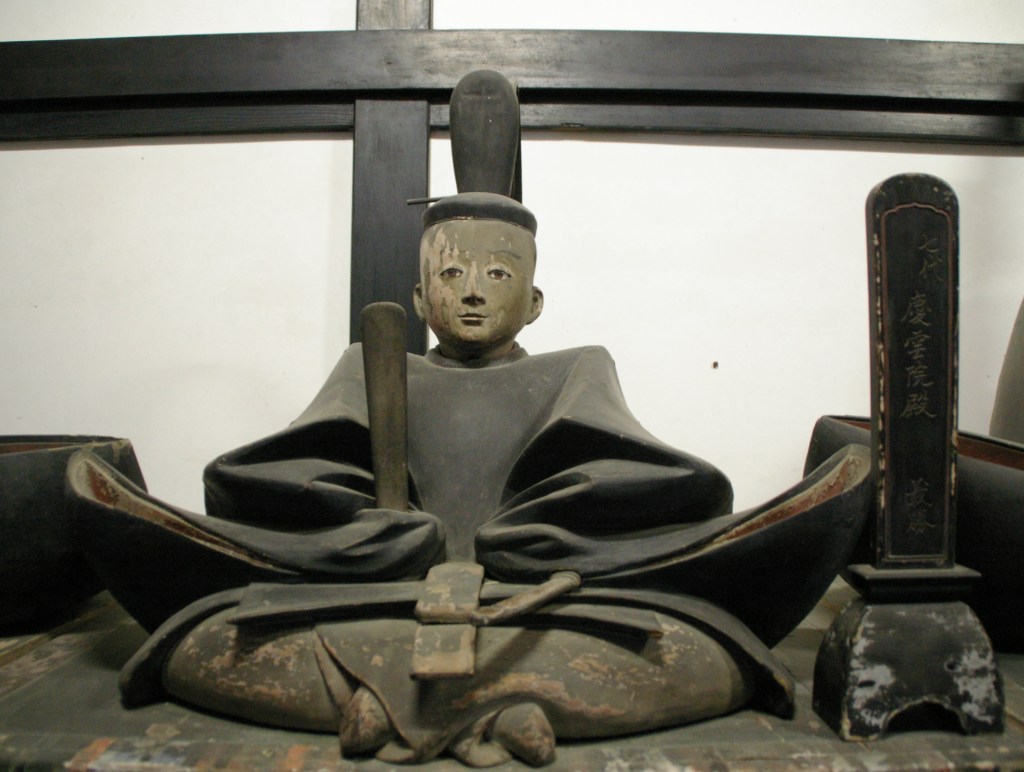
    A wooden statue of Ashikaga Yoshikatsu, whose reign, and life, were tragically short.
    CC 表示 3.0, https://commons.wikimedia.org/w/index.php?curid=9662197

    Yoshikatsu was replaced by his brother, Yoshimasa, who was even younger, and he wouldn’t be officially declared Shogun until 1449, by which time real power had shifted from the Shogunate to several powerful clans.

    Though no one knew it then, the Ashikaga Shogunate had begun what would prove to be a terminal decline.

    Sources
    https://ja.wikipedia.org/wiki/%E9%8E%8C%E5%80%89%E5%85%AC%E6%96%B9
    https://ja.wikipedia.org/wiki/%E8%B6%B3%E5%88%A9%E7%BE%A9%E6%95%99#
    https://ja.wikipedia.org/wiki/%E5%98%89%E5%90%89%E3%81%AE%E4%B9%B1
    https://ja.wikipedia.org/wiki/%E8%B6%B3%E5%88%A9%E7%BE%A9%E5%8B%9D
    https://ja.wikipedia.org/wiki/%E8%B6%B3%E5%88%A9%E7%BE%A9%E6%94%BF
    https://en.wikipedia.org/wiki/Ashikaga_Yoshimasa