Tag: jomon period

  • Yayoi: How Soggy Fields Changed Japan Forever.

    Last time, we talked about the Jomon People, Japan’s first inhabitants. Those folk existed primarily as Hunter-Gatherers, but around the year 900 BC, a new wave of culture crossed the Tsushima Strait from Korea. No, it’s not some prehistoric version of BTS (can you even imagine?), but settled villages, metalwork, and, most significantly, rice.

    Nowadays, we arguably take agriculture for granted; unless you live and work in the countryside, you may never think about it at all, but the ability to cultivate land and produce crops on it changed humanity. For the first time, our ancestors could produce more food than they needed, and if one man could produce enough food for himself and four or five others (mileage may vary), then those four or five others are no longer needed in the fields, which means they can spend their time doing other things, like art, music, war, and ruling over the farmers. (Ok, so it’s not all good.)

    Agricultural revolutions occurred pretty much everywhere at different times, but the Yayoi period is generally thought to have begun around 300 BC. Now, I have to point out that that is not an exact chronology, firstly, because these things never are, and secondly, because the exact transition between the Jomon and Yayoi periods is pretty murky in some places.

    For example, at the Itazuke Site in Fukuoka Prefecture, the earliest remains of rice paddies have been found in contexts that put them more in the Jomon period than the Yayoi, leading some scholars to suggest that the Yayoi period should actually be dated as starting as early as 800 BC, or perhaps even earlier. However, this remains controversial, and there’s never likely to be an exact timeline.
    The site at Itazuke represents possibly the earliest examples of rice farming yet found, although its exact context remains controversial.
    By Muyo – Own work, CC BY-SA 3.0, https://commons.wikimedia.org/w/index.php?curid=15136810

    While Itazuke probably represents a transitional site, it does raise some interesting questions. For example, was the appearance of irrigated rice paddies a case of technological spread, or was it brought over by waves of immigration? The answer, broadly, is a bit of both.

    The thing with ancient, pre-literate societies is that they weren’t generally big on keeping written records, and something as formal as a census was right out. Consequently, it’s pretty difficult to guess exactly how many people were living in Yayoi Japan; it’s also tricky to figure out where they came from.

    The first suggestion is that the Yayoi peoples represented a series of massive waves of migration over a 500 to 600-year period. Some estimates put the population of Japan at somewhere around 6 million by the end of the Yayoi Period in 300 AD. This represents a population increase of more than 4 million over that period, which some scholars suggest is impossible to explain as being a result of immigration alone.

    Now, this isn’t the sort of blog that’s going to go into where babies come from (there’s plenty enough of that sort of thing on the internet already), but a basic rule of thumb for any society is that food surplus = people surplus. If you have a reliable food source and aren’t running for your life from sabertooth tigers and the like, you’re more likely to have a baby, and what’s more, that baby is more likely to survive to adulthood.

    For archaeologists, the next step is trying to figure out who is having the babies. It’s the women, obviously, but the Yayoi people represent an interesting example of how populations change over time.

    Genetically speaking, you can divide the Yayoi into three broad groups: Early, Middle, and Late. So named because they came to Japan at different times (guess which is which!)

    All three groups share similar genetic traits, suggesting shared ancestry, but while human remains of early Yayoi people show a larger percentage of Jomon DNA, suggesting that immigrants and locals were pretty friendly, the later generation shows much less Jomon DNA, and much more from groups that inhabited Korea at the same time.

    Now, does that mean that the later waves of immigrants were pickier in their partners, or, does it mean that by the later Yayoi Period, anyone with large amounts of Jomon DNA had already moved away, or, to put it bluntly, been bred out of existence?

    The answer is unclear, but probably. We know that the Yayoi and Jomon populations were genetically distinct. We can also estimate that the population during the Jomon Period was around 75,000, whereas by the end of the Yayoi Period, it was 6 million. Outside of Hokkaido, then, it seems reasonable to state that Jomon people were simply swamped.

    Yayoi Culture

    Whilst the Jomon and Yayoi peoples were playing a long-term game of “Kiss, Marry, Avoid” (I know that’s not what it’s really called, but I’m trying to keep things PG), Yayoi culture and language were beginning to spread across the land. It should be pointed out, however, that the spread was not even, nor was it universal. Whilst Yayoi culture came to dominate in Kyushu, in Honshu, the adoption of rice farming and other Yayoi hallmarks was pretty inconsistent.

    For example, evidence of agriculture has been found in the Hokuriku region dating back to 380 to 300 BC. However, in the Tokai region, which is practically next door, the first evidence doesn’t appear until 220 BC in some areas, and as late as 50 BC in others.
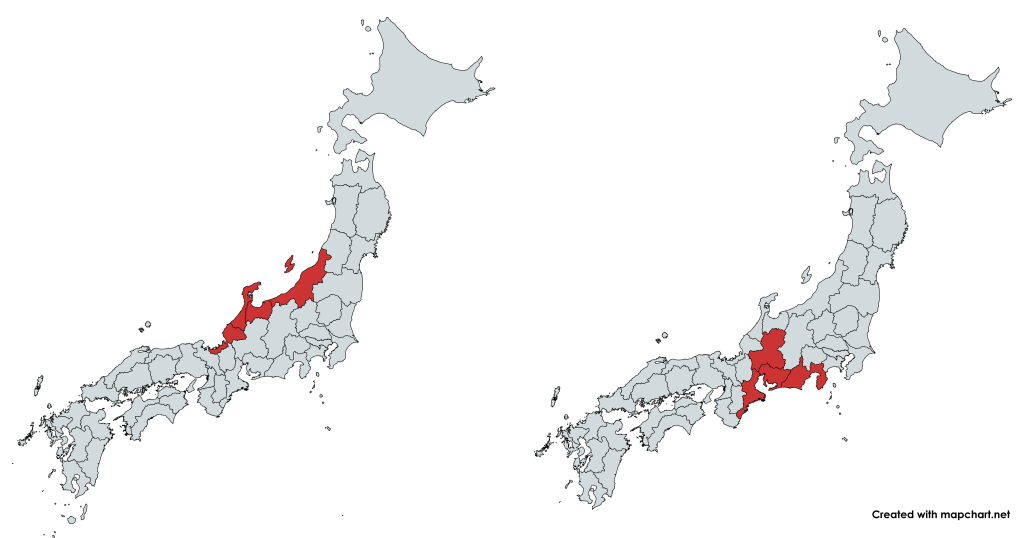
    The Hokuriku Region (left) where evidence of agriculture dates back to 380 BC, and the Tokai region (left) where it didn’t appear until 330 years later.

    This inconsistent development isn’t as random as it may first appear. It is generally believed that the Yayoi peoples were a so-called “sea” people, meaning that they came across from Korea and Eastern China by boat (because how else are you going to do it?). It is then reasonable to assume that the transmission of Yayoi culture would follow coastal routes first, before spreading inland over the following decades.

    Rise of Yamatai

    One of the major problems we have with ancient civilisations (some of them, anyway) is that they didn’t write things down. Now, this is likely because they didn’t have a written language, but it’s still a pain. The Yayoi are one such example. What we know about them comes from the archaeological record, and although archaeologists are (usually) pretty good at what they do, without a clear written record, it can be challenging to figure out exactly how the Yayoi people saw themselves.

    Luckily for us, other people nearby did have writing, and they were kind enough to leave some records. The Chinese Han Dynasty kept copious amounts of records about their neighbours, and it is in these sources that we see the first mention of the Japanese islands.

    In the Book of Later Han, in 57 AD, the Chinese Emperor Guangwu gave the Kingdom of Na a gold seal and some other fancy gifts in exchange for the King of Na recognising the Chinese as their overlords. For centuries, the seal, and indeed the Kingdom of Na, were considered to be semi-legendary, but then the seal itself was discovered by accident (by a farmer, apparently), confirming that the Chinese records were accurate and Na (Nakoku in Japanese) really existed.
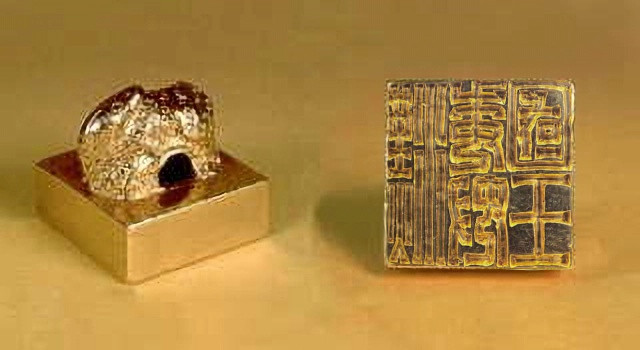
    The golden seal of the Kingdom of Na. Found in a field in 1784, it confirmed the truth of the Chinese Records, and the existence of Nakoku.
    By Original uploader: User:金翅大鹏鸟 at zh.wikipedia – Transferred from zh.wikipedia to Commons by Shizhao using CommonsHelper., Public Domain, https://commons.wikimedia.org/w/index.php?curid=15840653

    There are sporadic records of other Kingdoms and Tribes existing around Japan (called ‘Wa’ by the Chinese), but their exact nature and even their locations are often a mystery. One state from that era that has had an enduring legacy is Yamatai (Yamataikoku in Japanese.)

    This state features prominently in contemporary Chinese records and was apparently ruled by Queen Himiko, or, in some cases, the “King of Wa,” suggesting that the Chinese believed Yamatai to be the rulers of the whole of Japan (as they understood it) or at least a Kingdom of preeminent power.

    We know very little about Yamatai itself, as the only documentary sources are Chinese records, and the archaeological record is unclear. We’re not even sure where Yamatai was located within Japan, with Northern Kyushu or the Kinai Region (near modern Kyoto, Osaka, and Nara) being proposed.

    The two proposed sites of Yamatai, Northern Kyushu (left, in purple) and Kinai (right, in green).
    By Flora fon Esth – Own work based on the image Provinces of Japan.svg (GFDL et CC-by-3.0), CC BY-SA 3.0, https://commons.wikimedia.org/w/index.php?curid=160605946

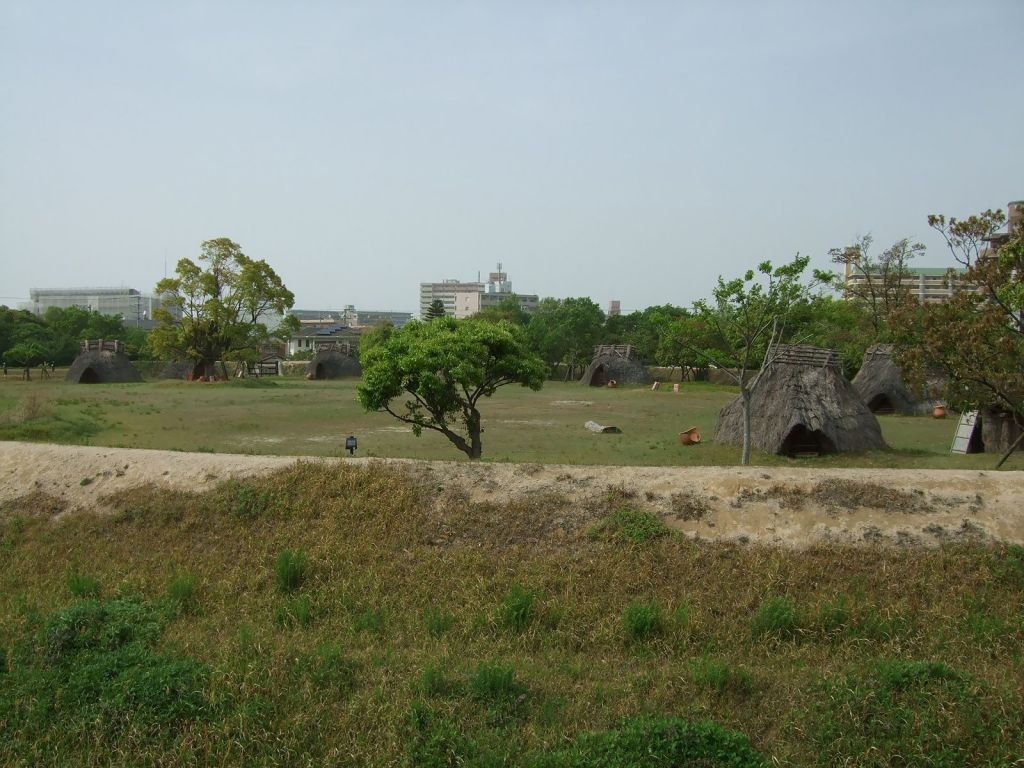
    The discovery of the Yoshinogari site in 1986 ignited the popular imagination, and Yamatai and Queen Himiko have been figures in popular culture ever since. Some have suggested that Yoshinogari is a good candidate for the supposed capital of Yamatai. However, this remains highly controversial, and most experts state that Yoshinogari is an important site, but there’s no evidence to support the assertion that it is the capital.

    The reconstructed village at Yoshinogari, and important site, but the capital of Yamatai? Most experts say not.
    By ja:User:Sanjo – Own work, Public Domain, https://commons.wikimedia.org/w/index.php?curid=4954364

    Queen Himiko is said to have died around 248 AD, after she was replaced, first by a King whose name is not recorded, and then by Toyo (Iyo in some records), about whom very little is known.

    When Himiko passed away, a great mound was raised, more than a hundred paces in diameter. Over a hundred male and female attendants followed her to the grave. Then a king was placed on the throne, but the people would not obey him. Assassination and murder followed; more than one thousand were thus slain. A relative of Himiko named Iyo [壹與], a girl of thirteen, was [then] made queen and order was restored. (Zhang) Zheng (張政) (an ambassador from Wei), issued a proclamation to the effect that Iyo was the ruler.

    Tsunoda, Ryusaku, tr (1951), Goodrich, Carrington C (ed.), Japan in the Chinese Dynastic Histories: Later Han Through Ming Dynasties, South Pasadena: PD and Ione Perkins, taken from Wikipedia.

    Ultimately, Yamatai would disappear from the records shortly after Iyo came to the throne, and, as with any records over such long periods of time, we should take the details with a grain of salt.

    That being said, thanks to Chinese records and the hard work of local archaeologists, we know that by the end of the Yayoi Period, kingdoms had begun to emerge across Japan. Like the preceding Jomon Period, the Yayoi Period can’t really be said to have ended, so much as it transitioned into something else.

    Some scholars suggest that Yamatai lent its name to the following Yamato Period, although the exact etymology isn’t clear (nothing ever is with this stuff.)

    Next time, we’ll take a look at the Yamato Period, Japan’s first Imperial State.

    Sources

    https://en.wikipedia.org/wiki/Yamatai https://en.wikipedia.org/wiki/Yoshinogari_site https://en.wikipedia.org/wiki/Nakoku https://en.wikipedia.org/wiki/Yayoi_period https://en.wikipedia.org/wiki/Yayoi_people https://www.cambridge.org/core/journals/antiquity/article/regional-variations-in-the-demographic-response-to-the-arrival-of-rice-farming-in-prehistoric-japan/7E6D28520A04B2F07DDD36908F291808 https://www.cambridge.org/core/journals/evolutionary-human-sciences/article/japan-considered-from-the-hypothesis-of-farmerlanguage-spread/BD91E69AEA3CCAEDC567519EF7F5AA97
  • The Jomon Period – Japan before it was Japan.

    In the beginning…

    In the beginning, there was an egg, thus answering that age old question at least.

    Actually, it wasn’t really an egg, but chaos in the shape of an egg, and all was silent. Then, things began to happen, and three layers were formed. At the top was light, then came Takamagahara, the High Plane of Heaven, and beneath that was the ‘huge, dark mass’ of Earth.

    Next, when the land was young, resembling floating oil and drift like a jellyfish, there sprouted forth something like reed shoots. From these came into existence the deity UMASI-ASI-KABI-PIKODI-NO-KAMI; next, AME-NO-TOKO-TATI-NO-KAMI. These two deities also came into existence as single deities, and their forms were not visible.

    Kojiki, translated by DONALD L. PHILIPPI

    What followed were the Kamiyonanayo, the Seven Generations of Gods. There are a lot of stories about what these guys got up to, which we’ll cover in a different article, but for our purposes, the most important are the last two, Izanagi and Izanami. Now, just so we’re clear, Izanagi and Izanami were husband and wife and brother and sister, but I’m told that kind of thing is cool when it comes to the Gods, apparently.

    Fun fact: Their names literally mean “Male who invites” and “Female who invites” so there’s that…

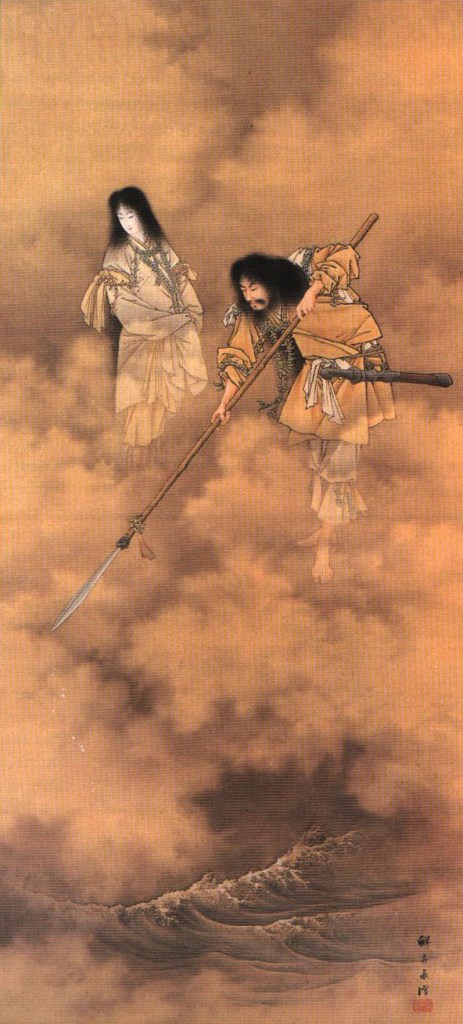
    Anyway, at that time, the earth, ‘huge and dark’ as it was, looked like floating oil and “drifted like a jellyfish”, so Izanagi was given Tenkei, the Heavenly Spear. He used it to stir up the primordial soup, and when he drew the spear out, a drop of water fell back, and created the island of Onogoroshima, the first of the Japanese Isles.

    Izanagi and Izanami stirring the primordial soup.

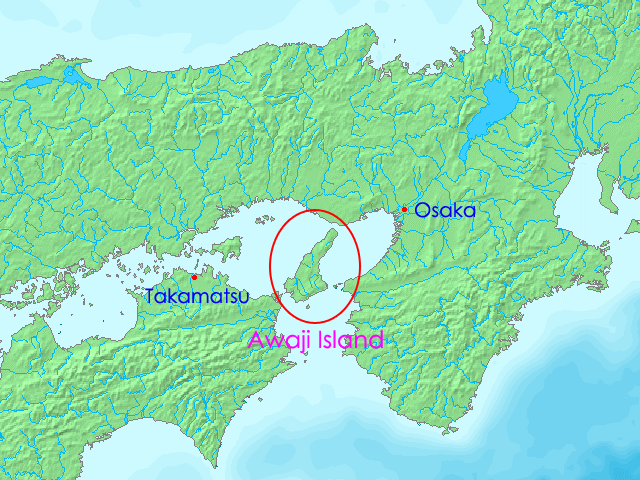
    Just in case you were wondering, no, you can’t visit Onogoroshima. Scholars aren’t sure which of the current Japanese islands represents the mythical “first island”, but it’s generally thought to be one of the small islands that surround Awaji-shima, if it exists at all.

    Awaji Island. Could it, or one of the smaller island around it, have been the first?

    There are plenty of other stories about Izanagi and Izanami, like how, upon erecting a holy pillar, they realised they needed to procreate (stop laughing), but all you need to know for now is that Izanagi and his sister-wife are considered to be the progenitors of the Japanese pantheon, and through their daughter Amaterasu (the Sun Goddess), the Japanese Imperial Family.

    Mythology aside, archaeologists generally agree that the first people arrived on what is now the Japanese Archipelago sometime around 36,000 BC, when Japan was still attached to mainland Asia by a land bridge.

    There are few remains of these people, largely because the soil in Japan is highly acidic, but also because it is probable that they lived in coastal areas which are now under water. The only artefacts that have remained are stone tools, and Japan has some of the oldest on record, with some possibly dating to as early as 30,000 BC, a full 20,000 years before appearing in other places.

    There are, however, some big question marks over the actual age of human habitation in Japan, and that is because of…

    The Japanese Paleolithic Hoax

    The short version of this story is that, during the 1970s and 80s, an amateur archaeologist by the name of Shinichi Fujimura began finding artefacts at sites in Miyagi Prefecture, which he claimed to be dated to the Palaeolithic Period. Fujimura quickly earned a reputation as one of Japan’s most prolific archaeologists, and despite concerns raised by some academics, he rose to become Deputy Director of the Tohoku Palaeolithic Institute. His research seemed to suggest that human habitation of Japan stretched back as far as 600,000 years, and several of his sites were listed as being of national importance.

    The problem, as you’ve probably already guessed, was that he made it up. In late 2000, the Mainichi Shimbun newspaper broke the story that Fujimura had been planting artefacts. He would take items from other sites, bury them secretly, and then “discover” them later. After a thorough review of his work, the Japanese Archaeological Agency reported that almost all Fujimura’s work had been based on faked finds, setting back Palaeolithic research in Japan by decades, and forcing the academic community to reassess everything they thought they knew about the period.

    So what do we know?

    Of the Palaeolithic Japanese? Not much, honestly. Japan’s acidic soil and the high level of coastal erosion over the last 30,000 years has meant that human remains are few and far between, and even real artefacts are limited to stone tools. In short, we know that people were here, but who they were, and how they lived, is open to conjecture.

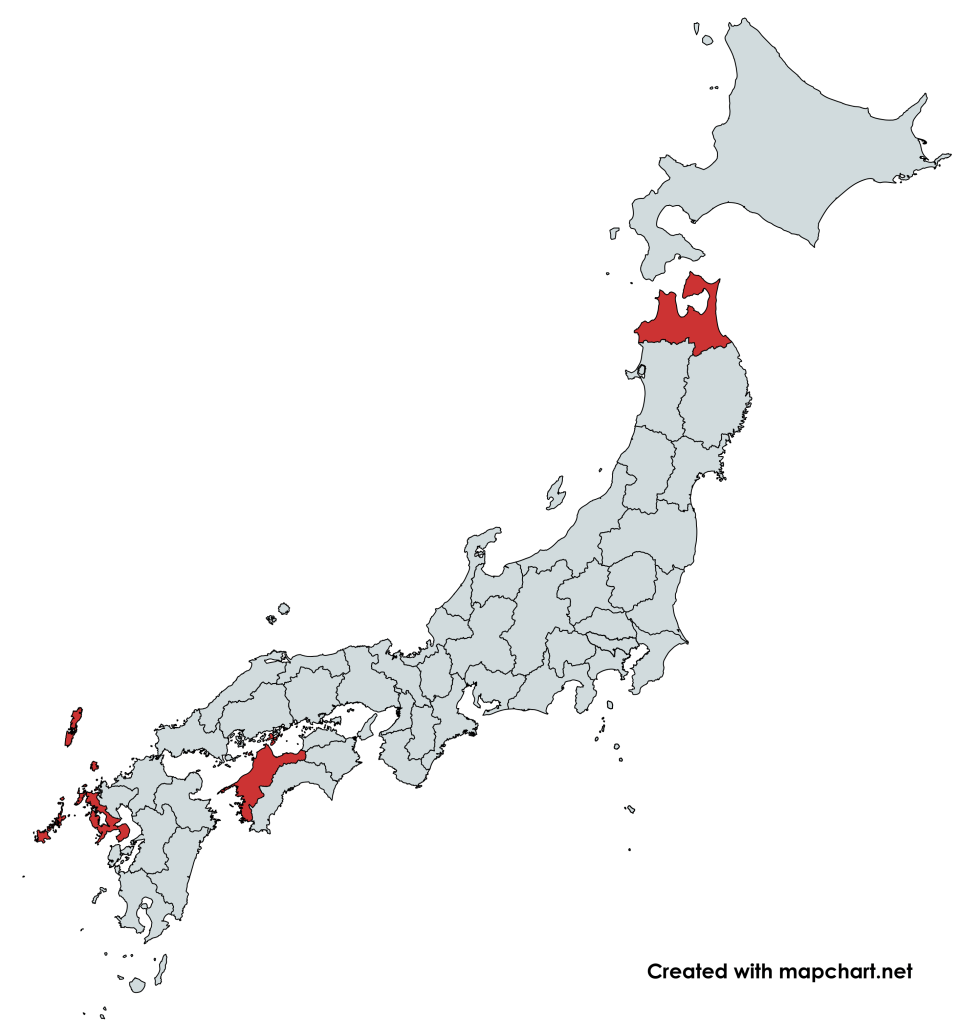
    After about 14,000 BC, however, the record becomes a lot clearer. Fragments of pottery, uncovered in 1998 in Aomori Prefecture, have been dated as early as 14,500 BC, and the distinctive “Cord Marked” (Jomon, in Japanese) style has also been found in Ehime and Nagasaki Prefectures, suggesting that the Jomon people represent the first ‘Japanese’ civilisation.

    The locations of Nagasaki, Ehime, and Aomori Prefectures, highlighting just how widespread the Jomon culture was.

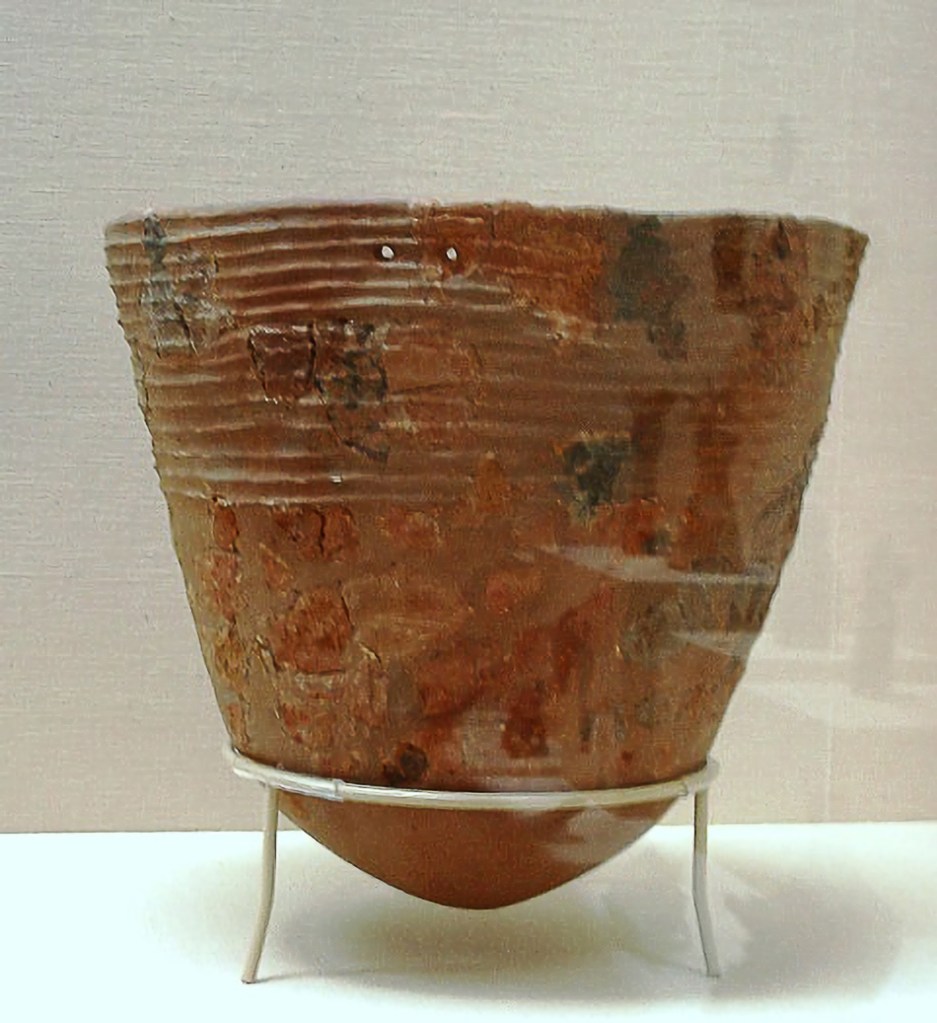
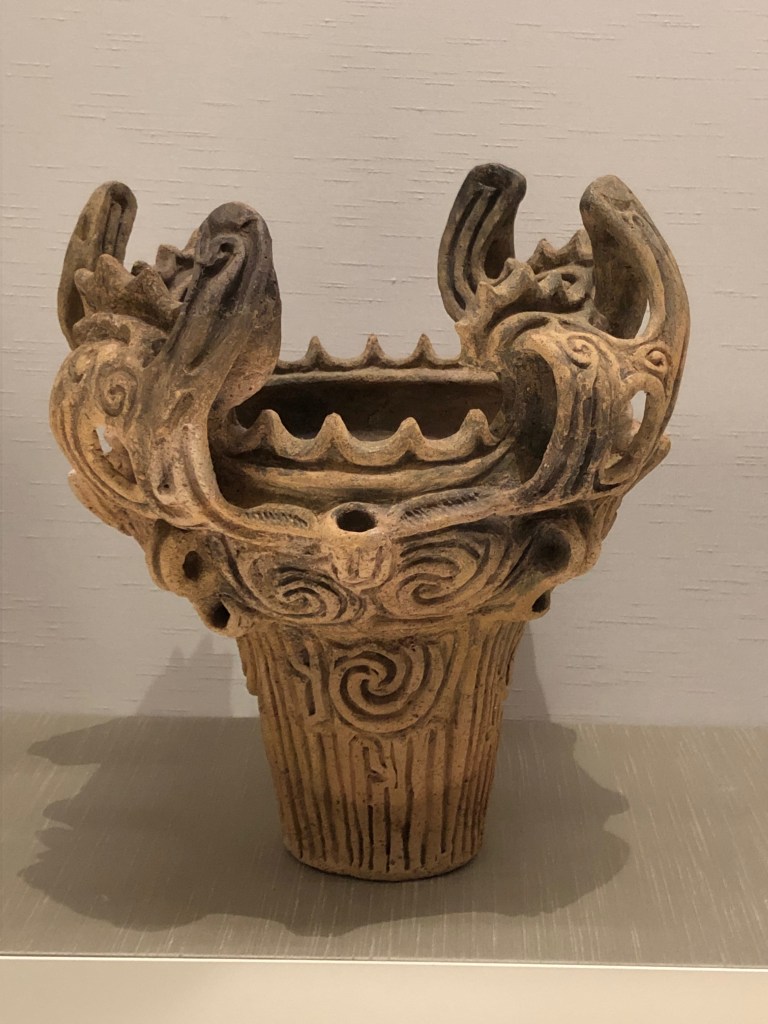
    So why is pottery important? Well, the short answer is, pots mean settlement. Why? Because pots break easily. The larger and fancier the pot, the greater the chances that its maker was planning to stay in one place for a while. Early Jomon pottery (around 14,000 BC) is decorated, but still fairly rudimentary, but by 3000 BC, they’re creating works that are almost absurdly flamboyant.

    Early Jomon Pottery, nice decoration, but nothing that’d you’d regret smashing on the kitchen floor.
    Jomon “Flame Style” Pottery from around 3000 BC. The challenge here being to take a sip without lacerating your face.
    By Netherzone – Own work, CC BY-SA 4.0, https://commons.wikimedia.org/w/index.php?curid=158990309

    The first Jomon people, with their basic pots, were mostly hunter-gatherers, and Japan in 14,000 BC was a pretty sweet place to be a hunter-gatherer. The end of the Ice Age brought on a figurative explosion of life, with widespread forests bringing forth more nuts than you could shake a stick at which, incidentally, is how you harvest them.

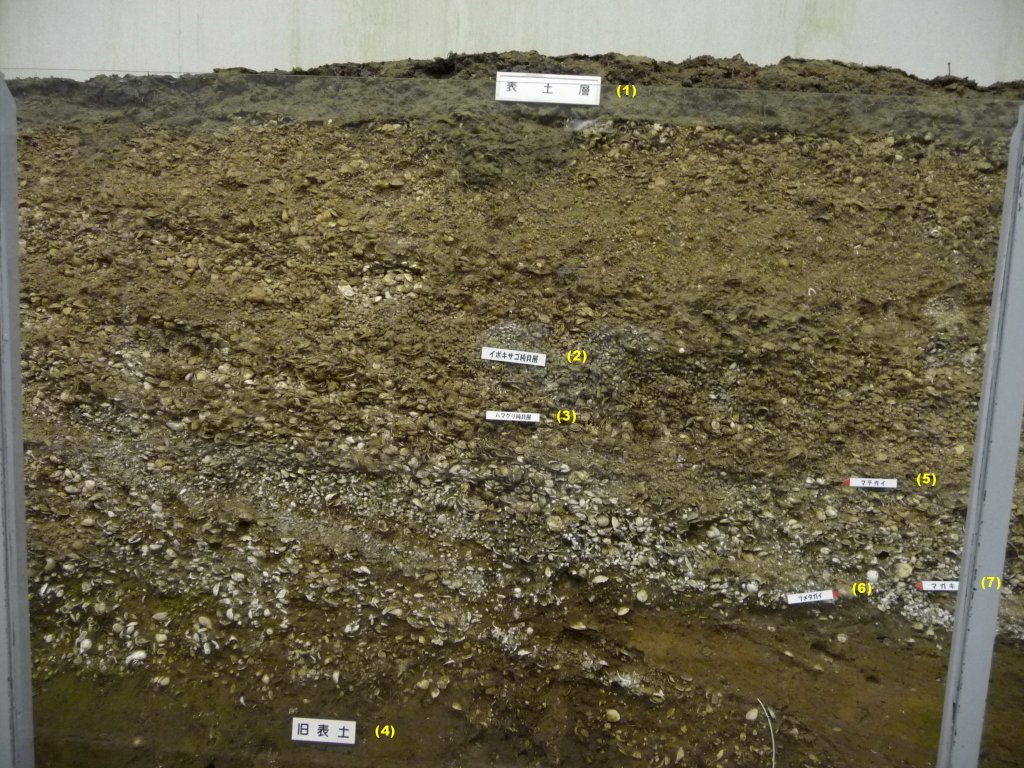
    This abundant plant life also meant abundant animal life, and deer, boar, and smaller creatures formed a large part of the Jomon diet, along with fish, and huge amounts of shellfish in the coastal regions.

    The Kasori Shellmound. Despite taking around 1000 years to form, it gives you an idea of how key shellfish were to the Jomon diet.
    By Namazu-tron – Self shot and numbers with parenthesis added, CC BY-SA 3.0, https://commons.wikimedia.org/w/index.php?curid=6685921

    Early Jomon people lived in rudimentary Pit Dwellings (literally holes in the ground with a roof), which are not thought to have been permanent or even particularly long-lasting structures. Instead, they suggest that these people were seasonally settled, most likely taking to their villages in the cooler months, before setting out to hunt and gather in more agreeable weather.

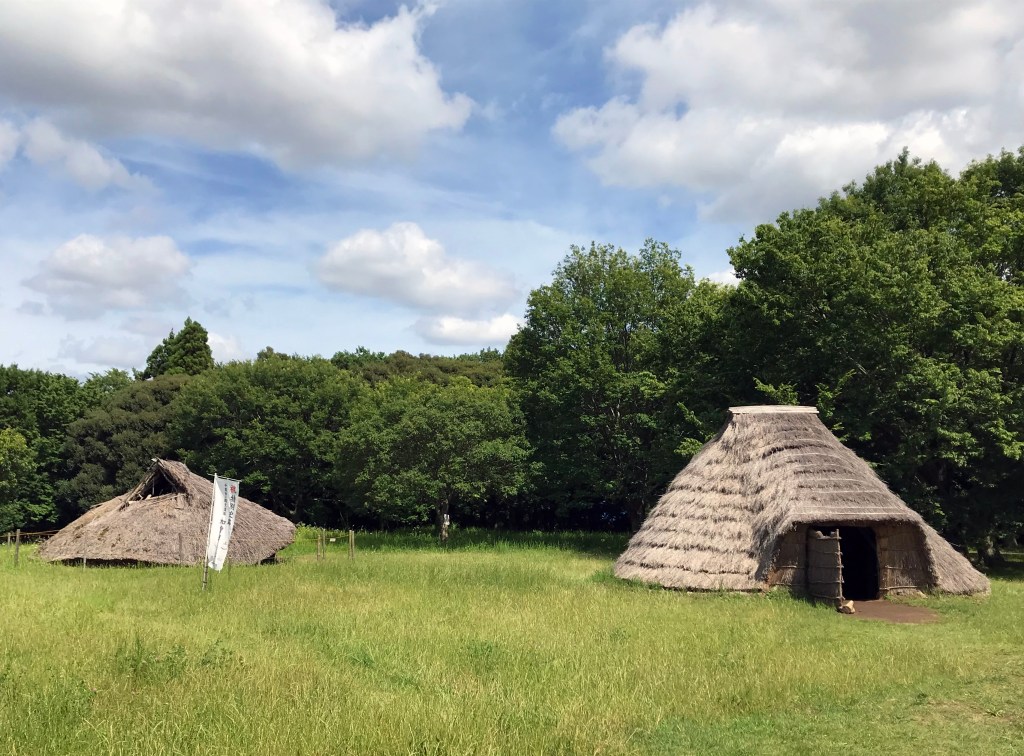
    Reconstructed pit dwellings at Kasori.
    By Xser21 – Own work, CC BY-SA 4.0, https://commons.wikimedia.org/w/index.php?curid=78835425

    Settlements developed slowly over time, but gradually became more sophisticated. Around 5000 BC, the first cemeteries appear, but the people themselves seem to have continued to rely on pits as temporary housing, as well for storage of food and other items. This is further evidence that the earlier Jomon people were only semi-sedentary, returning to their buried food supplies periodically, and hopefully not opening the wrong pits!

    By around 3000 BC, however, the Jomon appear to have settled down more permanently. Research at the Sannai-Maruyama Site in Aomori has uncovered examples of raised storehouses replacing pits during this period. Homes, too, appear to have become more complex, with large, wooden longhouses appearing, suggesting not only more settled people but a significant population increase as well. Large-scale building of this type requires considerable manpower, after all.

    A reconstructed storehouse at Sannai-Maruyama. Anyone who has ever built a shed can tell you that this kind of work requires more than one pair of hands.
    By I, Perezoso, CC BY-SA 3.0, https://commons.wikimedia.org/w/index.php?curid=2509930

    Big Eyes, Big Hips

    An increase in settlement also led to an increase in material culture. It’s easy to imagine early peoples limiting themselves to bashing out stone axes and antler arrowheads, but we already know that the Jomon people created pottery that was remarkably complex.

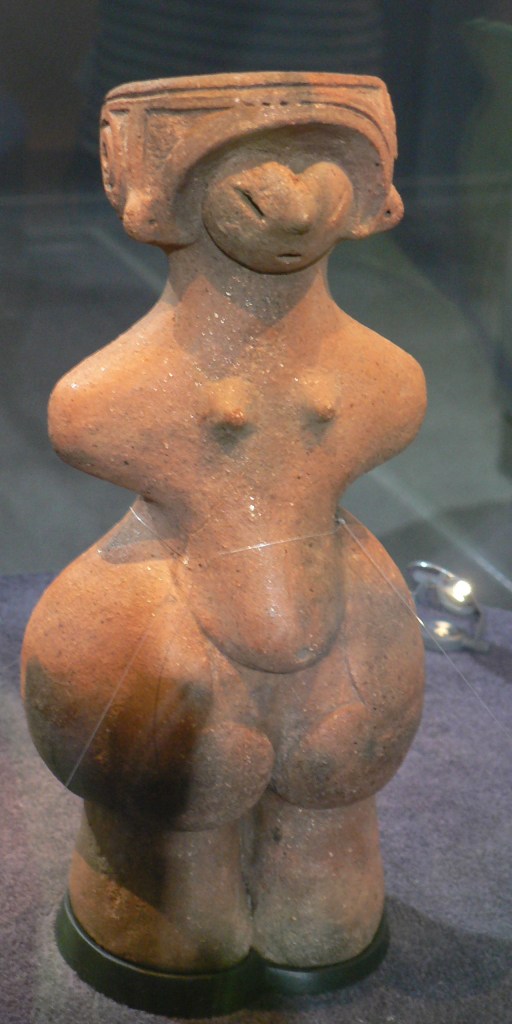
    Other art styles emerged during the later Jomon era as well. Clay figurines called Dogu begin to appear, mostly depicting human (typically female) figures, with exaggerated features, which scholars suggest means they represent some kind of Divine Figure, or are possibly associated with magic and healing.

    Due to the passage of time, many dogu are in poor shape, often missing pieces or smashed to shards. Some, however, remain in relatively good condition, and there is evidence of some having limbs deliberately cut off, giving rise to the belief that these figurines might have been used to “take” illness or injury, which was then removed from the figurine in an attempt to heal its human counterpart. (I don’t know if that worked, but I’m guessing, probably not.)

    The stylised female attributes, (typically consisting of big eyes, small waists, and large hips/buttocks) lead to the conclusion that many of these figurines were related either directly to fertility or to the worship of some kind of mother goddess, which aligns with the interpretations of similar items found around the world.

    The Jomon Venus, an unusually well-preserved example discovered in 1986, is typical of the accentuated female form found in many dogu.
    By Takuma-sa – File:Dogū of Jōmon Venus.JPG, CC BY-SA 3.0, https://commons.wikimedia.org/w/index.php?curid=30994656

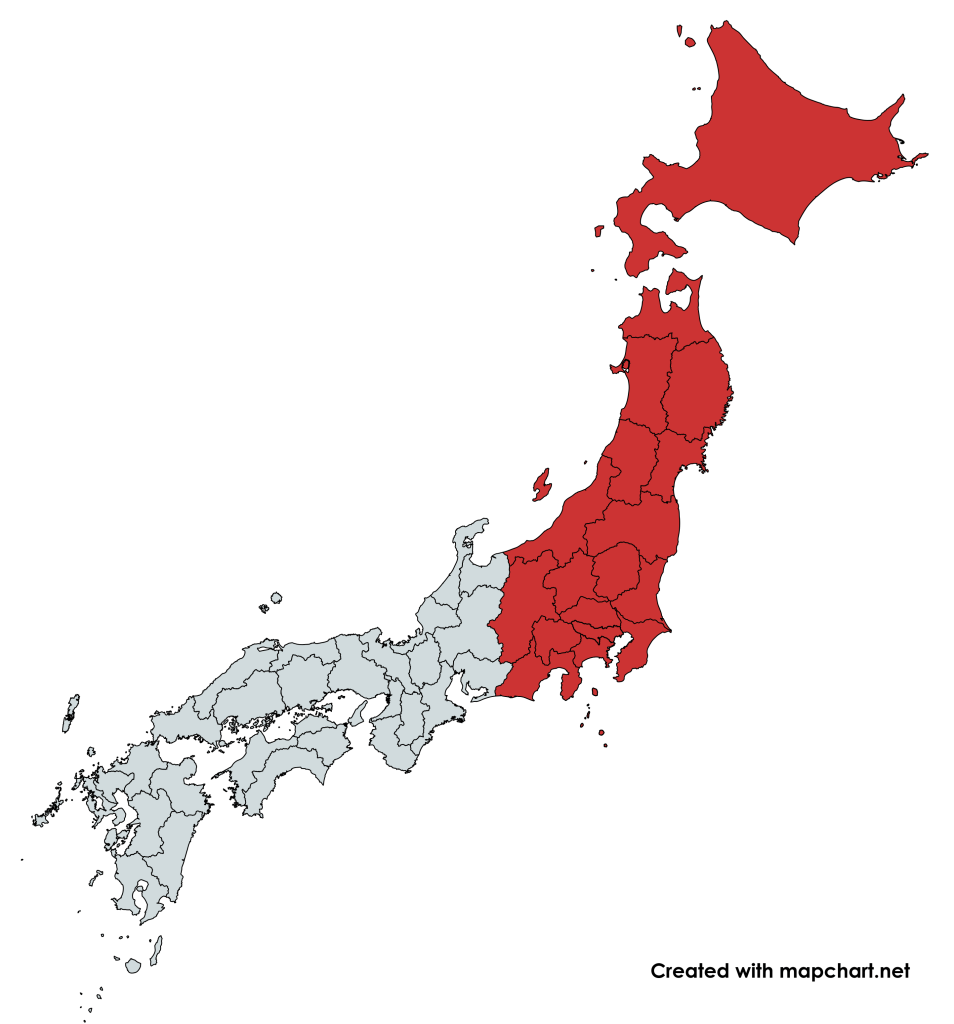
    Somewhere between 15 and 18,000 individual Dogu have been found across Japan, from Hokkaido to Kyushu (although not Okinawa), with the richest deposits coming from the north and eastern parts of Japan. It is apparently rarer to find examples of Dogu in other parts of the country, which isn’t surprising, given the population concentrations that current archaeological evidence points to.

    Eastern Japan, the area currently most associated with Jomon Culture.

    Where were they from?

    People move. Sometimes one by one (like a wide-eyed 20-something moving to the other side of the world) and sometimes in groups. In the modern world, we tend to associate large movements of people with refugees, people fleeing war, famine, plague, or natural disasters, but when it comes to talking about the world of 20,000 years ago, things are much murkier.

    So, the question is posed, “Where did the Jomon People come from?” The answer will surprise you!

    Not really, they came from Asia.

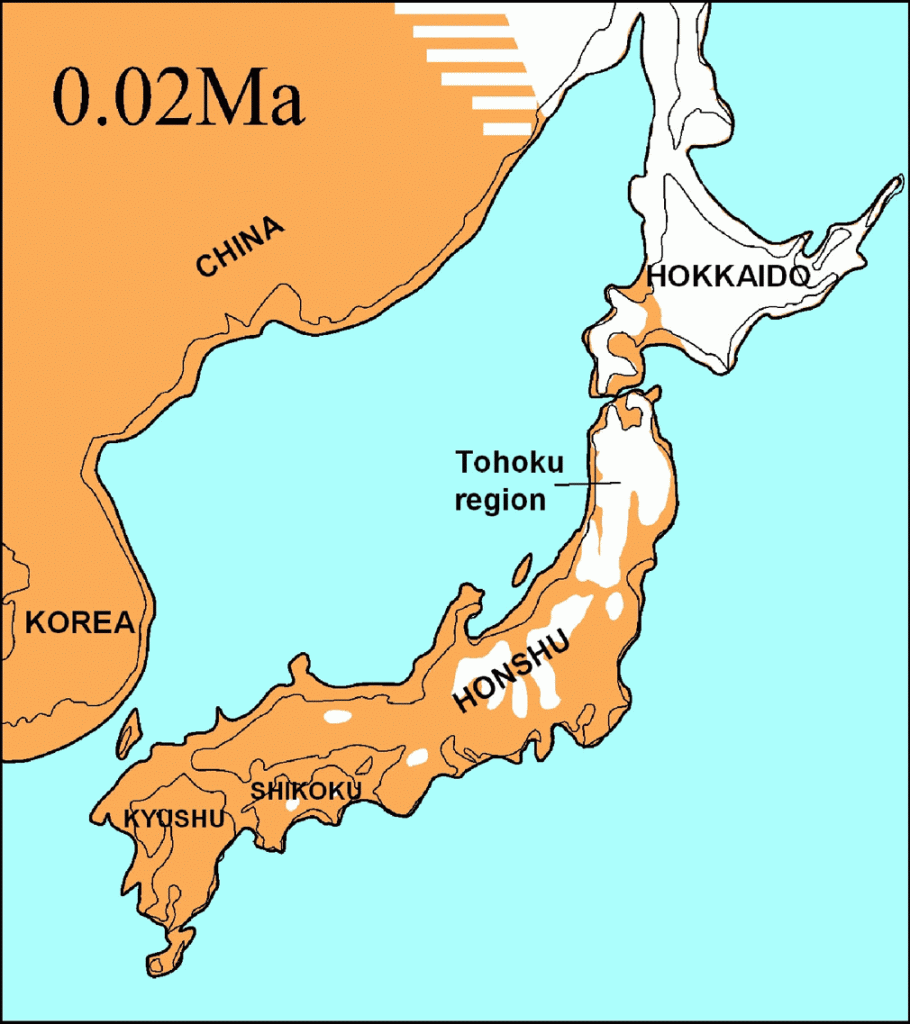
    Japan around 20,000 BC, showing the landbridge to Asia.
    Davison A, Chiba S, Barton NH, Clarke B. (2005) “Speciation and Gene Flow between Snails of Opposite Chirality” (in English). PLoS Biology 3 (9, e282). doi:10.1371/journal.pbio.0030282 [1]

    Japan is now, of course, an archipelago made up of over 14,000 islands of various sizes, shapes, and habitability. But before the end of the last Ice Age, it was attached to Asia, and at the time of the Last Glacial Maximum (which is the scientific way of saying “just before the ice melted”), the landbridge stretched from Hokkaido into modern Russia.

    Paleoarchaeologists (experts in old bones, for experts in new bones, you need the Police) have been able to study the remains of Jomon people and have suggested that, instead of a single, homogeneous migration, the Jomon people represent a pretty diverse group of origins.

    Now, genetics are a tricky thing, but people in the know (otherwise known as scientists) hypothesise that the ancestors of the Jomon People had their origins in South-East Asia, before joining a general migration of people following a coastal route that is now in Eastern China and Korea, before finally arriving in Japan.

    Although we’re reasonably certain of when the Jomon People arrived in Japan, the question of how isn’t as clear. There are basically two theories, which needn’t be mutually exclusive.

    The first theory is that the Jomon arrived via boat, travelling from the coast of what is now China, up the Okinawan Island chain, and arriving in Kyushu and Southern Honshu. The second theory is that their ancestors continued up the coast into what is now the Russian Far East, before travelling south across the remains of the land bridge into Hokkaido and Northern Honshu.

    Given that the majority of sites excavated so far have been in the northern parts of the country, the land bridge theory would appear to be the most plausible. Indeed, the 17 sites collectively known by UNESCO as the Jōmon Prehistoric Sites in Northern Japan are all located in the north (as the name suggests).

    However, even the sites already discovered have produced relatively scant remains, and it’s perfectly possible that more Jomon settlements existed in southern and western Japan, sites that are either lost due to natural changes or buried deep beneath Japan’s bustling modern cities, and some, that are just waiting to be discovered.

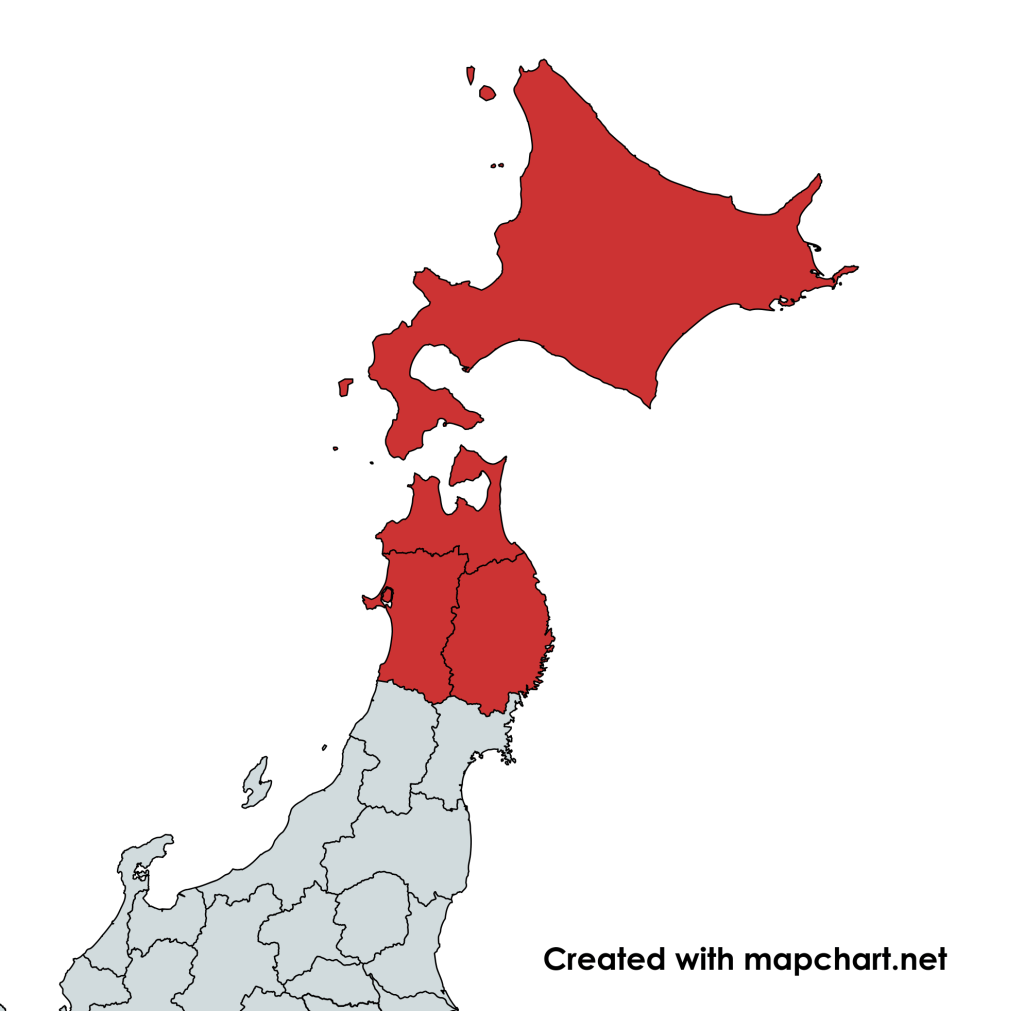
    Hokkaido, Aomori, Iwate, and Akita, the fourth northernmost prefectures of Japan, and the apparent centre of Jomon culture.

    The Jomon Today

    We know that the Jomon were eventually supplanted by the incoming Yayoi People (who we will talk about in a later post), but what became of the Jomon themselves? Well, like with so many other ancient peoples, their exact fate is open to debate.

    A common suggestion is that, when faced with the incoming Yayoi, the Jomon either migrated or were driven to the northern regions of Japan, where they gradually became the Emishi (another people we’ll discuss later), and the Ainu.

    Now, the exact origins of both these peoples are murky, and there is even debate over whether they were different tribes of the same people, or distinct groups that share distant but common ancestry. It is also possible that the Emishi were a cultural “missing link” between the Jomon and the modern Ainu, but we can save that particular rabbit hole for later.

    The historic homelands of the Ainu, with the pink area a suggested maximum range, based on toponymic (place names) and historical records.
    By Kwamikagami – This image has been extracted from another file, CC BY-SA 3.0, https://commons.wikimedia.org/w/index.php?curid=13262173

    While it will probably never be known for certain how the Jomon became the Emishi, or indeed the Ainu, DNA studies suggest that modern Ainu populations share up to 70% of their DNA with the Jomon, supporting the idea that they are indeed the modern descendants of these ancient people.

    We’ll cover the details of the Ainu in another post, but they represent the most concentrated examples of Jomon DNA in modern Japan, so if there can really be said to be modern Jomon, it’s them.

    What about the modern ‘Japanese’, though? Well, that’s a bit harder to nail down. Firstly, the Jomon themselves don’t seem to have been a single ethnic group, but rather a mixture of different groups arriving at different times.

    There’s also the so-called “admixture paradox”, which is a noticeable imbalance in the amount of paternal (30%) and maternal (15%) DNA, which suggests some fairly obvious patterns in the inter-mingling between Jomon and later Yayoi. As with all things to do with ethnicity and race, there’s a lot of interpretation, and while Jomon DNA has definitely been passed down to modern Japan in one way or another, Jomon Culture has disappeared entirely.

    Or has it?

    Nope.

    Allow me to elaborate. Firstly, the Jomon people themselves had no written language (scholars even disagree over whether the Jomon languages relate to modern Japanese at all) so everything we know, or think we know about them comes from archaeological records.

    Now, archaeology isn’t always an exact science, and particularly when it comes to very ancient sources, there’s a lot of guesswork involved. However, we do know that the Jomon peoples had some sort of religious belief system. They buried their dead in specific ways, and the existence of Dogu suggests some kind of worship, although the specifics aren’t clear.

    Some scholars suggest the origins of the Shinto belief can be found in the Jomon period, as Shintoism is based heavily on traditions of shamanism and reverence for the natural world, it isn’t hard to imagine that having sprouted from an ancient belief in some kind of mother goddess, like the Jomon Venus (I do love a call back).

    There are other, more tangible examples of how Jomon culture influenced modern Japan as well. Archery first appeared during the Jomon era, and although bows and arrows are hardly unique to Japan, the significance that the bow would have for the later development of Samurai culture could conceivably be said to have started with the Jomon.

    Too tenuous for you? Ok, how about Lacquerware? Yeah, that made you pay attention, didn’t it? Lacquerware is something quintessentially Japanese, and it has its origins with the Jomon peoples.

    Tsugaru-nuri. Lacquerware from modern Aomori Prefecture.
    By Kaburamata – Own work, CC BY-SA 4.0, https://commons.wikimedia.org/w/index.php?curid=41576897

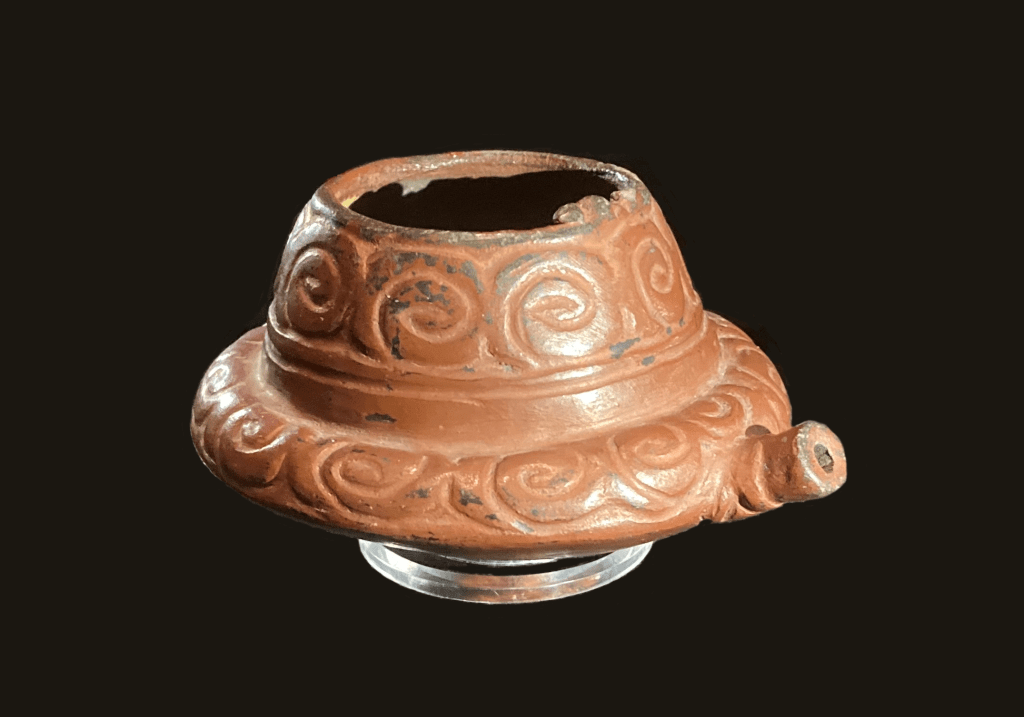
    We know this because surviving examples of it have been found at the Kakinoshima Archaeological Site in Hokkaido. Lacquerware has been found there that has been dated to over 9000 years old, making it the oldest examples of the craft in the world.

    Red Lacquerware like this was found at Kakinoshima in Hokkaido, representing the oldest examples of the craft.
    By Mccunicano – Own work, CC BY-SA 4.0, https://commons.wikimedia.org/w/index.php?curid=97142451

    End of an era.

    As with most historical periods, the Jomon Period didn’t just “end”. The year is usually given as being around 300 BC, but this is more for modern convenience than anything. After around 1500 BC, the climate began to shift again, cooling down significantly, and putting serious pressure on societies that relied on seasonal hunting and gathering. As the climate got cooler and wetter, the food supply got smaller, the population started to contract sharply, and settlements began to shrink, or be abandoned entirely.

    During this period (around 900 BC), increasing contacts with, and migration from, what is now Korea, led to a gradual, but dramatic shift in culture. These newcomers brought new agricultural techniques like wet rice farming, which does better in damper climates, as well as the first examples of metalwork found in Japan.

    Although the incoming people (called Yayoi) and the Jomon lived side by side for a long time, eventually, the Jomon were either driven out or absorbed by the new culture, with the last vestiges appearing to survive in Hokkaido until around the 7th Century.

    That, as they say, is that. Next time, we’ll take an in-depth look at the people who replaced the Jomon, the Yayoi.

    Sources: