Tag: Takeda Shingen

  • The Battles of Kawanakajima

    The Battles of Kawanakajima

    Having looked closely at the lives and careers of Takeda Shingen and Uesugi Kenshin, it is impossible not to notice the frequent mention of a place called Kawanakajima, and the series of battles that took place there from 1553 to 1564.

    The battles at Kawanakajima were not the only confrontations between the Takeda and Uesugi clans, nor were they the largest or most significant battles in the Sengoku period, but they have been the subject of extensive study, writing, and mythologising, as they seem to symbolise the famous rivalry between Shingen and Kenshin, and so they’re worth a closer look.

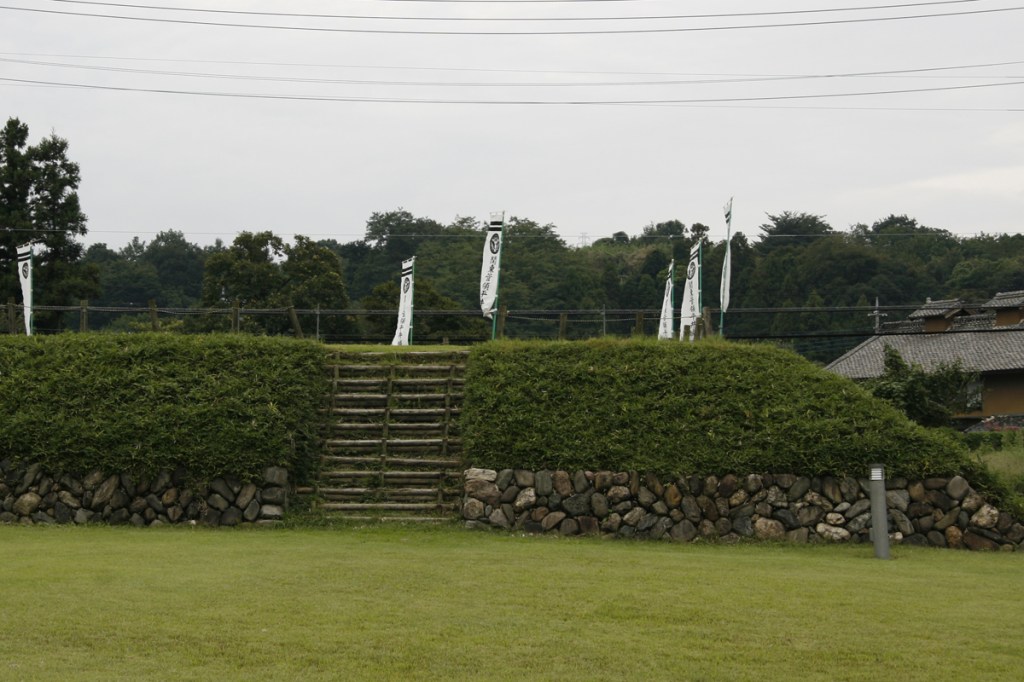
    Kawanakajima

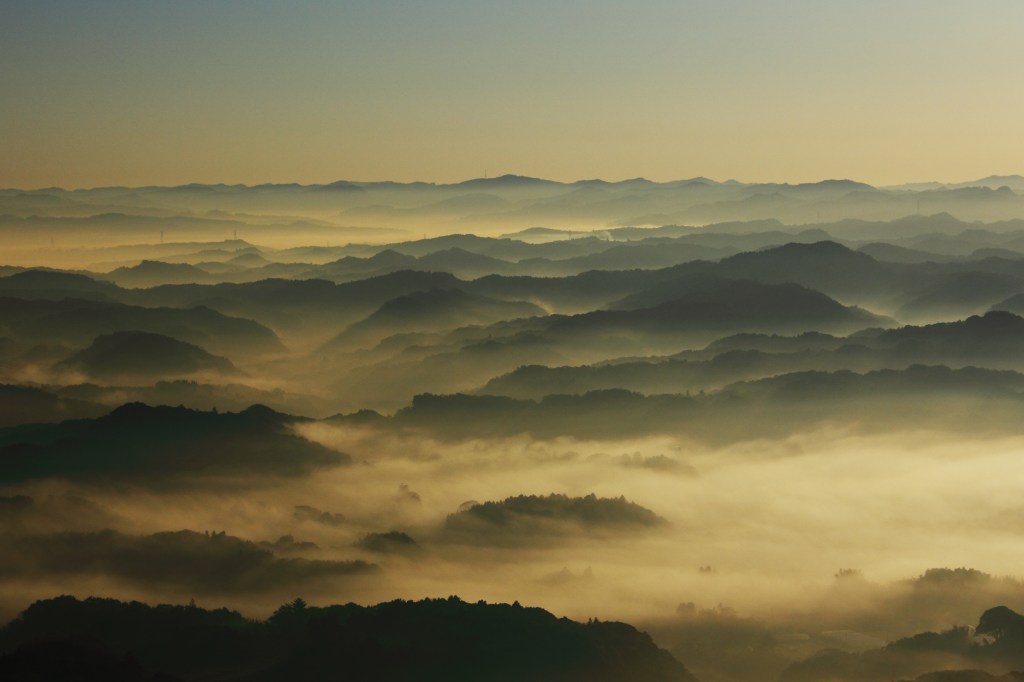
    Kawanakajima as it appears today.
    By Bloglider at Japanese Wikipedia – Own work by the original uploader (Original text: Photo by Bloglider.), CC BY-SA 3.0, https://commons.wikimedia.org/w/index.php?curid=12400636

    The area called Kawanakajima is located in the northern part of Nagano Prefecture, and is the area surrounding where the Chikuma and Sai rivers meet. Now within the modern city of Nagano, in the 16th century the area was in Shinano Province and had long served as a key transportation route from north to south, and as such had frequently been a battleground.

    There had been many small, but long-established clans in the area, but by the early 1500s, it was largely under the control of the Murakami Clan, who would come into frequent conflict with the Takeda, from neighbouring Kai Province, who were beginning to expand into Shinano around this time.

    Starting in 1542, Takeda Shingen began a concerted effort to bring the province under his control, but he faced resistance of varying degrees of severity during his campaign, and it was the Murakami who proved the sternest test. At the Battle of Uedahara in 1548, the Murakami inflicted a serious defeat on the Takeda, and although Shingen would recover, he suffered a further defeat at the Siege of Toishi Castle in 1550.

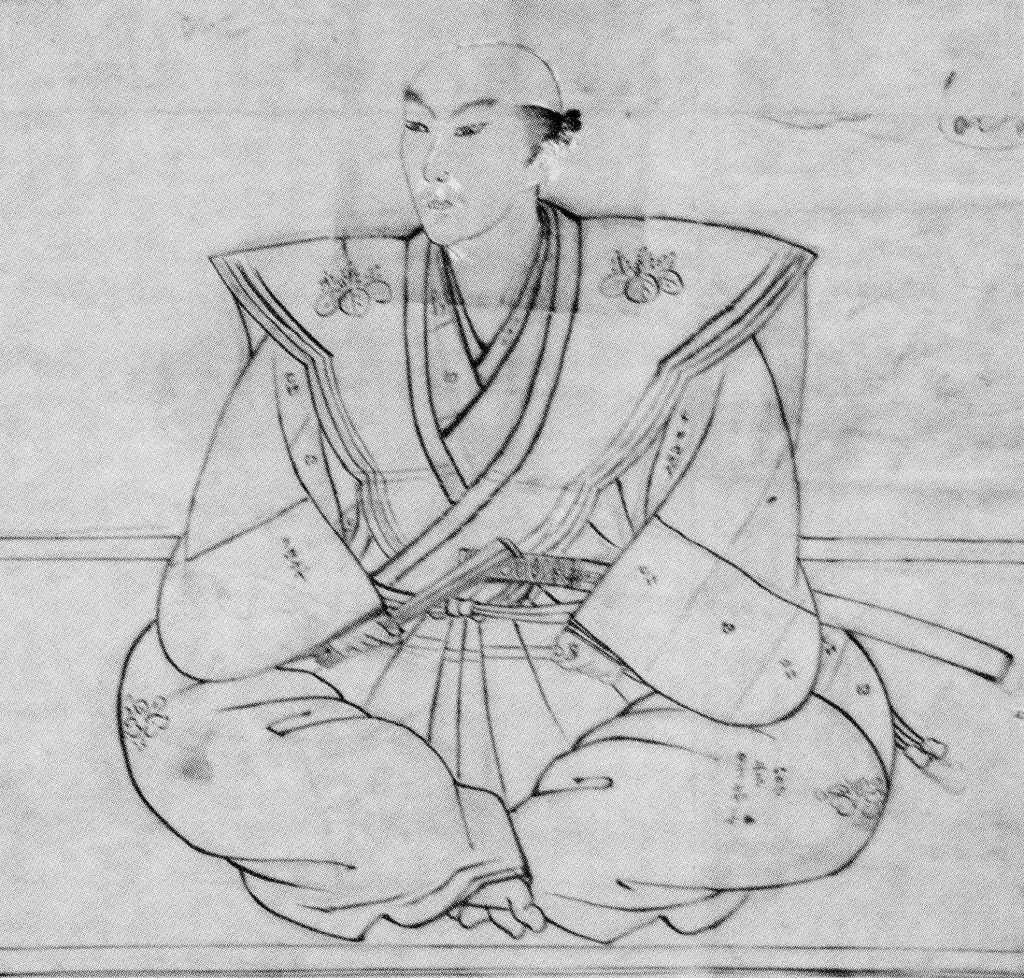
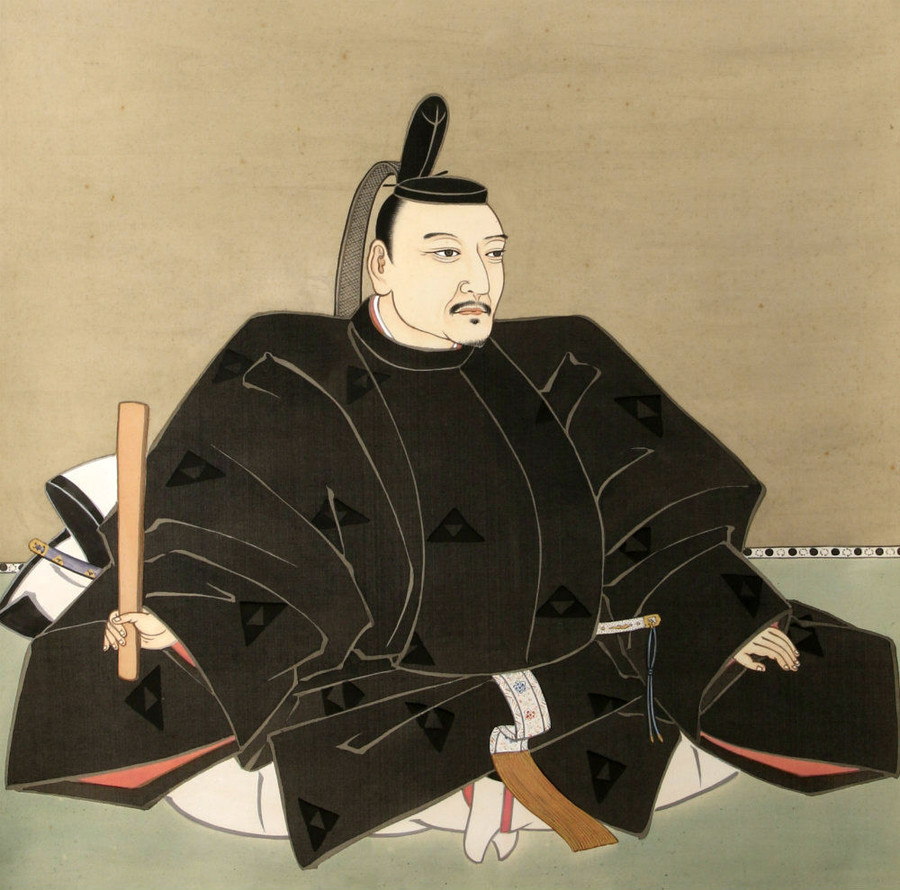
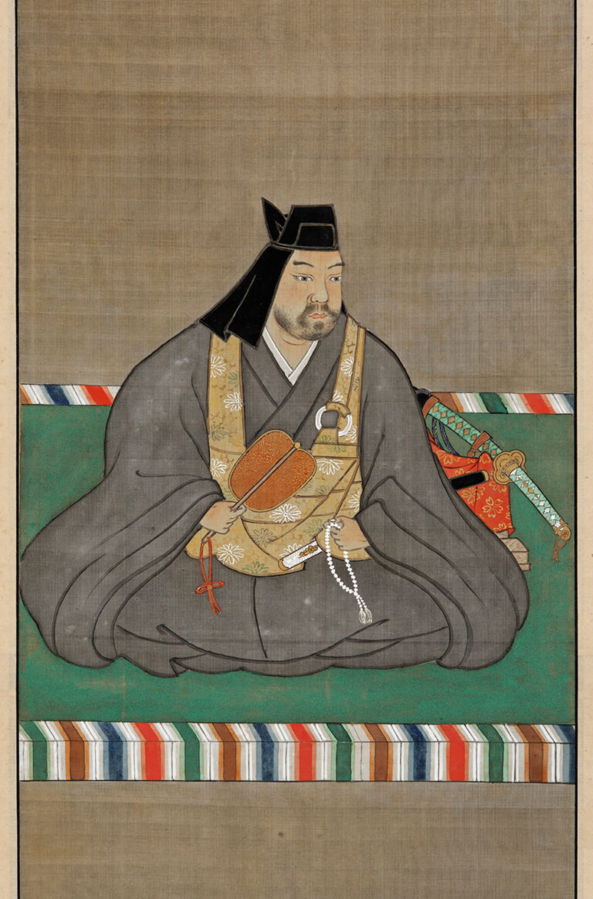
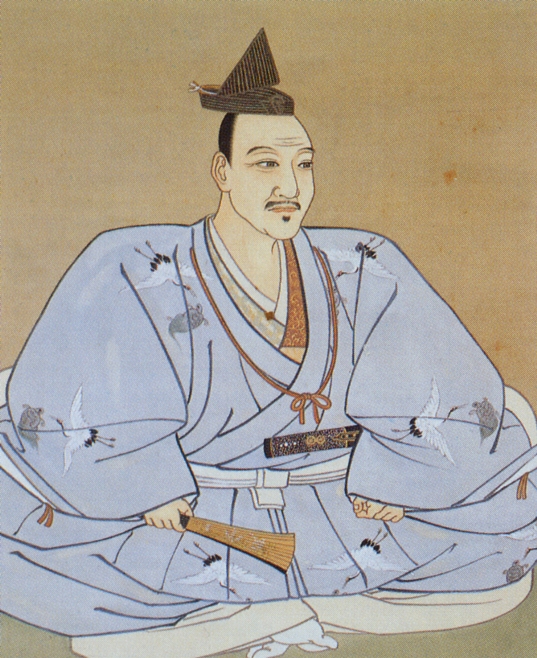
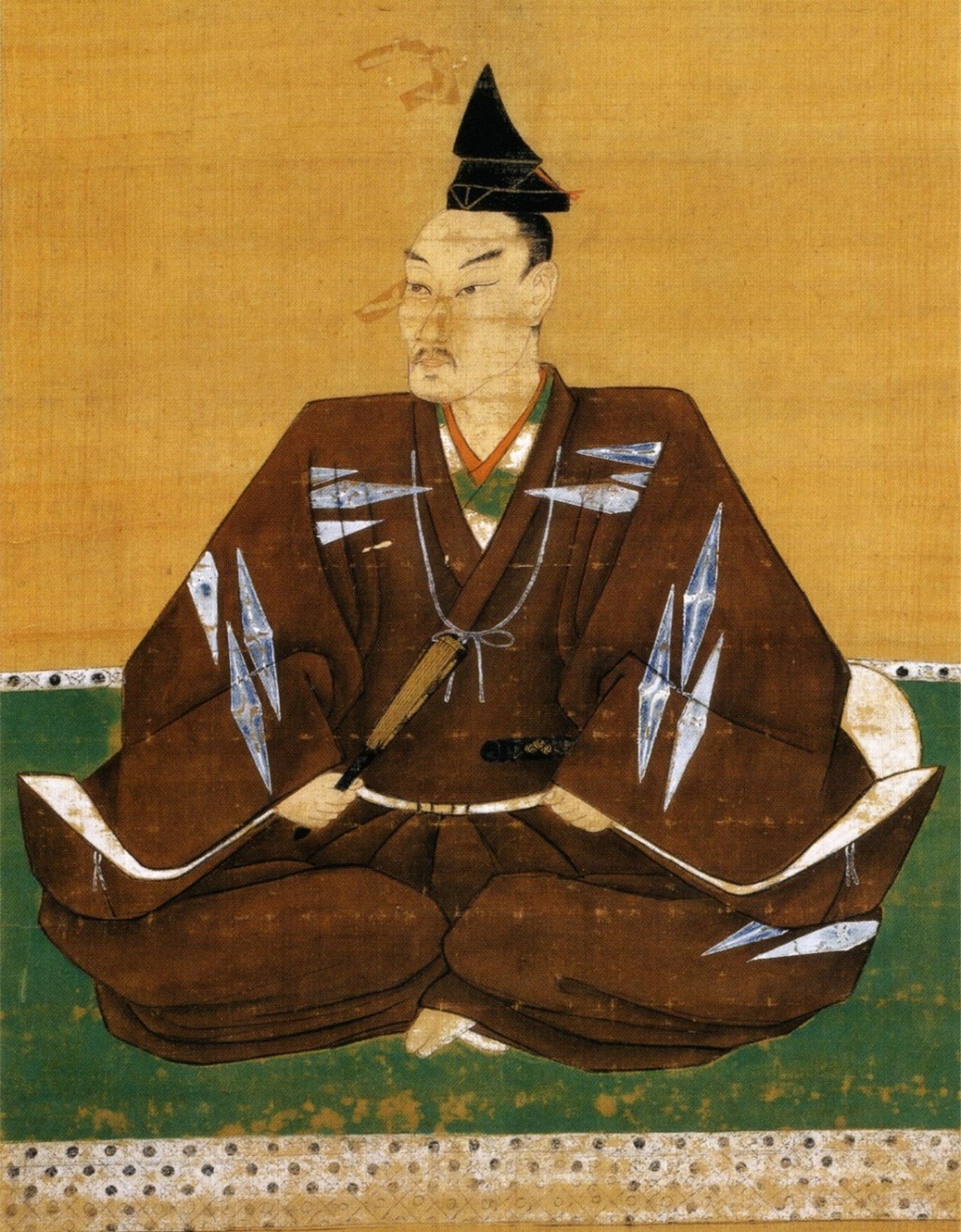
    Takeda Harunobu, better remembered as Takeda Shingen.

    Shingen had what we might call “Bouncebackability”, and in 1551, Toishi Castle fell, leaving the Takeda in control of most of Shinano, with the exception of the area including, and to the north of, Kawanakajima. The clans in this area had previously allied with the Murakami, but with their defeat, they went looking for new friends.

    They found them in the Nagao Clan of Echigo, and their lord, Kagetora, better known to history as Uesugi Kenshin, who advanced into northern Shinano to support these local clans and to oppose the Takeda.

    The First Battle

    In April 1553, Shingen resumed his advance against the remaining clans in northern Shinano, meeting only sporadic resistance and forcing the weakened Murakami to ask for intervention from Kenshin. He responded, and a combined force of around 5000 men counterattacked and defeated the Takeda at the Battle of Yahata in May.

    Nagao Kagetora, better known as Uesugi Kenshin.

    This success would be short-lived, however, as Shingen would resume his advance that summer, forcing the Murakami back again, until September, when Kenshin himself led a force into Shinano, engaging and defeating the Takeda at the Battle of Fuse, before laying siege to several castles in quick succession. Shingen would seek to outmanoeuvre Kenshin and cut off his retreat, but Kenshin responded with a strategic retreat to a place called Hachimanbara.

    Unable to cut off Kenshin’s retreat, Shingen instead retreated to Shioda Castle, entrenching himself there and avoiding direct battle. With neither side apparently up for the fight, both armies gradually disengaged, with Kenshin returning home at the end of September, and Shingen following suit a few weeks later.

    The First Battle of Kawanakajima was more of an extended series of engagements than a pitched battle, and both sides achieved some strategic goals. Kenshin was able to stop the Takeda advance into northern Shinano, whereas Shingen was able to consolidate his control in the central and eastern parts of the province, free from outside intervention.

    The Second Battle

    Through the remainder of 1553 and into 1554, Takeda Shingen continued to expand and consolidate his control of the areas of Shinano south of Kawanakajima. He has also formed an alliance with the Hojo and Imagawa Clans, securing his southern borders and gaining an ally (in the Hojo) against Kenshin’s ambitions in the wider region.

    Shingen also sought to keep Kenshin off balance by supporting local rivals and instigating rebellions amongst his vassals. Though Kenshin was often able to swiftly put down these uprisings, in 1555, a previously loyal vassal, Kurita Eiju, who was based near the Zenkoji Temple, defected to the Takeda side. This was significant because Eiju controlled the southern half of the Nagano Basin, of which Kawanakajima was a central part.
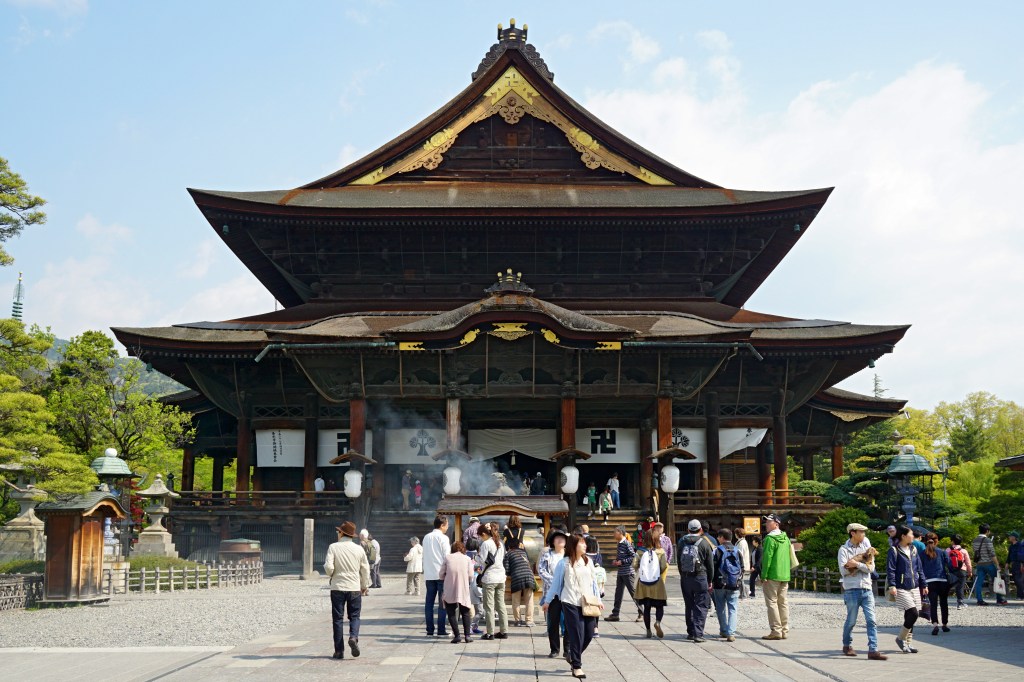
    Zenkoji Temple as it appears today.
    By 663highland, CC BY 2.5, https://commons.wikimedia.org/w/index.php?curid=48785737

    Shingen marched north to support his new ally, whilst Kenshin was obliged to dispatch an army to retake the lost territory. Eiju, alongside 3000 Takeda allies, holed up at Asahiyama Castle (in modern Nagano City), a strategically important location that controlled crossings of the Sai River.

    Kenshin could have manoeuvred around the strong point, but this would have left an enemy garrison at his rear, so instead, he entrenched his forces at Katsurayama (also in modern Nagano) and constructed a castle there, effectively bottling up the garrison at Asahiyama and neutralising the threat.

    Shingen was not idle during all this construction; however, he dispatched an army in support of Kurita Eiju, and it arrived in early July, facing Kenshin’s forces across the Sai River. The only serious engagement of the Second ‘Battle’ was on July 19th, when Kenshin sent forces across the river and engaged in sporadic fighting against the Takeda. Whether this was a serious attempt to force a crossing or just a kind of skirmish isn’t clear, but Kenshin’s forces swiftly withdrew, and both sides spent the next 200 days glaring at each other across the river.

    Eventually, events away from Kawanakajima would force a resolution. Shingen was a long way from his home base in Kai and was beginning to struggle to feed his army, whereas Kenshin was facing issues on his western borders from increasing activity from the local Ikko-Ikki, as well as dissatisfaction from his vassals over the months of inactivity.

    The Ikko-Ikki proved to be difficult to deal with for many lords. Uesugi Kenshin was no different.

    Eventually, both sides agreed to mediation, led by the Imagawa Clan, and a peace was agreed in October. The terms set the border between the rivals as the Sai River, as well as calling for the destruction of Asahiyama Castle, and the complete withdrawal of both armies from the area.

    In the immediate aftermath, Kenshin would turn to deal with the Ikko-Ikki, and Shingen would subdue the remaining independent lords in southern Shinano, but neither side was done with Kawanakajima.

    The Third Battle

    In 1556, Kenshin, apparently suffering from what we might now call ‘burnout’, announced his intention to renounce his lordship and become a monk. His retainers, horrified at the prospect, did everything they could to persuade him to change his mind. They were ultimately successful, and a good thing too, because through the interim period, Shingen had again begun putting pressure on local lords to switch sides, or face conquest.

    During the New Year festivities in January 1557, Kenshin, who had by now given up on his idea of becoming a monk (and the restful lifestyle that would have provided him), offered prayers at the Hachimangu Shrine (in Chikuma, Nagano) for the defeat of Takeda Shingen.

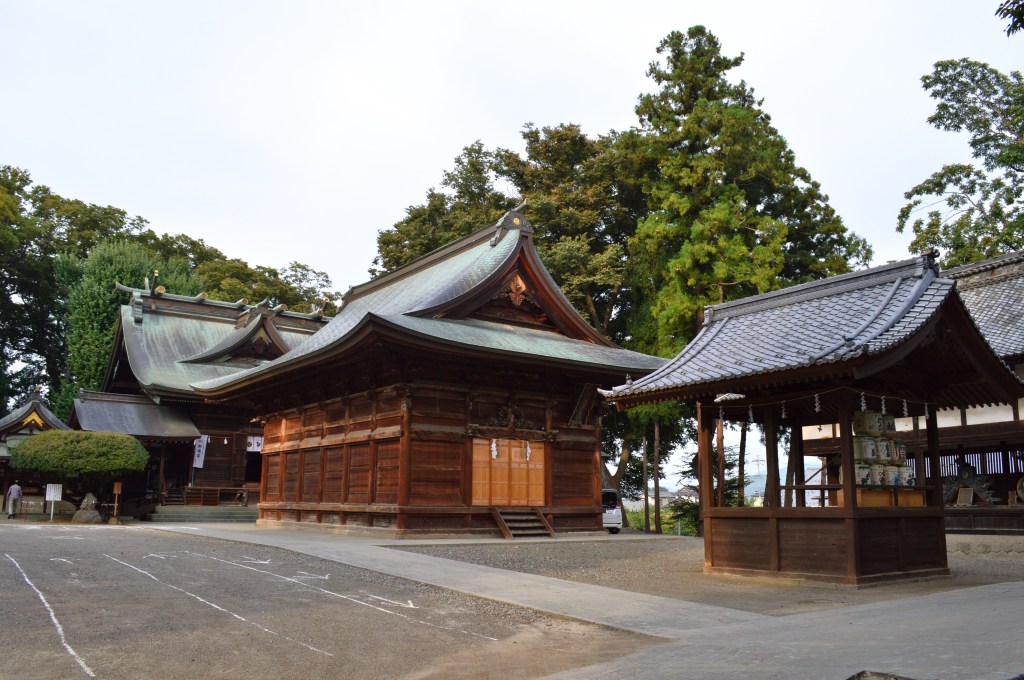
    Hachiman Shrine as it appears today. It’s now called Takemizuwake Shrine.

    Shingen, apparently put out by these attempts at divine intervention, advanced again, taking Katsurayama Castle (the site of the second ‘battle’) in mid-February, then advanced north, defeating the Takanashi Clan, who were allies of Kenshin. Kenshin’s response was delayed by winter snows, but he eventually came south, capturing several Takeda castles and even rebuilding Asahiyama.

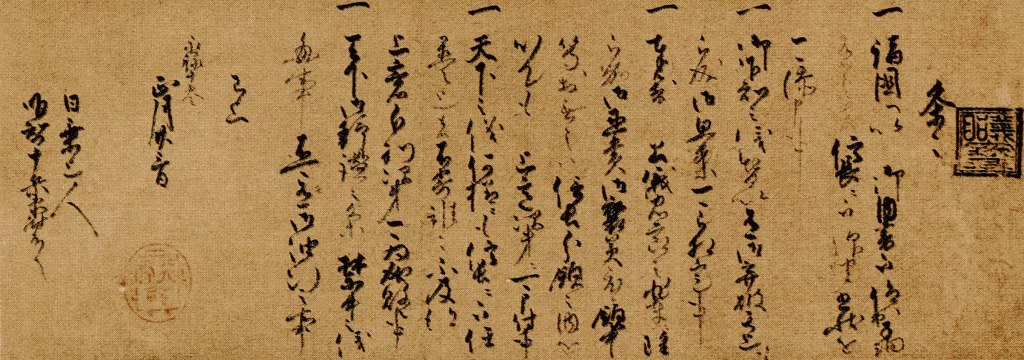
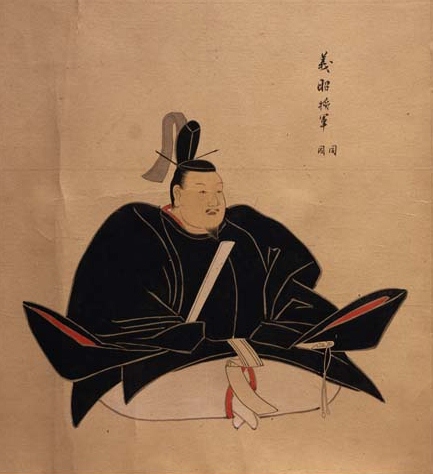
    Shingen would continue to evade Kenshin’s advance, and both sides continued to dance around each other until an indecisive clash at Uenohara in late August, after which, Kenshin, who had advanced far from his supply bases in Echigo, withdrew. At this point, the Shogun, Ashikaga Yoshiteru, intervened, sending a letter requesting that both sides make peace, apparently in the hope that they would then send forces to aid the Shogunate.

    Neither side did, but a truce was agreed upon, which did not last long, as both Kenshin and Shingen would dispatch armies to duke it out in Northern Shinano. Kenshin arguably got the better of it, as the remaining clans in the area, previously just allies, were forced to become effectively his vassals.

    The Fourth Battle

    In 1559, Kenshin went to Kyoto to ask that the Shogun grant him the position of Kanto Kanrei, which had long been held by the Uesugi clan. Though the power of the Shogun and the prestige of any positions he might bestow were long since diminished, Kenshin was able to combine his appointment as Kanrei with his considerable martial talents to gather a large army and attack the Hojo in the Kanto region.

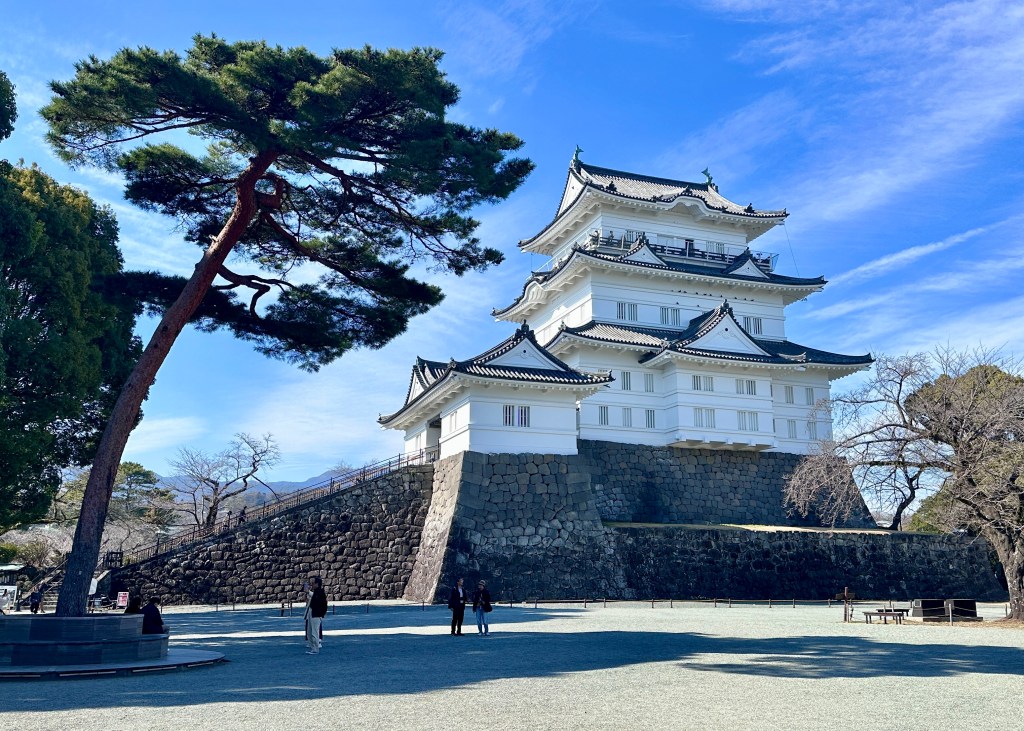
    In 1560, he was apparently able to gather an army of 100,000 men (though this is probably exaggerated) and advance deep into Hojo territory, even besieging their capital at Odawara in March 1561, though he was unable to take the formidable fortress. In response, the Hojo called for help from their ally, Takeda Shingen, who responded by invading Northern Shinano once again.

    The modern reconstruction of Odawara Castle.
    By Akonnchiroll – Own work, CC BY 4.0, https://commons.wikimedia.org/w/index.php?curid=145493350

    When news of Shingen’s attack reached Kenshin’s army, many of his supporters returned home, and he was obliged to lift the siege of Odawara and turn to face the Takeda. Beginning in August, the Takeda and Uesugi forces would again seek to gain advantage, advancing and retreating in turn, largely centred on Kaizu Castle, newly constructed at Shingen’s command.

    This would continue until late October, when the Takeda devised a strategy to launch a surprise attack against the Uesugi, with a second force positioned nearby to ambush and (hopefully) destroy the Uesugi as they attempted to regroup. Kenshin, however, was made aware of the Takeda’s movements, and, taking advantage of a moonless night, he had his army change position, moving them closer to the main Takeda force.

    Just after dawn on October 28th, a thick fog covered the ground around Kawanakajima, obscuring both armies. When the fog cleared, however, the Takeda were confronted with the sight of the entire Uesugi army positioned in front of them. Almost as soon as visibility allowed, Kenshin ordered a furious attack that smashed into the Takeda force and forced them onto the back foot.

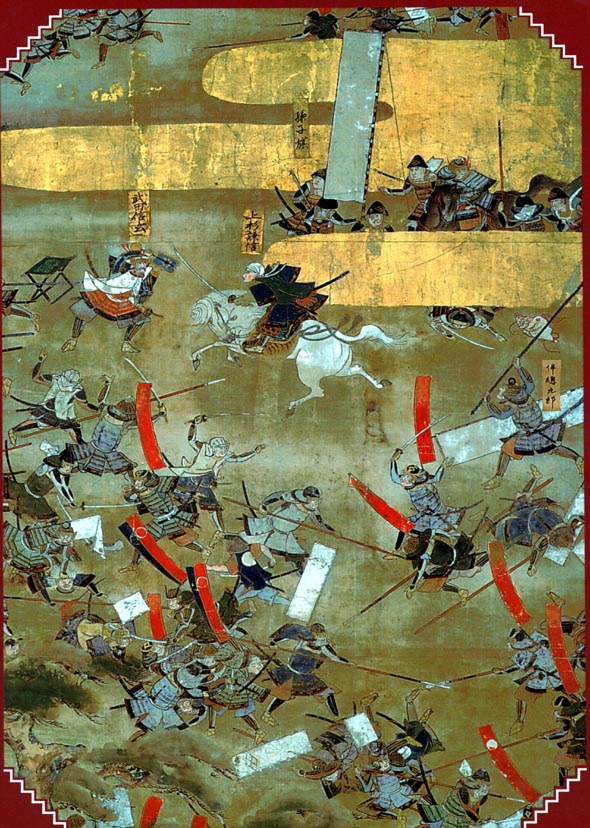
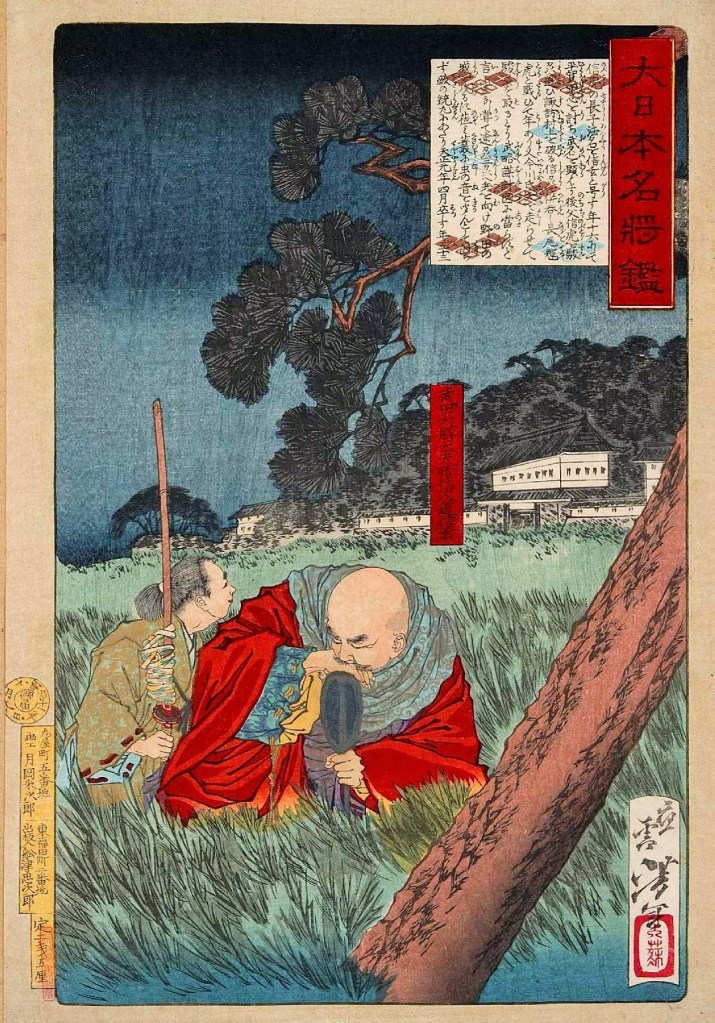
    The Uesugi made it as far as the Takeda’s main camp, and it is here that one of the most famous tales of the Sengoku period takes place. In the heat of the battle, a warrior wearing a white robe (or towel) around his head charged directly at Takeda Shingen. This warrior slashed three times at Shingen, who was able to parry the blows with his war fan (made of iron, not the usual paper, luckily), before Takeda’s soldiers came to the rescue and forced the white-clad warrior to retreat.

    The moment that Uesugi Kenshin and Takeda Shingen are said to have met on the battlefield.

    It was later revealed that this warrior was Uesugi Kenshin himself, and the duel became a legendary scene, symbolising the violence of the age, and the particular rivalry between Shingen and Kenshin. Unfortunately, we’re not sure that the duel actually took place. Takeda sources describe it as I’ve written here, whereas the Uesugi say the duel did take place, but that it was either a different attacker, or that it took place, not in the Takeda camp, but nearer the river, where the fighting was fiercest.

    Whether the famous duel actually happened or not, the battle itself was a bloody affair. The Uesugi attack was ferocious and drove the Takeda back to their camp, but failed to break them. At the same time, Takeda reinforcements rushing towards the battlefield were held up by a Uesugi rearguard.

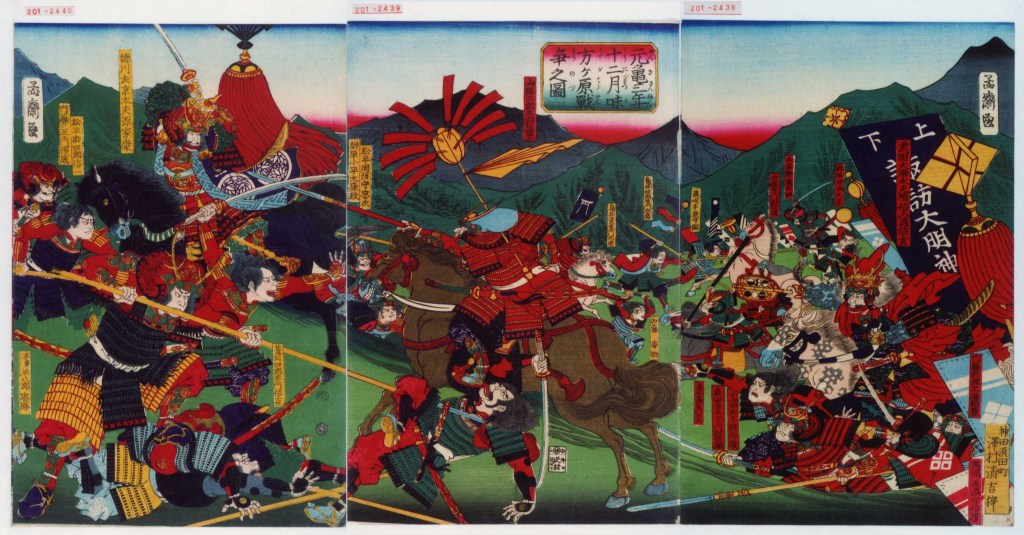
    The Uesugi army (right) advance against the Takeda (left)

    If the battle had been brought to a conclusion that morning, then it’s likely the Uesugi would have won; however, the Takeda reinforcements arrived at around noon, and, fearing encirclement, Kenshin ordered a retreat. Shingen pursued him until around mid-afternoon, but then called it off, bringing an end to the bloodiest of the Battles of Kawanakajima.

    Exact death tolls are always tricky, as are the size of the opposing armies, but total numbers of combatants are estimated to have been around 20,000 for the Takeda and 13,000 for the Uesugi. When the fighting was over, the Takeda had suffered 4000 casualties, to the Uesugi’s 3000, and since they remained in control of the field, the battle was arguably a Takeda victory.

    The Fourth Battle of Kawanakajima was by far the bloodiest.

    That being said, the Uesugi would also claim victory, as they had foiled Takeda’s attempts to trap them, stopped their advance, and, despite a bloody day, their army remained more or less intact. Strategically, the battle was probably a draw, as it ultimately didn’t change much on the ground, neither side was able to secure new territory in the aftermath, and apart from the casualties (who would no doubt be comforted to know they’d died for nothing), both sides remained relatively strong.

    The Fifth Battle

    The Fifth and Final Battle of Kawanakajima occurred in 1564. In the interim period, Kenshin had continued to send forces into the Kanto, and Shingen had continued to try to expand his control of Shinano and other surrounding provinces.

    In Hida Province, a proxy war between a faction backed by the Uesugi and one by the Takeda swiftly drew both clans into direct confrontation once again. Shingen dispatched troops, and Kenshin moved to intercept them. The Takeda would get as far as the southern end of the Nagano Basin, but there would be no serious fighting. The Uesugi were content to limit themselves to blocking Shingen, and Shingen seemed to be content to allow himself to be blocked.

    Both sides eventually withdrew after nearly two months of little more than dirty looks, and this would prove to be the last confrontation between the clans at Kawanakajima.

    Aftermath

    The conflict between the Takeda and Uesugi Clans did not end after the Fifth Battle (such as it was), but both sides had more pressing concerns elsewhere. Kenshin was keen to focus on Etchu Province, the source of frequent Ikko-Ikki attacks, whilst Shingen’s attention was drawn south, and then eventually towards Kyoto as the political situation shifted dramatically.

    When Shingen died in 1573, Kenshin is supposed to have wept openly at the loss of his great rival, but the fortunes of both clans would continue to decline. The Takeda would be heavily defeated at the Battle of Nagashino in 1575, and their power would be permanently diminished. Then, in 1578, Kenshin died, and the Uesugi Clan was wracked by a civil war to determine who would succeed him.

    The Takeda would eventually be destroyed by Oda Nobunaga in 1582, whereas the Uesugi would survive the Sengoku Period and the centuries to come. In fact, as I mentioned in their brief profile, direct descendants of this famous clan still live in Japan to this day.

    Ultimately, the Battles of Kawanakajima became the stuff of myth and legend in the decades following the actual events. This was largely due to the actions of Tokugawa Ieyasu and his descendants, who made concerted efforts to elevate the actions of Takeda Shingen to almost semi-divine status.

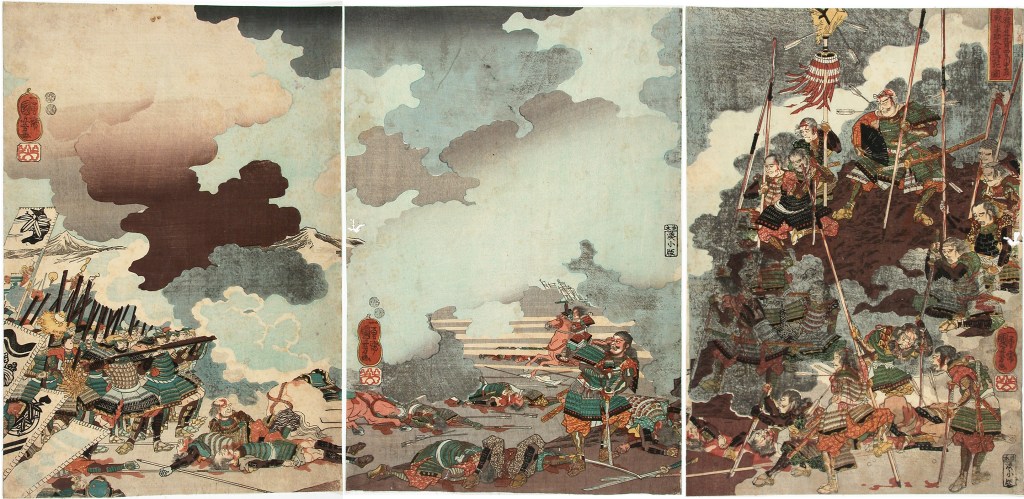
    A 19th Century artistic representation of the Battle of Kawanakajima.

    The reality is that the battles were locally important, but ultimately proved to be fringe events in the course of the enormous bloodshed elsewhere in Japan during this period, as we shall soon see.

    Sources
    https://ja.wikipedia.org/wiki/%E4%BF%A1%E6%BF%83%E6%9D%91%E4%B8%8A%E6%B0%8F
    https://en.wikipedia.org/wiki/Battles_of_Kawanakajima
    https://ja.wikipedia.org/wiki/%E5%B7%9D%E4%B8%AD%E5%B3%B6%E3%81%AE%E6%88%A6%E3%81%84
    https://ja.wikipedia.org/wiki/%E6%97%AD%E5%B1%B1%E5%9F%8E
    https://ja.wikipedia.org/wiki/%E6%AD%A6%E6%B0%B4%E5%88%A5%E7%A5%9E%E7%A4%BE
    https://ja.wikipedia.org/wiki/%E9%AB%98%E6%A2%A8%E6%B0%8F%E9%A4%A8
    https://en.wikipedia.org/wiki/Uesugi_Kenshin
    https://en.wikipedia.org/wiki/Takeda_Shingen

  • The Dragon of Echigo

    The Dragon of Echigo

    Much like Takeda Shingen, Kenshin’s real name wasn’t Kenshin, but Kagetora, with Kenshin being a religious name given in later life. However, as this is the name he is best known by, we will be referring to him as it throughout.

    Uesugi Kenshin, the Dragon of Echigo and the topic of this post.

    If you live your life in such a way that you earn the nickname ‘Dragon of something’ and have followers who think of you as an avatar of the God of War, then I’d say you’ve done pretty well for yourself. By this standard, our subject for today, Uesugi Kenshin, is a historical figure worthy of a closer look.

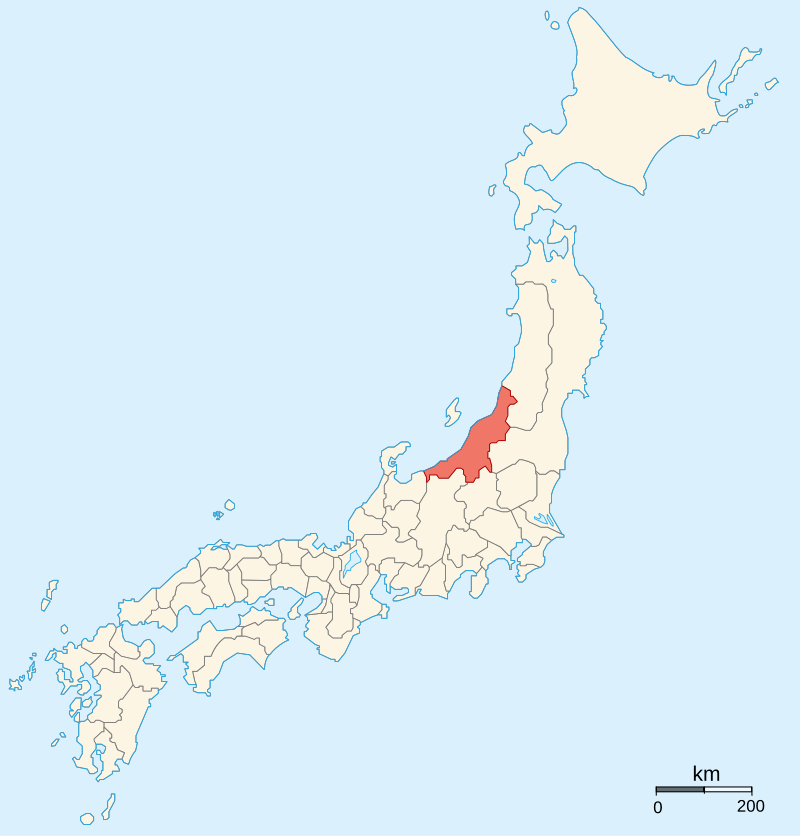
    Confusingly enough, Uesugi Kenshin wasn’t actually a member of the Uesugi family to begin with. He was a scion of the Nagao family, a strong clan who were vassals of the Yamanouchi branch of the Uesugi Clan, based in Echigo Province, in what is now Niigata Prefecture.

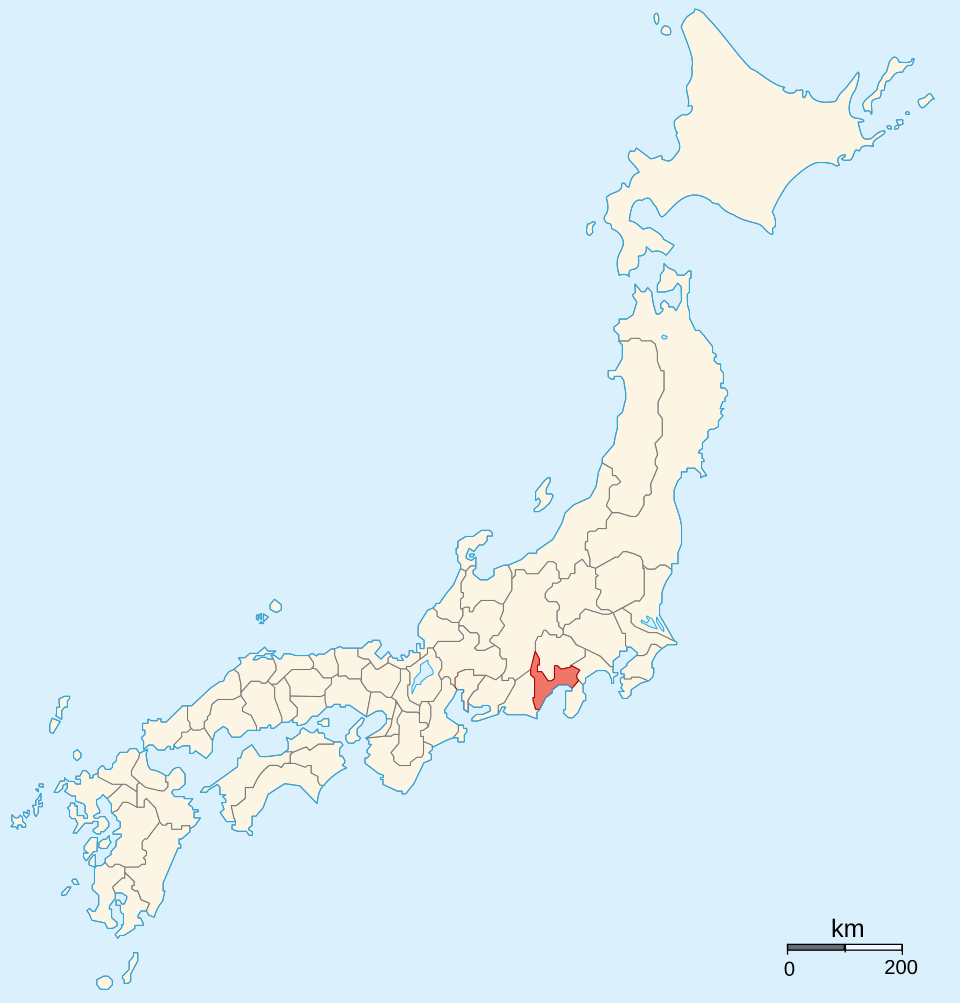
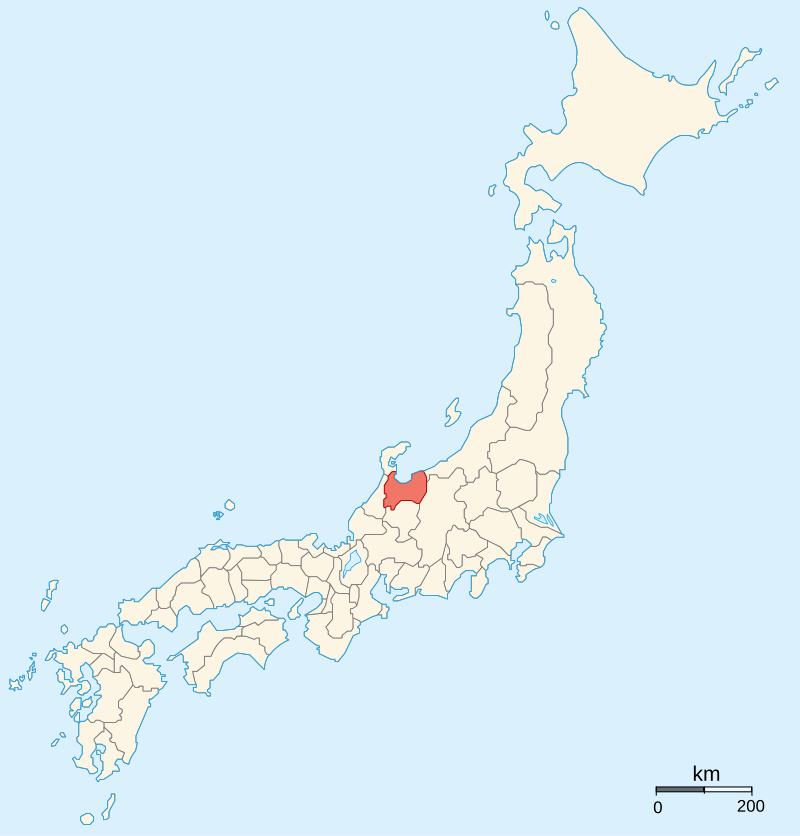
    Echigo Province.
    By Ash_Crow – Own work, based on Image:Provinces of Japan.svg, CC BY 2.5, https://commons.wikimedia.org/w/index.php?curid=1655309

    Born in 1530, it is quite likely that Kenshin’s mother was a concubine, and what’s more, the boy himself was the second son. He was never intended to inherit control of the Nagao Clan, and he entered the temple at Risenji at age 11, apparently set on a life as a monk.

    He doesn’t seem to have stayed at Risenji for long, however, as when his father died in 1542, just a year later, he was at the funeral with armour and sword at his side, and shortly after that, he was at Tochio Castle when a rebellion against Kenshin’s brother (the new Lord Nagao) broke out. Despite being just 14, Kenshin is supposed to have led the defence of the castle and won his first victory.

    At the time, though the Uesugi were nominally the lords of the region, the Nagao served as deputy (and de facto) governors in their place. After the death of Kenshin’s father, it was his elder brother, Harukage, who inherited this position. The brothers don’t seem to have gotten along very well, however, and in the late 1540s, a movement emerged within the Nagao clan that sought to replace Harukage with Kenshin as head of the clan.

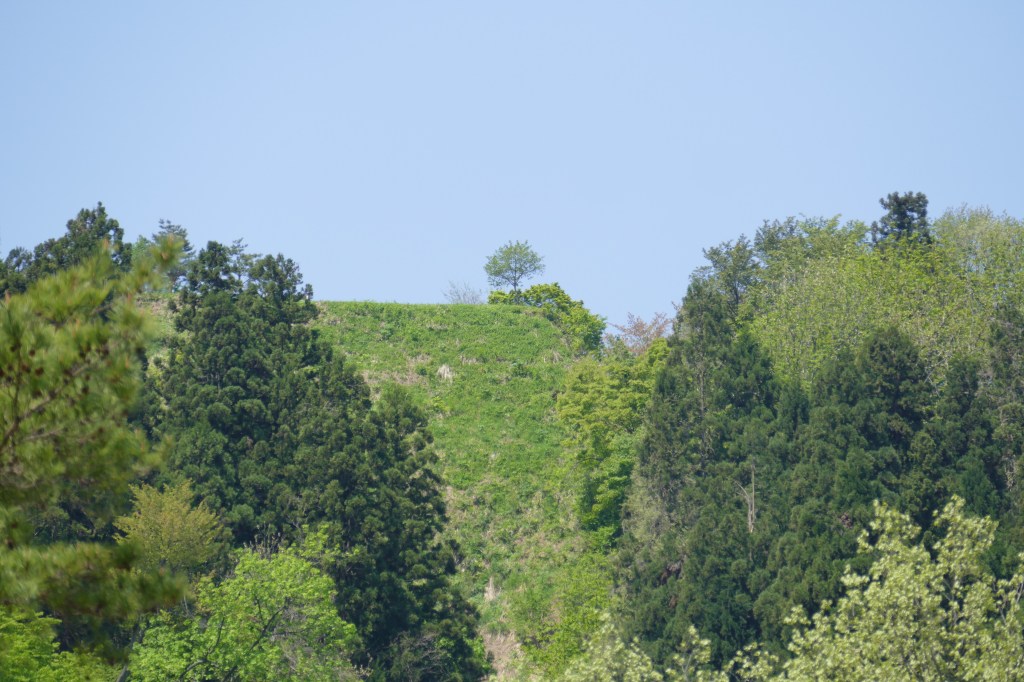
    The remains of Tochio Castle, site of Kenshin’s first victory.
    nubobo – 栃尾城本丸跡, CC 表示 2.0, https://commons.wikimedia.org/w/index.php?curid=59682349による

    Exactly why the clan was so against Harukage isn’t clear, but their efforts were ultimately successful. In 1548, under mediation from Uesugi Sadazane (their nominal overlord), Harukage agreed to adopt Kenshin, then retire as head of the clan, clearing the way for Kenshin to become head of the Nagao Clan aged just 18 or 19 (depending on the source).

    In 1550, Sadazane died without an heir, leaving Echigo Province without a lord. At this point, Shogun Ashikaga Yoshiteru instructed Kenshin to take the position of shugo of the province, effectively making him the new lord. Shogunate recognition was not quite the prestigious thing it had once been, however, and not long after this, supporters of Kenshin’s brother rose up in rebellion against him.

    Kenshin quickly bottled up the rebels at Sakado Castle, when the castle fell, the leader of the rebels was spared because he was Kenshin’s brother-in-law, and following this, Kenshin, still aged just 22 had established effectively control over the whole of Echigo Province.

    Looking back for a moment, five years earlier, the Uesugi Clan (or more accurately, the Ogigayatsu branch of the clan) had been defeated at the Battle of Kawagoe by the new rising star of the Kanto, the Hojo Clan. The Ogigayatsu-Uesugi were wiped out after this battle, leaving only the Yamanouchi Branch of the clan. In 1552, Uesugi Norimasa, who was, on paper, the Kanto Kanrei (Shogun’s deputy) was finally driven out of the Kanto entirely and sought refuge with Kenshin.

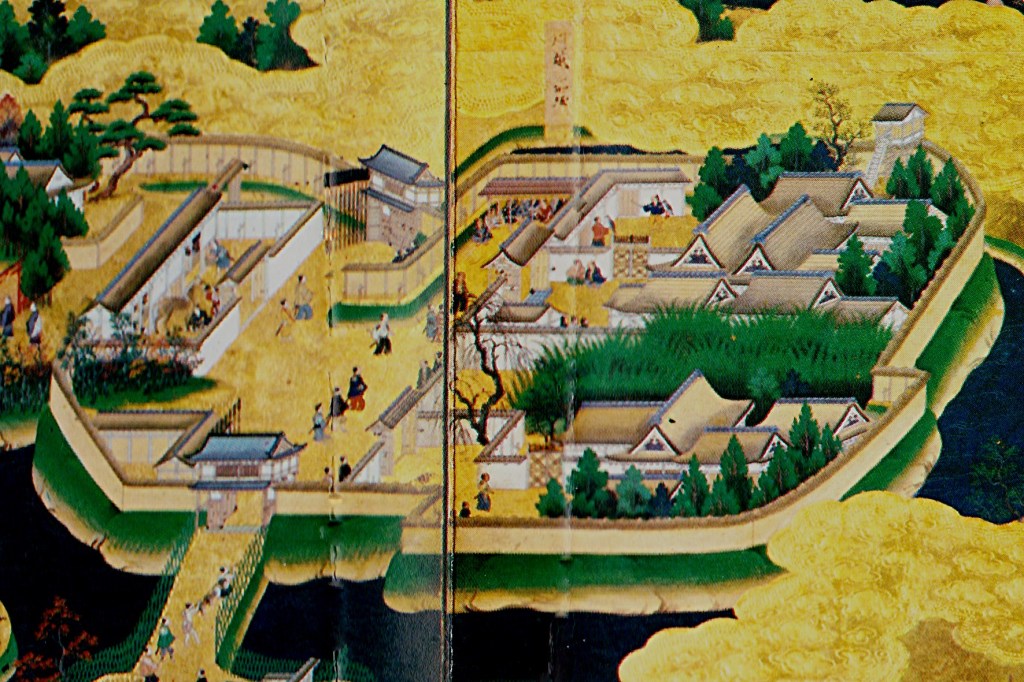
    A later depiction of Kawagoe Castle.

    Unsurprisingly, harbouring their enemies didn’t do much for the relationship between Kenshin and the Hojo, and Kenshin would send an army to oppose the Hojo’s invasion of Kozuke Province (modern Gunma Prefecture), capturing Numata Castle, and forcing the Hojo to retreat.

    A year later, Kenshin would face a new enemy, as Takeda Shingen’s long-running invasion of Shinano eventually obliged some of the clans there to flee and seek refuge with Kenshin in Echigo. Much like the Hojo, the Takeda didn’t take kindly to someone giving refuge to their enemies, and one of Japanese history’s most famous rivalries was born.

    In August 1553, an army led by Kenshin himself advanced against the Takeda in Shinan, defeating Shingen himself at the Battle of Fuse on August 30th, then again at Yuwata on September 1st. After this, Shingen adopted a strategy of avoiding direct battle with Kenshin, and the conflict settled into a stalemate that was later called the First Battle of Kawanakajima.

    A modern view of Kawanakajima.
    日本語版ウィキペディアのBlogliderさん – 原版の投稿者自身による著作物 (Original text: Photo by Bloglider.), CC 表示-継承 3.0, https://commons.wikimedia.org/w/index.php?curid=12400636による

    In 1554-55, Kenshin was obliged to face a rebellion launched by treacherous vassals in league with Shingen. Putting down the rebellion quickly, Kenshin again marched into Shinano in April 1555 to face the advancing Takeda forces, again led by Shingen.

    At the Second Battle of Kawanakajima, the two sides faced each other in another stalemate, which dragged on for five months, before mediation from the Imagawa Clan led to both sides withdrawing after little actual fighting.

    In the following year, Kenshin apparently announced he would retire and become a monk, however, another outbreak of Takeda-backed rebellion forced him to change his plans, and after a period of peace, in 1557, Shingen again advanced against Kenshin’s allies in Shinano, forcing him to intervene and leading to the Third Battle of Kawanakajima, which, much like the previous two, swiftly settled into stalemate.

    A year later, Kenshin dispatched an army in an ultimately unsuccessful invasion of Kozuke Province and then in 1559 he was ‘invited’ for a meeting with the Shogun, Ashikaga Yoshiteru. Some sources say that Kenshin was granted the title of Kanto Kanrei at this time, the position traditionally held by the Uesugi Clan. He also apparently donated funds towards the maintenance and repair of the Imperial Palace.

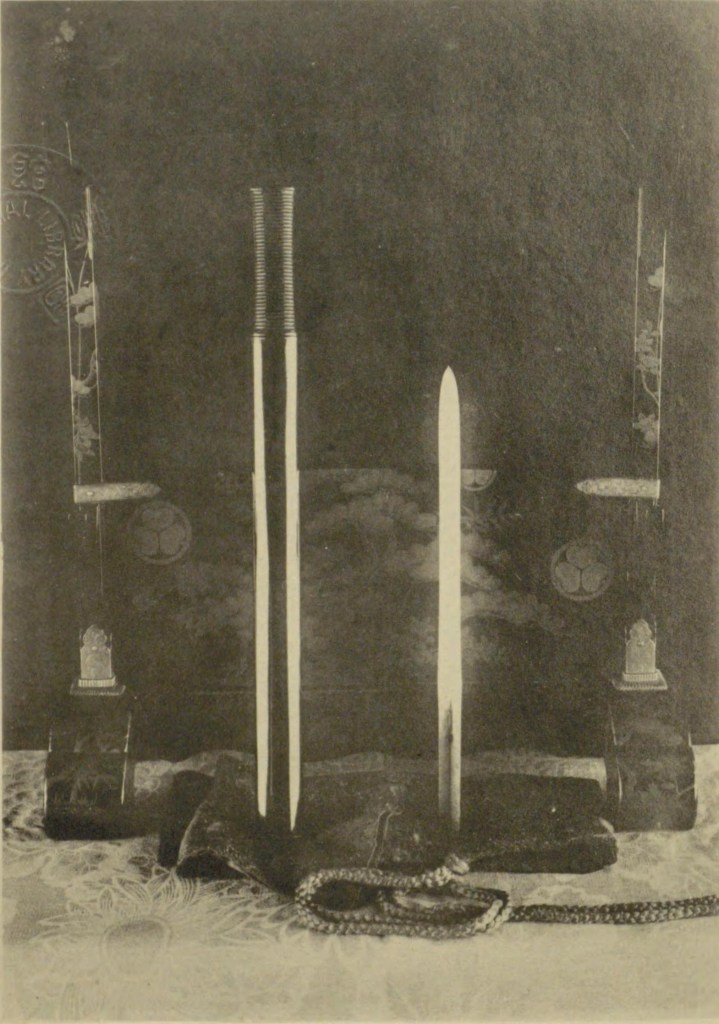
    Swords supposedly gifted to Kenshin by the Emperor, photographed in 1928.

    It seems that Kenshin enjoyed good relations with the Shogunate, but the already well-established decline of the Shogun’s power is highlighted again when he asked Kenshin, Shingen, and the Hojo to make peace in order to combine their forces against the Shogun’s enemies. All three parties refused.

    In March 1560, the Imagawa Clan’s devastating defeat at Okehazama opened the way for Kenshin to intervene directly in the Kanto again, as the Imagawa had been allied to his enemies, the Hojo, and their defeat left the Hojo vulnerable. Later that year, Kenshin launched another large-scale invasion of Kozuke Province, driving the Hojo back and capturing several important castles before celebrating New Year at Maebashi Castle, the gateway to the Kanto Plain.

    In March 1561, Kenshin was formally adopted by the Yamanouchi-Uesugi Clan (the only remaining branch) and changed his surname to match. Though he would be known as Uesugi Kagetora from this point, we will continue to call him Kenshin to keep things simple.

    In August of that year, Kenshin led another large army into Shinano, and engaged the Takeda at the Fourth Battle of Kawanakajima. Unlike the previous three, this battle was not an extended stalemate, but a bloody one. Both sides suffered heavy casualties, with sources ranging from around 20% losses, to as high as 60 or 70%, and when the battle was over, the Takeda held the field, but made no attempt to intervene as the Uesugi withdrew, leading some to suggest the battle was a bloody draw.

    A legendary depiction of the Fourth Battle of Kawanakajima, depicting the (possibly apocryphal) moment that Uesugi Kenshin and Takeda Shingen met on the field.

    The Takeda and Hojo clans, recognising the Uesugi as their common enemy, renewed their combined efforts and launched a joint counter-attack in Musashi Province in late 1561. At first, Uesugi forces were successful against the alliance, even getting as far as besieging Odawara Castle, the Hojo’s main stronghold, before being forced to withdraw after allied counter-attacks in other parts of the Kanto.

    The strategic situation in the Kanto would ebb and flow over the following years, as Uesugi, Takeda, and Hojo armies advanced and retreated, and the local lords would switch sides depending on whoever appeared to be in the ascendancy.

    All three factions would be occupied with fighting each other, but also engaged in other battles and proxy wars with allies and supporters of each other’s enemies. For Kenshin, this meant being obliged to dispatch forces into neighbouring Etchu Province in 1568, to deal with Ikko Ikki forces nominally allied with Shingen.

    Etchu Province.

    Seeking to take advantage of this distraction, Takeda forces attacked in Shinano and were ultimately defeated, but a rebellion in Echigo (Kenshin’s home province) meant he was unable to take advantage of this victory in the short term.

    Later that year, the strategic situation would shift in Kenshin’s favour, however, as the long-term decline in Takeda-Imagawa relations finally led to open conflict between two of his main rivals. The Imagawa would request aid from both the Uesugi and the Hojo, and while Kenshin would refuse, the Hojo dispatched forces to oppose the Takeda, bringing an end to the alliance that had done so much to oppose Kenshin.

    However, years of expensive (and bloody) campaigns in the Kanto had left the Uesugi exhausted, and in 1569, Kenshin reluctantly agreed to a peace deal with the Hojo, which saw the Uesugi withdraw from Musashi Province (modern day Tokyo and Saitama) and the Hojo withdrew from Kozuke.

    With his borders with the Hojo (relatively) secure, Kenshin was able to focus on campaigning against the Takeda again. In 1570 and 1571, he would engage the Takeda and their allies in Etchu and Shinano Provinces, generally having the better of the fighting, but the situation would shift again in 1572 when the lord of the Hojo, Ujiyasu, passed away, and was replaced by Ujimasa, who made peace with the Takeda, turning on the Uesugi. At the same time, the Etchu Ikko Ikki launched a fresh attack, instigated by Takeda Shingen.

    Hojo Ujimasa, who reversed his father’s diplomatic policy.

    The Ikko Ikki would initially be successful against Kenshin, but by mid-1573, the momentum had shifted back in his favour, and several key fortresses within Etchu were taken. Also in that year, Kenshin’s long-time rival, Takeda Shingen, passed away, an event that apparently caused Kenshin to weep openly, but also significantly weakened the Takeda.

    Over the following two years, Kenshin was forced to split his focus between his ongoing campaign in Etchu and the situation in the Kanto. By the end of 1574, the Hojo had effectively ended any Uesugi presence in the region, and although Kenshin would launch counterattacks, the writing was on the wall for Uesugi power in the Kanto.

    In 1576, Kenshin would receive a request for aid from the Shogun, seeking support against Oda Nobunaga, who now dominated central Japan and had forced the Shogun into exile. In order to get to Kyoto, Kenshin was obliged to focus all his resources on securing Etchu and Noto Provinces. This campaign would drag on throughout 1576 and 1577, delayed by intervention from the Hojo and internal rebellion, but by November 1577, Kenshin had secured control of the provinces and was poised to strike at Kyoto itself.

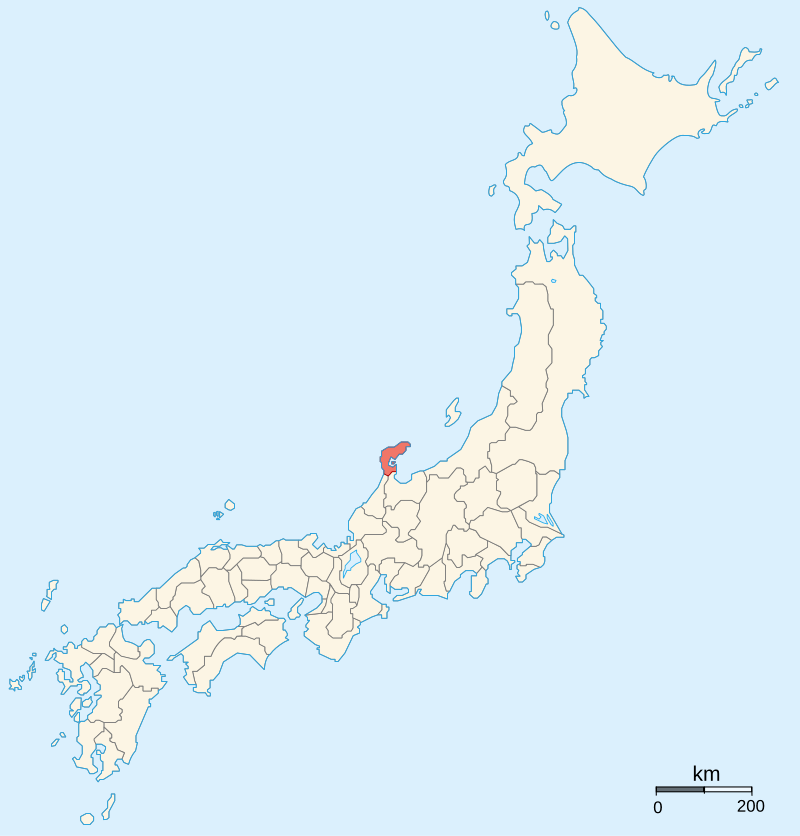
    Noto Province.
    By Ash_Crow – Own work, based on Image:Provinces of Japan.svg, CC BY 2.5, https://commons.wikimedia.org/w/index.php?curid=1690738

    Mustering a large army, Kenshin would march out to meet a force led by Nobunaga’s generals, Shibata Katsuie and Hashiba Hideyoshi (better remembered to history as Toyotomi Hideyoshi), who were not fond of each other. A dispute led to Hideyoshi withdrawing his forces early, and when the two sides clashed at the Battle of the Tedori River on November 3rd, Kenshin would emerge victorious.

    The exact course of the battle, and even the size of the forces involved, is not clear from contemporary sources, but Kenshin would withdraw temporarily, issuing instructions for a renewed campaign to begin in the spring. The battle at the Tedori River had opened a strategic opportunity for Kenshin, and it has been speculated that he might have been able to complete his march on Kyoto.

    Much like his rival, Shingen, however, Kenshin would never make the march. In early March, Kenshin would collapse (allegedly whilst in the toilet) and fall into a coma from which he would never wake up; he died on March 13th, aged 49.

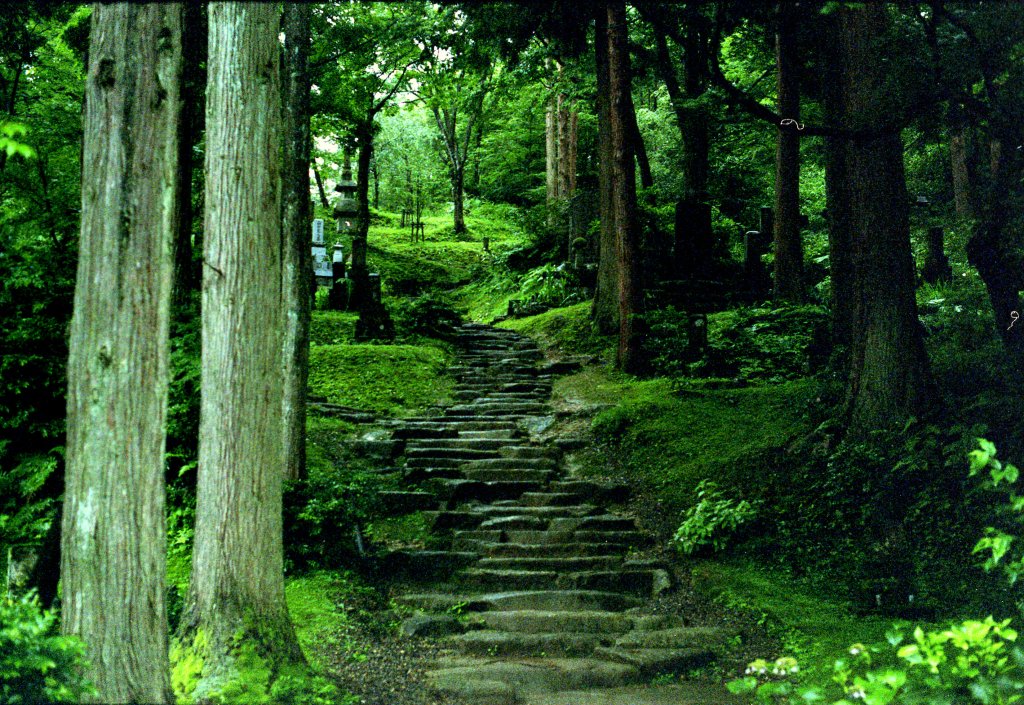
    The site of Kenshin’s grave at Risenji, where he studied as a boy.
    By shikabane taro, CC BY 3.0, https://commons.wikimedia.org/w/index.php?curid=54071606

    Much like the Takeda after the death of Shingen, the Uesugi would be seriously weakened by Kenshin’s death. Though they had been a threat to Nobunaga, Kenshin’s death, and the ongoing effects of years of more or less constant conflict, rendered them powerless to stop the rise of Nobunaga, and after his death in 1582, the Uesugi would make their peace with his successors.

    Decisions made at the end of the Sengoku Jidai would see the clan’s star fall even further, though that is a story for another time.

    Sources
    https://ja.wikipedia.org/wiki/%E4%B8%8A%E6%9D%89%E8%AC%99%E4%BF%A1
    https://ja.wikipedia.org/wiki/%E6%89%8B%E5%8F%96%E5%B7%9D%E3%81%AE%E6%88%A6%E3%81%84
    https://en.wikipedia.org/wiki/Battle_of_Tedorigawa
    https://ja.wikipedia.org/wiki/%E5%B7%9D%E4%B8%AD%E5%B3%B6
    https://ja.wikipedia.org/wiki/%E5%89%8D%E6%A9%8B%E5%9F%8E
    https://ja.wikipedia.org/wiki/%E6%B2%BC%E7%94%B0%E5%9F%8E
    https://en.wikipedia.org/wiki/Battles_of_Kawanakajima

  • Takeda-mned if you don’t…

    Takeda-mned if you don’t…

    (I had to make this a two-parter or the joke in the title wouldn’t have worked.)

    Note: Takeda Shingen’s real name was Harunobu, with Shingen being a name he took as part of his religious vocation. In keeping with my policy of using the names that figures are best known by, we’ll be referring to him as Shingen throughout this post, but in other sources, he is often called Harunobu, just so you know.

    Takeda Shingen, who has kind of become an unofficial mascot of this site.

    In June 1541, Takeda Shingen (then known as Harunobu) overthrew his father, Nobutora, and established himself as the leader of the Takeda Clan and master of Kai Province. As we mentioned last time, the exact reasons for this coup aren’t known; some sources say he was overthrowing his tyrannical father, others that it was a self-serving power grab, but whatever his motivation, Harunobu was in charge, and he had big plans.

    The strategic and diplomatic situation that Shingen inherited was full of risks and opportunities. His father had successfully subjugated all of Kai Province and even expanded the borders of Takeda control into neighbouring Shinano. He had been a fierce rival of the Hojo Clan, based in Izu and Sagami Provinces (modern day Kanagawa Prefecture), but had established peaceful relations or alliances with other powerful neighbours.

    Almost immediately, Shingen would chart a radically different course. His father had been allied with the Suwa Clan of Shinano, to the Takeda’s north, but in June 1542, Shingen invaded Shinano Province, defeating the Suwa at the Battle of Kuwabara Castle, and forcing their leader to commit suicide, absorbing their lands into his own.

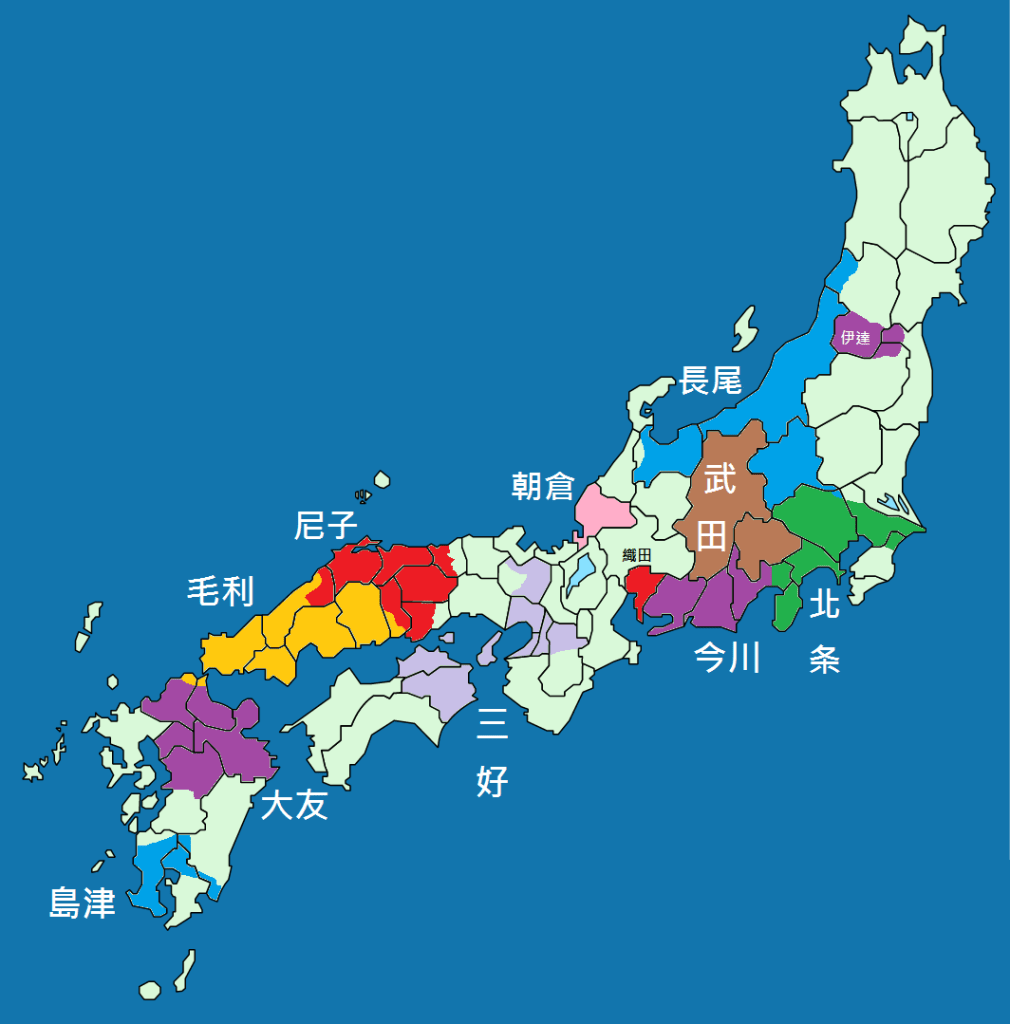
    Takeda territory is in blue, and the clans that Shingen quickly made enemies of are shown approximately in red.

    Though the result of this campaign is relatively undisputed, the exact nature of how things got started is more controversial. Allegedly, in March 1542, before Shingen’s invasion of Shinano, the Suwa Clan and their allies attacked first, before being defeated at the Battle of Sezawa. The problems come from there being little evidence that this battle ever took place, with some historians suggesting that it might have been a later invention to justify Shingen’s invasion after the fact.

    Regardless of its origins, the campaign would be a long and ultimately successful one for Shingen. A series of battles through the late 1540s put the Takeda in a pre-eminent position in Shinano. By 1553, the clan occupied almost the entire province; only the far north, around the modern city of Nagano, remained outside their control.

    This would prove significant later, but during this period, Shingen would also prove himself to be a savvy political player as well. In 1544, Shingen made peace with the Hojo and then mediated between them and the Imagawa, bringing an end to their conflict, allowing both clans to focus on issues elsewhere, and securing peace on Kai’s southern borders.

    Hojo Ujiyasu, with whom Shingen made peace.

    Turning his attention back to Shinano, Shingen would launch semi-annual campaigns into Shinano, winning a series of victories against the clans based in the province, and slowly extending Takeda dominance. He didn’t have it all his own way, however; in March 1548, the Takeda marched against the Murakami Clan, one of their chief rivals for control of Shinano. The Battle of Uedahara was arguably a draw, as both sides suffered similar losses; however, the Takeda advance was stopped, and they lost several key commanders, with Shingen himself being wounded.

    In July of that year, another of Shingen’s enemies in Shinano, the Ogasawara Clan, sought to take advantage and push the Takeda back into Kai; however, at the Battle of Shiojiri Pass, the Ogasawara were decisively defeated by a resurgent Shingen, and the momentum would swing back in favour of the Takeda.

    In 1550, Shingen took control of what is today called the Matsumoto Basin (around the modern city of the same name), but a second serious defeat would follow in September of that year, as the Takeda tried and failed to take Toishi Castle. Sources differ, with some saying the Takeda lost a fifth of their forces, and others saying it was as many as two-thirds.

    Although losses were clearly heavy, as with Uedahara a few years earlier, Shingen wasn’t on the back foot for long. In April 1551, Toishi Castle was taken (supposedly through trickery), and over the next two years, he would drive the Murakami Clan out of Shinano, until they were forced to flee Shinano entirely.

    This left Shingen in control of almost all of Shinano, but it also presented a new problem. In fleeing Shinano, the Murakami Clan sought the support of another powerful player in the region, the lord of Echigo Province and lord of a clan that was every bit as powerful as the Takeda, Uesugi Kenshin. Though neither side knew it yet, the stage was now set for one of the great rivalries of the Sengoku Period.

    A later depiction of Uesugi Kenshin, Shingen’s legendary rival.

    Shingen and Kenshin would clash repeatedly in the years to come, mostly at and around the now-famous battlefield of Kawanakajima (which literally means “The Island in the River”). The first clash of these rivals would come in April 1553, and would be indecisive, but the frontier in northern Shinano would remain volatile.

    In 1554, Shingen strengthened his diplomatic position by marrying his son to a daughter of the Imagawa Clan, followed shortly afterwards by a marriage of his son to a daughter of the Hojo Clan, who were also conveniently an enemy of the Uesugi. Following the establishment of the so-called Koso Alliance, Shingen secured control of southern Shinano and advanced into neighbouring Mino Province, securing the submission of several border clans in the process.

    The second and third Battles of Kawanakajima would be fought in 1555 and 1557, respectively, and both would end in further stalemate, but following the third battle, the Shogun (very much a figurehead at this point) issued a command that both sides make peace. Kenshin accepted immediately, but Shingen responded that he would only make peace if the Shogun named him shugo (governor) of Shinano, which was duly granted.

    In 1559, the Eiroku Famine and a serious flood in Kai Province led to the cessation of hostilities (at least temporarily) and that year, Shingen became a monk, formally adopting the name Shingen. Exactly why he chose to become a monk isn’t recorded, but it is speculated that it was in response to the twin disasters of famine and flood, with Shingen perhaps seeking divine intervention.

    Whether or not the gods were listening isn’t known, but after 1560, Shingen and the Takeda clan would begin to move away from older alliances and local authority and towards a policy of seeking power on the national stage. In May 1560, the Imagawa, allies of the Takeda, were severely defeated by the rising star that was Oda Nobunaga, and although Shingen publicly declared his intention to continue the alliance, he made secret arrangements with Nobunaga, with his son, Katsuyori, marrying Nobunaga’s adopted daughter.

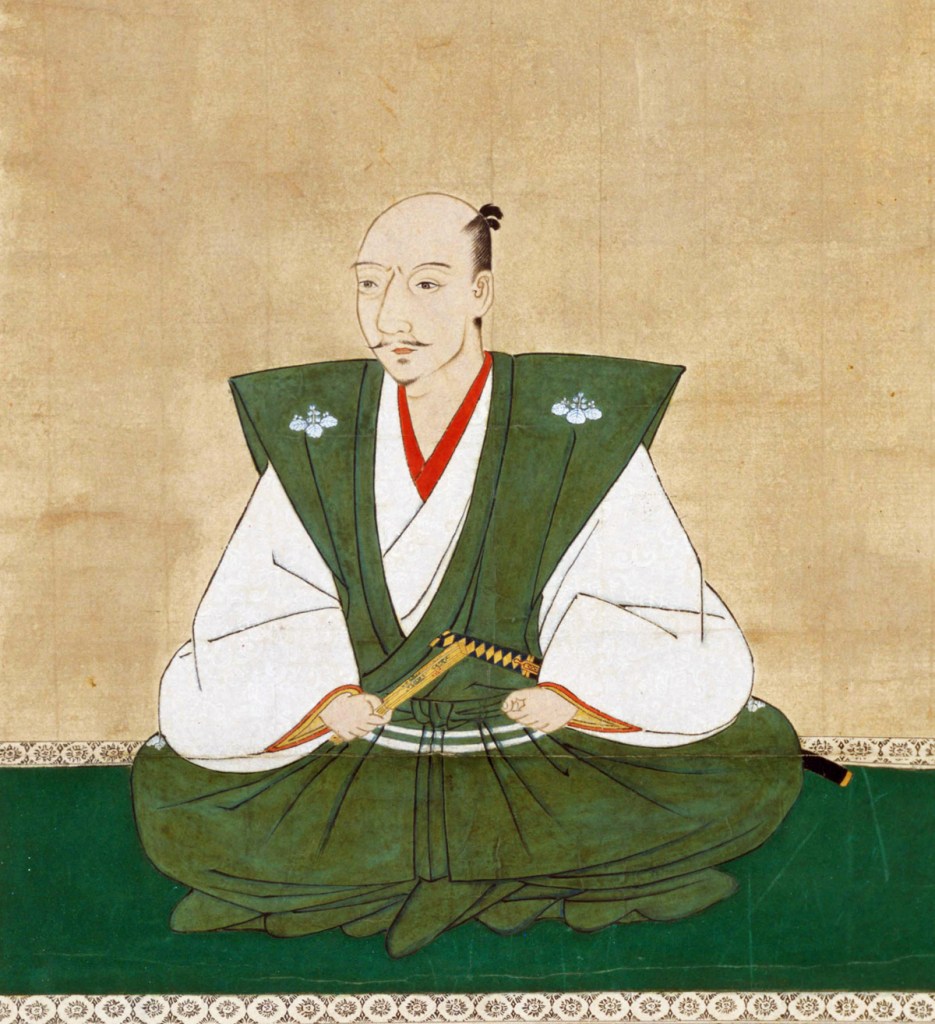
    Oda Nobunaga. He would go on to be one of the most significant figures in Japanese history, but in the 1560s he was just getting started.

    The relationship continued to break down until 1567, when the Imagawa ended the trade of salt (abundant in their coastal provinces) to Kai, effectively cutting the Takeda off from this vital resource. The next year, in cooperation with a former Imagawa vassal, Tokugawa Ieyasu (then known as Matsudaira Motoyasu), Shingen invaded Imagawa territory, taking Suruga Province, whilst Ieyasu invaded Totomi, to the west.

    The invasion was a military success, but had serious diplomatic repercussions more or less immediately. The relationship with the Imagawa was obviously already pretty bad, but when Shingen tried to enlist the help of the Hojo in attacking Suruga, he was rebuffed, and the Hojo would instead send troops to support their Imagawa allies.

    The relationship with Ieyasu, always a marriage of convenience, broke down swiftly as well. The erstwhile allies got into a dispute about actual control of Totomi Province, and Ieyasu took his proverbial ball and went home, making peace with the Imagawa, and ignoring his previous agreement with Shingen.

    Tokugawa Ieyasu. Much like Nobunaga, he came up in the shadow of men like Shingen, but the future was very bright indeed for him and his clan.

    Shingen, now surrounded by potential enemies, sought out allies amongst the pre-existing enemies of the Hojo, and launched a counter-attack in 1569, getting as far as the Hojo capital at Odawara, which he briefly laid siege to before withdrawing, contenting himself with burning the town around the fortress.

    Retreating to Kai, Shingen defeated a pursuing Hojo force at the Battle of Mimasu Pass, effectively ending the Hojo threat to Kai and preventing them from intervening further in the invasion of Suruga. By the end of 1569, Shingen was in complete control of the province.

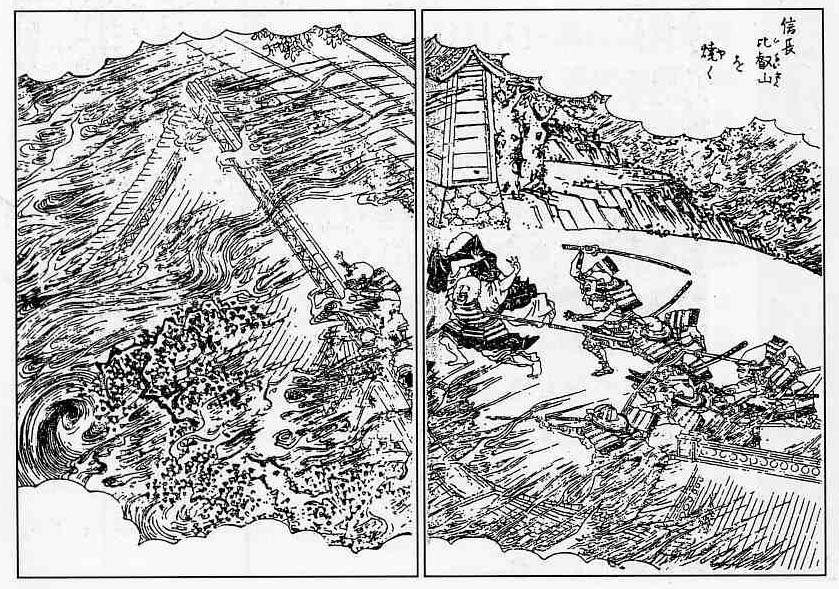
    Shingen would consolidate his position, but in 1571, Oda Nobunaga, with whom Shingen had enjoyed good relations previously, attacked and burned Mt Hiei, one of the holiest sites in Japanese Buddhism, sparking religious outrage across the realm.

    Shingen, who was a monk, remember, was personally outraged, and allowed surviving monks from Mt Hiei to take refuge in Kai. In 1572, the Shogun, Ashikaga Yoshiaki, sent a letter, reaching out to Shingen and calling on him to march on Kyoto and destroy Nobunaga.

    By this point, the Shogun’s options were severely limited (Yoshiaki would prove to be the last Ashikaga Shogun), but it was probably a smart move. By the early 1570s, Nobunaga had risen to become one of the most powerful warlords in Japan, and there simply weren’t that many contemporaries who could match him for strength and strategic acumen.

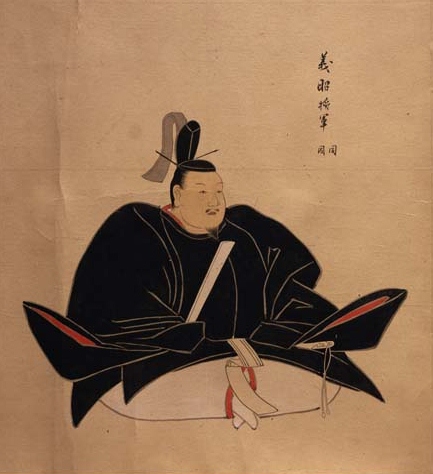
    Ashikaga Yoshiaki, the last Ashikaga Shogun. Even by the standards of his troubled dynasty, Yoshiaki was a powerless leader.

    Shingen had the strength, he had the experience, and after Mt Hiei, he had plenty of reason to answer the Shogun’s request. Gathering somewhere in the region of 27,000 men, a gigantic army for the time, the Takeda Steamroller began its move west in October 1572, first striking at Tokugawa Ieyasu’s territory in Mikawa Province, taking several fortresses in a matter of days, and forcing Ieyasu to call for help from Nobunaga.

    Nobunaga, however, was busy elsewhere, and could only spare 3000 troops to help, not nearly enough, and whenever Tokugawa forces made a stand, they were defeated. Initially, Ieyasu sought to defend the castle at Hamamatsu, a strong position, but weak strategically, as Shingen was able to bypass it on his march to Kyoto.

    Forced to either give battle or see himself rendered effectively impotent, Ieyasu marched out and met Shingen at Mikatagahara in January 1573. The result was a catastrophic defeat for Ieyasu, who saw his army scattered in all directions, with thousands left for dead on the battlefield. It was only due to the heroic resistance of several of his retainers that Ieyasu himself was able to survive the battle.

    A 19th century depiction of the Battle of Mikatagahara.

    Flush with victory, the Takeda forces would continue their advance, defeating what remained of the Tokugawa Clan and securing many castles throughout Mikawa Province. At that point, it may well have seemed that Shingen was well placed to launch a final thrust at the capital, and it isn’t unreasonable to speculate that, had such an attack occurred, he may have been successful, and we might today be talking about a ‘Takeda Shogunate’.

    Alas, it wasn’t to be. Despite his military and political acumen, Shingen was still just a man. His health had been getting steadily worse for years. As early as 1571, he was forced to abandon military action due to symptoms as severe as coughing up blood, and after Mikatagahara, his condition took a turn for the worse.

    In early spring 1573, Shingen made the decision (or had it made for him) to return to Kai Province to recover his health. Somewhere along the road home, however, he died. Exactly when and where he passed isn’t clear, but most historians agree it was sometime in April. According to Shingen’s will, his death was kept a secret, and although this would later lead to speculation around the circumstances of his death (perhaps best seen in the film Kagemusha), Shingen’s remains were most likely returned to his capital in modern Kofu, Yamanashi Prefecture.

    A later artistic rendition of Shingen’s final moments.

    Shingen’s sudden death raises some of the most interesting ‘what if?’ questions of this period. He was arguably one of the few men who could match Oda Nobunaga for strength and cunning, and it is possible that, if he had lived, he might have defeated Nobunaga and perhaps led the unification of Japan himself.

    This is ultimately not how things played out, but Shingen’s role in Japanese history didn’t end with his death. Although he had a well-earned reputation as a warrior, he was also a wise administrator and reformer, and many of the policies he introduced in his territories were adopted by those who came after him, with some even going on to influence Japanese law after the Sengoku Jidai, but we’ll talk about that another time.

    Sources
    https://ja.wikipedia.org/wiki/%E6%AD%A6%E7%94%B0%E4%BF%A1%E7%8E%84
    https://ja.wikipedia.org/wiki/%E4%B8%89%E6%96%B9%E3%83%B6%E5%8E%9F%E3%81%AE%E6%88%A6%E3%81%84
    https://ja.wikipedia.org/wiki/%E6%9D%BE%E6%9C%AC%E7%9B%86%E5%9C%B0
    https://ja.wikipedia.org/wiki/%E7%A0%A5%E7%9F%B3%E5%B4%A9%E3%82%8C
    https://ja.wikipedia.org/wiki/%E5%A1%A9%E5%B0%BB%E5%B3%A0%E3%81%AE%E6%88%A6%E3%81%84
    https://ja.wikipedia.org/wiki/%E4%B8%8A%E7%94%B0%E5%8E%9F%E3%81%AE%E6%88%A6%E3%81%84
    https://ja.wikipedia.org/wiki/%E7%94%B2%E7%9B%B8%E9%A7%BF%E4%B8%89%E5%9B%BD%E5%90%8C%E7%9B%9F
    https://ja.wikipedia.org/wiki/%E5%AE%AE%E5%B7%9D%E3%81%AE%E6%88%A6%E3%81%84
    https://ja.wikipedia.org/wiki/%E6%B2%B3%E6%9D%B1%E3%81%AE%E4%B9%B1
    https://ja.wikipedia.org/wiki/%E9%AB%98%E9%81%A0%E5%90%88%E6%88%A6
    https://ja.wikipedia.org/wiki/%E7%94%B2%E5%B7%9E%E6%B3%95%E5%BA%A6%E6%AC%A1%E7%AC%AC
    https://ja.wikipedia.org/wiki/%E6%A1%91%E5%8E%9F%E5%9F%8E%E3%81%AE%E6%88%A6%E3%81%84
    https://ja.wikipedia.org/wiki/%E7%80%AC%E6%B2%A2%E3%81%AE%E6%88%A6%E3%81%84
    https://en.wikipedia.org/wiki/Ashikaga_Yoshiaki
    https://en.wikipedia.org/wiki/Battle_of_Mikatagahara


  • The Power in the Provinces Part Two

    The Power in the Provinces Part Two

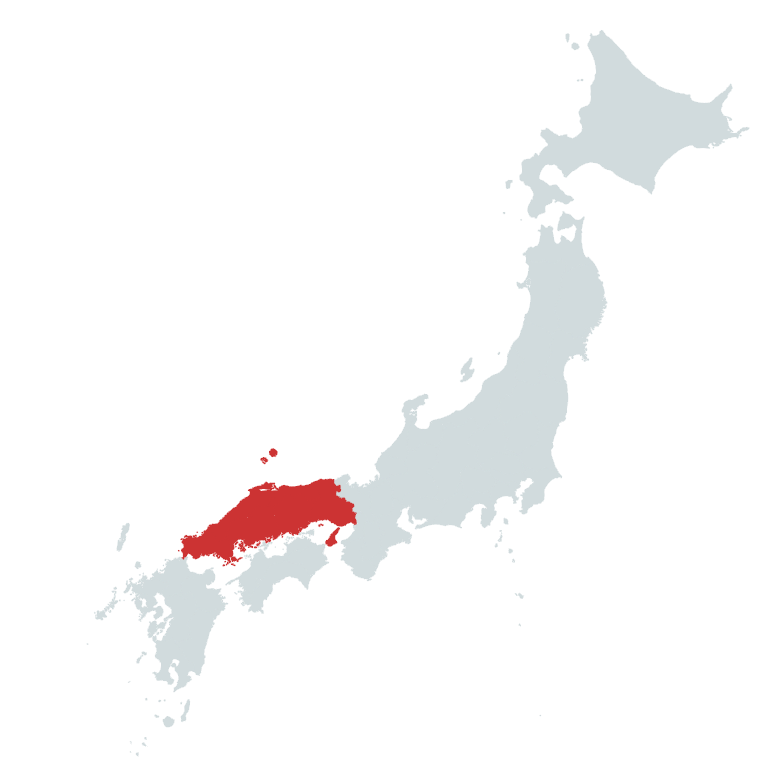
    Western Japan

    Western Japan was, much like the Kanto, away from the centre of power, but still close enough to be a perpetual source of trouble.

    The Ouchi

    The mon of the Ouchi Clan
    By Mukai – No machine-readable source provided. Own work assumed (based on copyright claims)., CC BY-SA 3.0, https://commons.wikimedia.org/w/index.php?curid=7845833

    At the end of the 15th Century, the Ouchi Clan were one of the strongest in Japan. Based at Yamaguchi, in the furthest west of ‘The West’, they were in an enviable position. Their centre of power was far enough away from Kyoto that they were often spared the worst of the destruction, and the city of Yamaguchi, positioned as it was, near the coast, was a prime location for getting involved in the trade with China and Korea.

    These close links to mainland Asia go back into the mists of time. Unlike many other clans, the Ouchi did not claim descent from one of the ‘Imperial’ Clans (Fujiwara, Minamoto, or Taira). Instead, they claimed as their ancestor a Korean prince, Prince Imseong, although the long years involved make a definitive link impossible to prove.

    During the Nanbokucho Period, the Ouchi proved to be staunch supporters of the Northern Court and the Ashikaga Shoguns, earning them rich rewards, and by the time of the Onin War, they had extended their control into Northern Kyushu, officially on behalf of the Shogun, but effectively ruling their little empire independently.

    During the Onin War, the Ouchi sided with the Yamana Clan and the Western Army. In fact, after the decline of the Yamana during the war, it was the Ouchi who stepped forward and played the leading role in securing Western military victories in the West. When the war ended, the Ouchi regained control of their former territories in northern Kyushu, and would continue to be one of the leading powers at the dawn of the 16th Century.

    Their links to international trade continued during this period as well, in fact, during the mid-16th Century, they would prove to be one of the key clans in what became called “Nanban trade”, literally the “Southern Barbarian Trade”, the ‘Barbarians’ in this case, being the Portuguese, who arrived in Japan in the 1540s.

    Despite their wealth and power, the Ouchi would eventually become overstretched. Facing powerful clans in Kyushu and nearer to home, they would initially see success, crushing the Shoni Clan of Kyushu in 1536, and facing the Amago Clan of Izumo Province in 1541. An initial victory over the Amago was followed by a serious defeat in which the Ouchi clan’s heir was killed.

    Ouchi Yoshitaka, who oversaw the decline of his clan.

    After this, the head of clan, Yoshitaka, began neglecting affairs of government, and the Ouchi would enter a period of steep decline. In 1551, Yoshitaka was killed in a rebellion, and over the next five years, the Ouchi’s once expansive domains were chipped away, as rivals took advantage of the chaos, and even formerly loyal vassals (most notably the Mori Clan) went their own way, often violently.

    The Ouchi would enter terminal decline from this point. There was a brief attempt at a restoration in 1569, but it was crushed by the Mori, and the original Ouchi Clan ceased to exist. A supposed branch of the family, the Yamaguchi Clan, would survive as rulers of the Ushiku Domain, in modern Ibaraki Prefecture, but they appear to have died out in the male line in 1991.

    The Mori

    The mon of the Mori Clan.
    Kashiwamon – 投稿者自身による著作物, CC 表示-継承 4.0, https://commons.wikimedia.org/w/index.php?curid=91163213による

    Like the Hojo in the Kanto Region, the Mori were arguably the most successful clan based in Western Japan. Despite this, the origins of the clan are actually in Sagami Province, close to the modern city of Atsugi in Kanagawa Prefecture. From there, the clan would branch off (as they always seem to) into several different ‘Mori’ Clans, but the one we are focusing on here is the ‘Aki Mori’ Clan, which came to be based in Aki Province in what is today Hiroshima Prefecture.

    During the period of the Kamakura Shogunate, the Mori clan remained largely aloof, and when the Emperor Go-Daigo overthrew the Kamakura, the Mori did not get involved. This actually worked against them as Go-Daigo adopted a “With me or against me” approach, and the Mori temporarily saw their territories forfeit.

    This backfired pretty spectacularly when, just three years into the “Kenmu Restoration”, Emperor Go-Daigo himself was overthrown by the Ashikaga Family, leading to the establishment of the eponymous Shogunate, and the Mori (who had helped the Ashikaga) being restored to their lands.

    Much like every other major Samurai family, the Mori broke up into several branch families that would often end up fighting each other. Their situation in the mid-15th Century was further weakened by the presence of the powerful Ouchi and Amago Clans in the region.

    Through the late 15th Century, the Mori would find themselves caught between these two powers, but in the 16th Century, several savvy political marriages and a few adoptions improved their position considerably, and they would eventually rise to eclipse their former masters, the Ouchi, entirely.

    Mori Motonari, the man who would lead his clan to the height of their power.

    Throughout the Sengoku Period, the Mori would become the power in the West in the same way the Hojo were the power in the East. When Oda Nobunaga (him again!) drove the last Ashikaga Shogun out of Kyoto in 1576, he sought protection from the Mori, who would remain Nobunaga’s chief rivals in the West until his death (spoilers) in 1582.

    The Mori would make peace with Nobunaga’s successor, Toyotomi Hideyoshi and remain a major power, eventually establishing their base at Hiroshima. However, the final battles of the Sengoku period would see the Mori choose the losing side, and they were eventually reduced to just two provinces, which became known as the Choshu Domain.

    There they would remain, implacably opposed to the new government, but far enough away from the capital to be too much trouble to get rid of. During the Meiji Restoration in the 19th Century, it was Choshu, and the Mori clan, who would play a leading role in the modernisation of Japan, but that’s a story for another time.

    The Mori family continued through this period and into the modern era, with the current head being Mori Motohide, who works for Hitachi Steel Works, and became the family head in 2020.

    The Amago

    The mon of the Amago Clan

    The Amago were a branch of another clan, the Kyogoku, who were themselves descended from the Sasaki Clan, whose progenitor was a son of the Emperor Uda, who ruled in the late 9th century.

    Emperor Uda, who ruled from 887-897. The Amago claimed him as their illustrious ancestor.

    The Amago Clan themselves were a relative latecomer; their direct ancestor (the ‘first’ Lord Amago) was Takahisa, who took the name Amago for the area (near Kyoto) where he had his manor. In the early 15th Century, he was appointed as the deputy governor (shugo-dai) of Izumo Province (in modern Shimane Prefecture) on behalf of the Kyogoku Clan, who were obliged to reside in Kyoto.

    We’ve discussed in previous posts how the Shogun’s policy of demanding that Shugo reside in Kyoto led to the rise of independently minded deputies; well, the Amago are one of them. Although officially only deputies, the Amago would take advantage of the chaos of the Onin War to consolidate their power, and by the time the war ended, they were in effective control.

    When the Kyogoku line became extinct in 1514, with the death of the last lord, the Amago graduated from de facto to actual lords of Izumo, and it would be there that they based their power. The rise of the Amago was initially opposed by the Ouchi, and throughout the early 16th Century, they would engage in something of a hostile coexistence, neither side quite able to overcome the other, with the Ouchi focusing on the west, whilst the Amago had their eyes to the east.

    The Amago would eventually rise to be the masters of eight provinces in the region, but in the 1540s, the rise of the Mori clan would lead to the decline of the Ouchi and directly threaten the Amago. The conflict between these clans would drag on for nearly 40 years, but the Mori would eventually prevail, with the surviving members of the Amago family serving as retainers for the Mori throughout the Edo Period.

    The family itself would survive until 1940, when the last head of the clan passed away without an heir.

    The Akamatsu

    The mon of the Akamatsu Clan
    By お茶飲む人 – Own work, CC BY-SA 4.0, https://commons.wikimedia.org/w/index.php?curid=53365103

    Unlike many of the other clans we’ve been looking at, the Akamatsu Clan were a family that peaked early, and then never really recovered. The exact origins of the clan are disputed, with some sources suggesting they descended from the Minamoto Clan, whilst others refute this, leading to some confusion.

    What is not disputed is that the Akamatsu Clan originally supported the Emperor Go-Daigo during the short-lived Kenmu Restoration, earning Harima Province for their trouble, only for the province to be forfeited shortly afterwards during Go-Daigo’s controversial “Alienate everyone as quickly as possible” policy, which saw him overthrown by the Ashikaga Shogunate after just three years.

    The Akamatsu, thoroughly alienated as they were, sided with the Ashikaga and had Harima Province restored to them after their victory, and the clan would be steadfast loyalists of the new Shogunate, at least for a while. The Akamatsu remained faithful, but in 1429, a serious peasant revolt in their home province badly weakened them, and not long after that, the Shogun, Yoshinori, came to the throne and proved to be an effective, but extremely paranoid ruler.

    The exact reasons for the so-called Kakitsu Rebellion are unclear, but members of the Akamatsu Clan assassinated the Shogun in 1441, after which they raised an army only to be crushed by the Shogunate army shortly afterwards.

    Branches of the family would survive, and after conspicuous service during the Onin War, the Akamatsu were actually restored to control of Harima Province. For a while, things were looking up. By 1488, the head of the clan, Masanori, had established control of three provinces, and there was every indication that the Akamatsu would enter the 15th century as one of the major players.

    You’ve probably already guessed that that isn’t what happened, though, and you’d be right, good on you for paying attention. Masanori died suddenly in 1496, and his heir was just four years old, meaning that the clan fell into the hands of so-called ‘Elders’ who were supposed to rule until the little lord came of age.

    Akamatsu Masanori, who might have held things together for his clan, if he’d lived.

    This might have worked in more peaceful times, but in the early days of the Sengoku Jidai, it led to chaos. Before long, different factions of the clan were fighting each other, and the Akamatsu entered a period of steady decline. Even after the lord, Yoshimura, came of age, he couldn’t change the situation.

    It got so bad that Yoshimura was first forced to abdicate in 1521 and was then assassinated shortly afterwards. His son, Harumasa, was young and easier to control, which might be why the ‘elders’ favoured him as ruler.

    There was a brief resurgence in 1531, when Harumasa managed to establish his own rule, but years of infighting had effectively bled the Akamatsu dry, and in 1537, the neighbouring Amago Clan invaded and conquered the Akamatsu’s home province of Harima.

    The Akamatsu would return to Harima, but they were never able to establish control of the whole province ever again, and throughout the 16th century, their power was gradually eroded away, until 1568, when they made the somewhat short-sighted decision to resist Oda Nobunaga, who promptly crushed them and took Harima for himself.

    Branches of the family would survive in one form or another, but they never ruled large territories again. In the modern era, a descendant of the clan, Akamatsu Yoshinori, served in several high positions in the Imperial Navy, eventually being granted the title of Baron. His descendants are still going today, although there’s not a lot of information available online.

    Sources
    https://en.wikipedia.org/wiki/%C5%8Cuchi_clan
    https://ja.wikipedia.org/wiki/%E5%A4%A7%E5%86%85%E6%B0%8F
    https://reichsarchiv.jp/%E5%AE%B6%E7%B3%BB%E3%83%AA%E3%82%B9%E3%83%88/%E7%89%9B%E4%B9%85%E5%B1%B1%E5%8F%A3%E6%B0%8F
    https://en.wikipedia.org/wiki/M%C5%8Dri_clan
    https://ja.wikipedia.org/wiki/%E6%AF%9B%E5%88%A9%E6%B0%8F
    https://ja.wikipedia.org/wiki/%E6%AF%9B%E5%88%A9%E5%85%83%E6%95%AC
    https://ja.wikipedia.org/wiki/%E6%AF%9B%E5%88%A9%E5%85%83%E6%A0%84
    https://ja.wikipedia.org/wiki/%E5%B0%BC%E5%AD%90%E6%B0%8F
    https://en.wikipedia.org/wiki/Akamatsu_clan
    https://ja.wikipedia.org/wiki/%E8%B5%A4%E6%9D%BE%E6%B0%8F

  • The Power in the Provinces Part One

    The Power in the Provinces Part One

    We’ve spent a lot of time talking about the breakdown of Shogunate power during the 15th Century. We’ve also discussed the three most powerful clans that were located closest to Kyoto during the Onin War. The Hosokawa, Yamana, and Hatakeyama Clans all played leading roles in the fighting, and in the aftermath, all three were seriously weakened.

    But what about the provinces? We’ve only spoken in very broad terms about what was going on out there, mostly because, to focus on it would require posts that resemble small novels, and keeping track of all those names and places is a task that is beyond most of us.

    In the interests of keeping things moving, then, I have generally neglected to go into much detail; however, since we’re now at the beginning of the Sengoku Jidai, a period of civil war lasting 120 years, we need to take a moment to look at who the main players are now that the Onin War is over.

    Central Japan

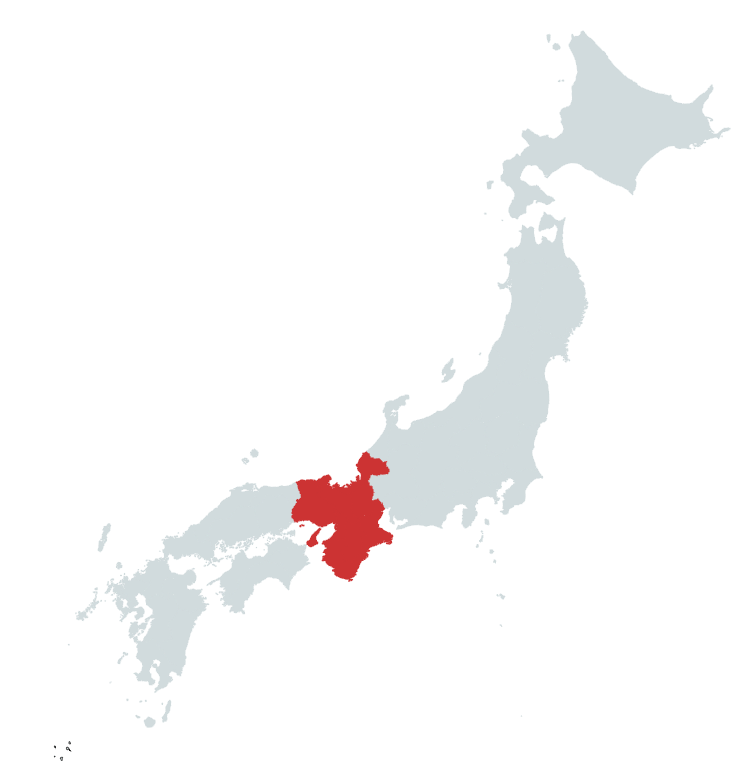
    Central Japan, corresponding mostly to the modern Kansai region, was the political and cultural heart of the nation.

    We’ve spent a lot of time looking at this region recently, so this is just a quick overview of who is still on the field in this part of Japan.

    The Hatakeyama Clan had been one of the main players, but a serious succession dispute fractured the clan and eventually led to the Onin War, as the Hosokawa and Yamana Clans supported rival claimants in a feud that would spiral out of control.

    By the end of the 15th Century, the Hosokawa remained largely in control of Kyoto, but they were already in decline. They would remain powerful, but a succession dispute (yes, another one) would divide the clan in the early 16th Century, and they’d never recover.

    The Yamana Clan had been badly mauled by the Onin War, and from a position as one of Japan’s mightiest clans, they’d eventually lose everything but a single province, which they’d manage to hold until the end of the 16th century, when some poor political decisions would see them forfeit even that.

    The Hatakeyama, for their part, were fragmented repeatedly throughout the late 15th Century, and they’d never recover their former power. However, some descendants would hold positions of power in Kyoto until the 1580s, when they’d run afoul of Oda Nobunaga, a name you should remember.

    Eastern Japan

    Eastern Japan, centred on the Kanto. Although home to Tokyo today, in the 15th Century it was Kamakura that was the centre of power in the region.

    The power in Eastern Japan was centred mostly around the Kanto Plain, with the political capital at Kamakura. In the period preceding the Ashikaga Shogunate, Kamakura had been the de facto capital of Japan, and even after the new Shogunate relocated to Kyoto, Kamakura remained the regional capital, and holding it was a prize in itself.

    The Kanto region was the source of a lot of trouble for the Ashikaga Shoguns, as there was the legacy of the previous Shogunate to contend with, and the strong, often semi-independent Kamakura Kubo to contend with. The kubo was the head of the local government, and they often openly defied the Shogun, who had to rely on the fickle loyalty of other powerful clans in the region to enforce his will.

    The Uesugi

    The Mon (crest) of the Uesugi Clan
    By Mukai – Own work, CC BY-SA 3.0, https://commons.wikimedia.org/w/index.php?curid=8629467

    The dominant power in the Kanto in the 15th Century was arguably the Uesugi Clan. Like many others, the clan claimed descent from the illustrious Fujiwara Clan, and various members of the family would become shugo in and around the Kanto. Their most important role, however, was that of Kanto Kanrei, the Shogun’s deputy in the Kanto, a position that was supposed to complement that of the kubo, but in reality, often served as a check on Kamakura’s power, and frequently, a direct rival.

    Like most clans at this time, the Uesugi were divided into branches, three in this case, that were just as likely to fight as support each other. This infighting predated the Onin War, but the outbreak of general civil war saw the destruction of one branch, and the serious weakening of the other two, so much so that, in the early 16th Century, the Uesugi would lose their position in the Kanto to another rising power, the Hojo.

    The Uesugi would survive, however, and continue to play a major role in the Sengoku Jidai. The clan’s most famous son is arguably Uesugi Kenshin, who would engage in a rivalry with fellow warlord Takeda Shingen that became the stuff of legend. Mythology aside, Kenshin would die without heirs, and a succession crisis would severely weaken the clan.

    Uesugi Kenshin became a Samurai legend, but his death would leave the Uesugi in a weak position.

    Although they would survive, they chose the losing side in the final battles of the Sengoku Jidai and would end up in Yonezawa Domain, in modern Yamagata Prefecture, where they would actually prosper until the abolition of the Domains in the 19th Century.

    The clan endured into the modern day. The current head is Uesugi Kuninori, who was a professor at the Institute of Space and Astronautical Science until he retired in 2006.

    The Hojo

    The Mon of the Hojo Clan, and the later Hojo clan, who took the name and emblem for their own.
    By Mukai – No machine-readable source provided. Own work assumed (based on copyright claims)., CC BY-SA 3.0, https://commons.wikimedia.org/w/index.php?curid=9416600

    The Hojo Clan, or more accurately the Go-Hojo, or Later Hojo, were relative latecomers to the scene. Although they would lay claim to illustrious ancestry (which was the style at the time), their progenitor was Ise Sozui (better known as Hojo Soun), who, despite being revered as the ancestor of the clan, never used the name Hojo himself. Traditionally, Soun was believed to have been a Ronin (masterless samurai) who rose to power seemingly out of nowhere in the aftermath of the Onin War.

    More recent scholarship, however, seems to indicate that Soun’s family, the Ise Clan, had a much longer history and would serve in the Shogun’s government in Kyoto before relocating to the Kanto later.

    Soun arguably deserves a post of his own, but the short version is that, he was originally in the service of the Imagawa Clan, another power in the region, before raising an army of his own and taking Izu Province for himself, establishing his base at Odawara Castle, which he took in 1494, some say, after tricking the previous owners, convincing them to leave on a hunting trip, and arranging their murders.

    It was his son, Ujitsuna, who renamed the clan to Hojo. You may remember that it was the Hojo Clan who acted as regents for the Kamakura Shoguns, rising to such power that they were effectively masters of Japan, before being overthrown by the Ashikaga.

    This new Hojo Clan was no relation to these regents, hence why they are referred to as the “Later” Hojo. Ujitsuna, apparently attempting to add some prestige to his family, adopted the name and mon (family crest) of the former Hojo, and everyone just went with it.

    Hojo Ujitsuna, who understood that there was power in a recognisable name.

    Ujitsuna wasn’t just savvy with brand recognition, however. Throughout the first half of the 16th century, he would guide the Hojo to become the predominant power in the Kanto. He would challenge and eventually drive out the Uesugi, taking control of their castle at Edo, which would eventually become the Imperial Palace in modern Tokyo.

    Throughout the Sengoku Period, the Hojo would continue to be masters of the Kanto, eventually becoming one of the greatest powers in the late 16th century, before they were eventually defeated by Toyotomi Hideyoshi in 1590. A branch of the family would survive as the lord of Sayama Domain (near modern Osaka) until the 19th century, and members of this family would continue playing a role in Japanese politics into the 20th century.

    The Takeda

    The Mon of the Takeda

    The Takeda also claimed descent from the Minamoto Clan, and from the earliest days of the Kamakura Shogunate in the 12th Century, they had established their power base in Kai Province (modern day Yamanashi Prefecture). Though they were a relatively minor player (one amongst many, you might say), the Takeda would develop a difficult relationship with the Uesugi Clan.

    When the Uesugi rose up against the Kamakura Kubo in 1416 (the Zenshu Rebellion), some members of the Takeda sided with the Uesugi, whilst others remained loyal to the government. The Uesugi were eventually defeated, but there was now bad blood between the Takeda and Uesugi that would last for another 120 years.

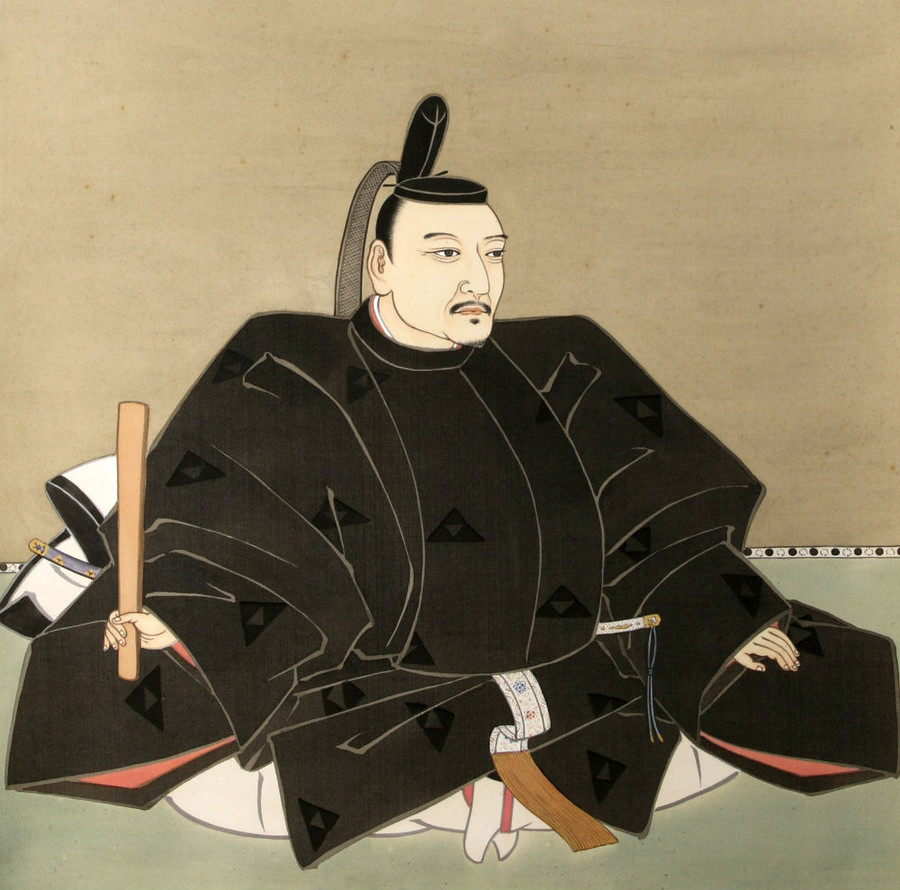
    The best known Takeda was certainly Takeda Harunobu, better known to history as Takeda Shingen. He is widely regarded as one of the best leaders of the Sengoku Period; indeed, some scholars have speculated that, had it not been for his sudden death in 1573, we might now be talking about Shingen as one of the great unifiers of Japan.

    Takeda Harunobu, better known as Shingen. Arguably one of the Sengoku Period’s best leaders, his sudden death brought an end to his ambition and seriously weakened the Takeda Clan.

    Alas, it wasn’t to be. Shingen was succeeded by his far less capable son, Katsuyori, who would lead the Takeda to disaster at the Battle of Nagashino in 1575, and the clan would cease to have any meaningful power after a final campaign led by Oda Nobunaga in 1582.

    Much like other major clans of the era, the Takeda Clan would live on in much reduced straits, eventually becoming direct vassals of the Tokugawa Shoguns, receiving a stipend of just 500 Koku a year. For reference, a Daimyo (great lord) could only claim that rank if he controlled lands worth 10,000 Koku a year or more. The Takeda had once controlled lands that were estimated to produce 1.2 million Koku, which gives you some idea of how far they had fallen.

    The Rest

    There are still several other regions to cover, and many more clans, but we’ll cover them next time.

    Sources
    https://ja.wikipedia.org/wiki/%E4%B8%8A%E6%9D%89%E9%82%A6%E6%86%B2
    https://ja.wikipedia.org/wiki/%E4%B8%8A%E6%9D%89%E6%B0%8F
    https://ja.wikipedia.org/wiki/%E5%8C%97%E6%9D%A1%E6%97%A9%E9%9B%B2
    https://en.wikipedia.org/wiki/H%C5%8Dj%C5%8D_S%C5%8Dun
    https://ja.wikipedia.org/wiki/%E5%BE%8C%E5%8C%97%E6%9D%A1%E6%B0%8F
    https://ja.wikipedia.org/wiki/%E6%AD%A6%E7%94%B0%E6%B0%8F