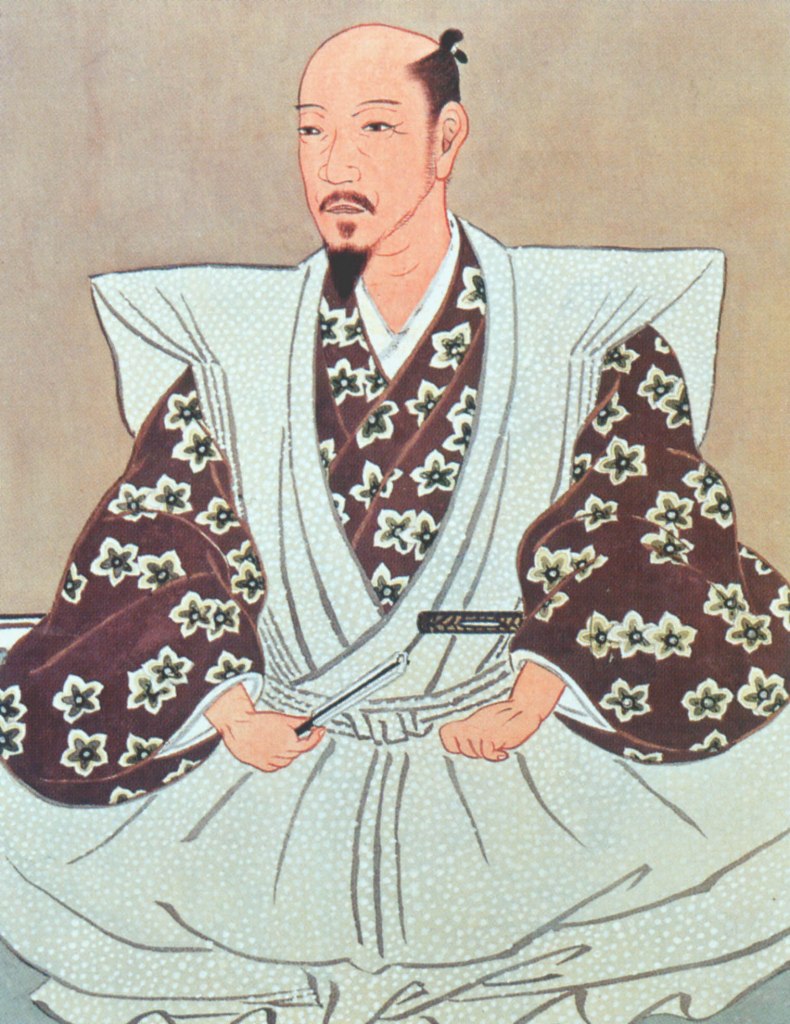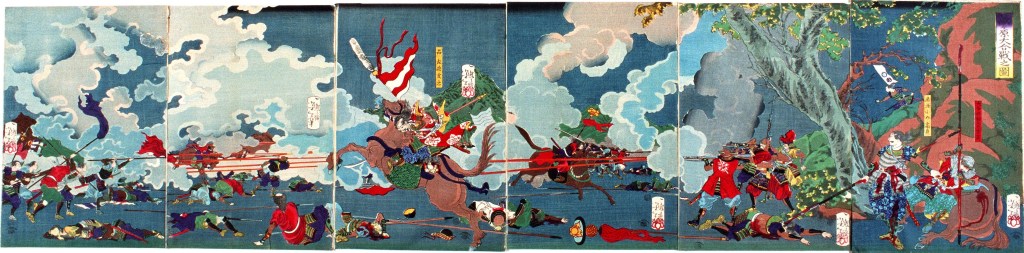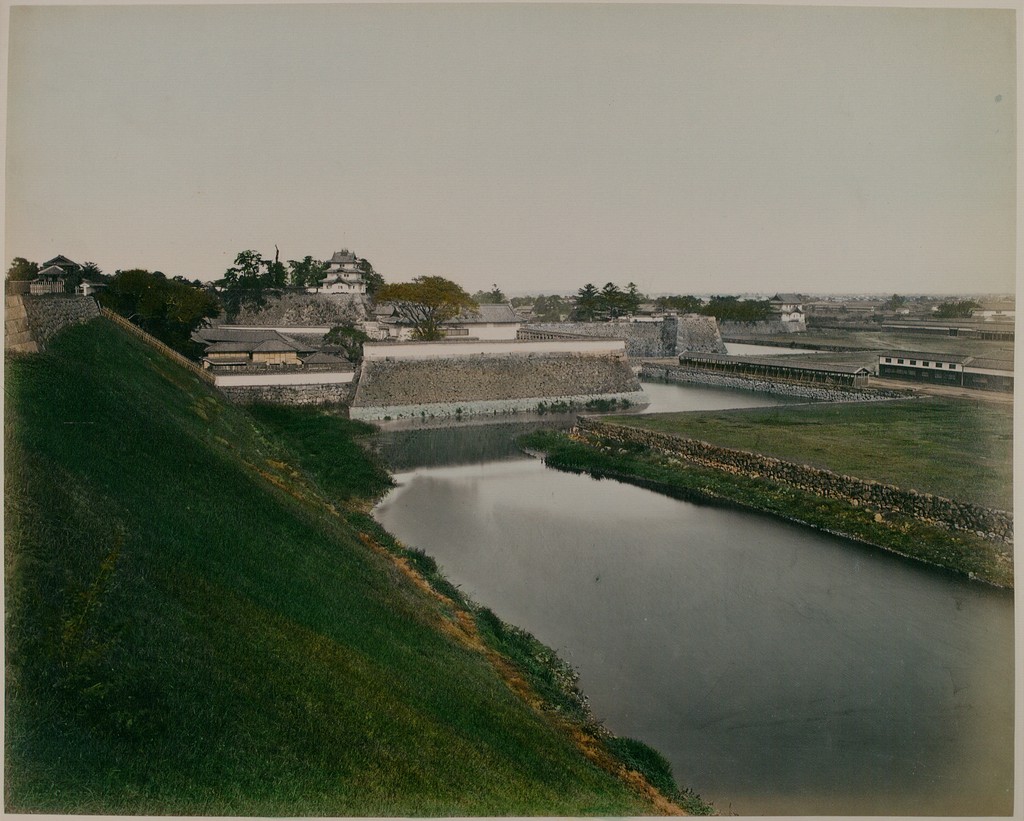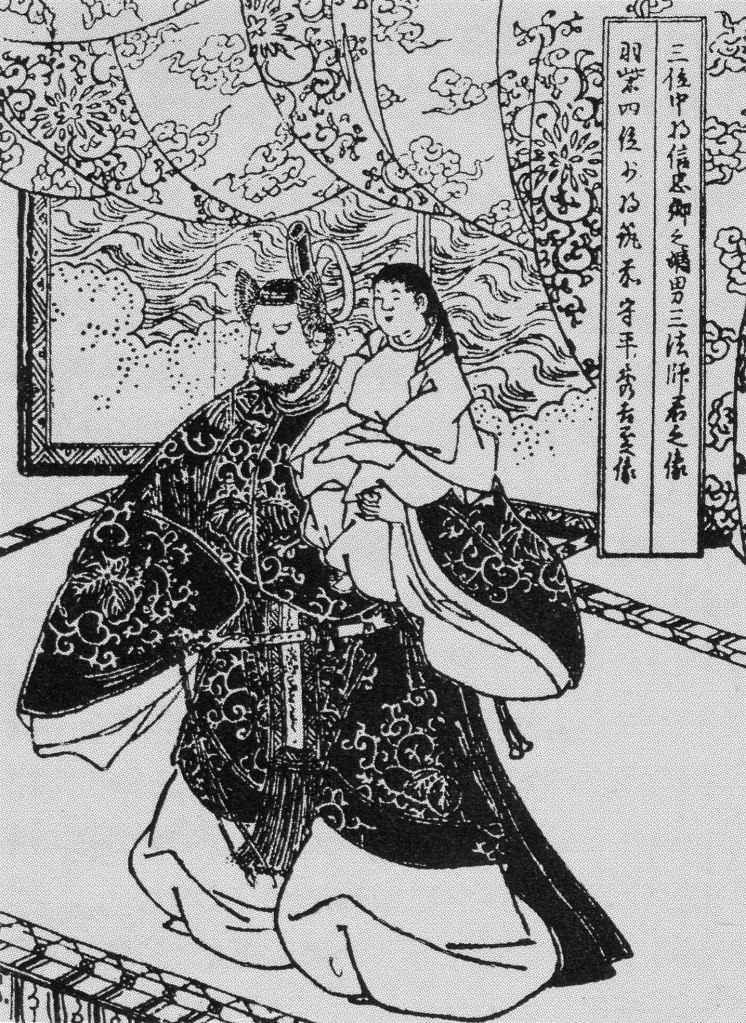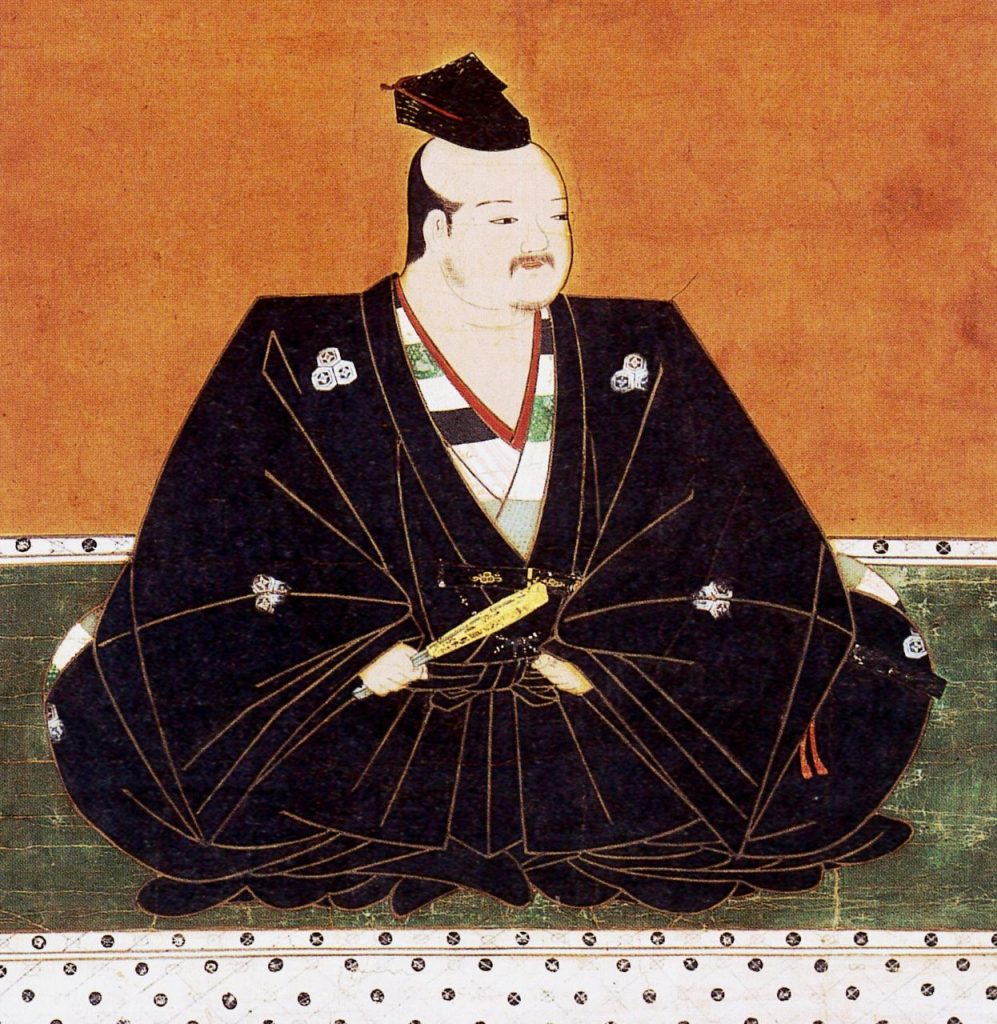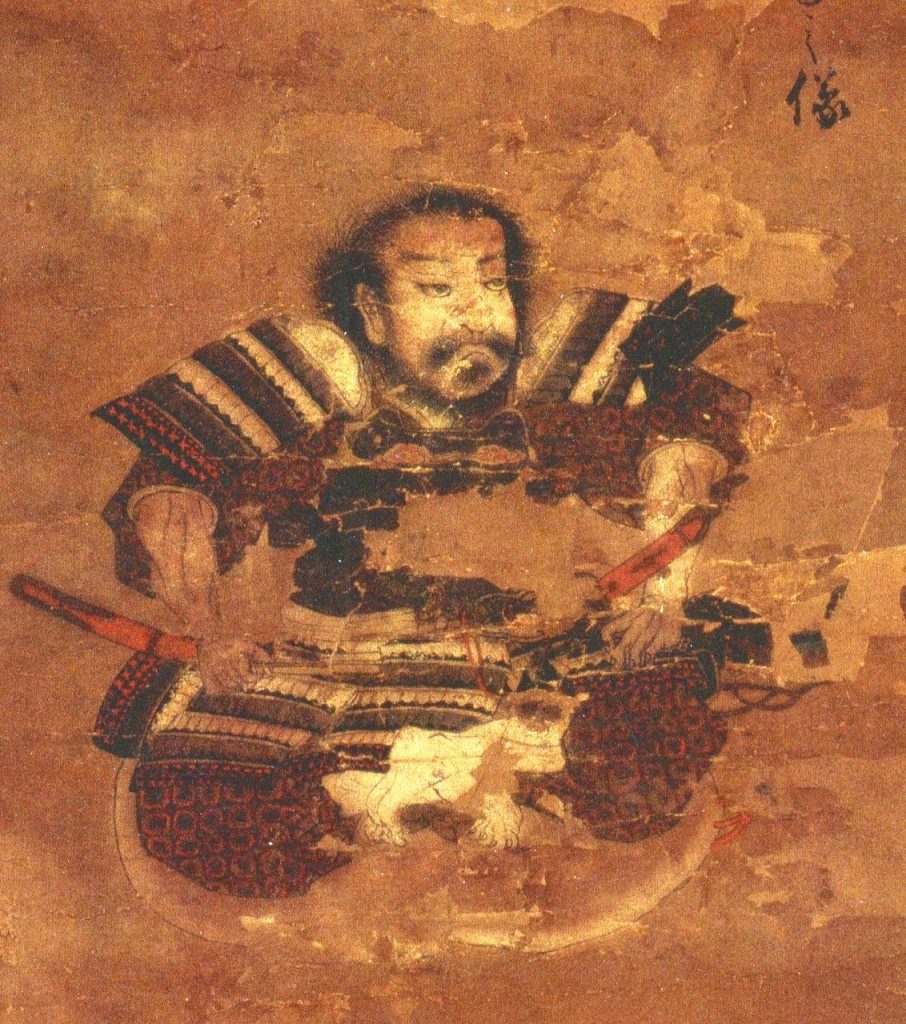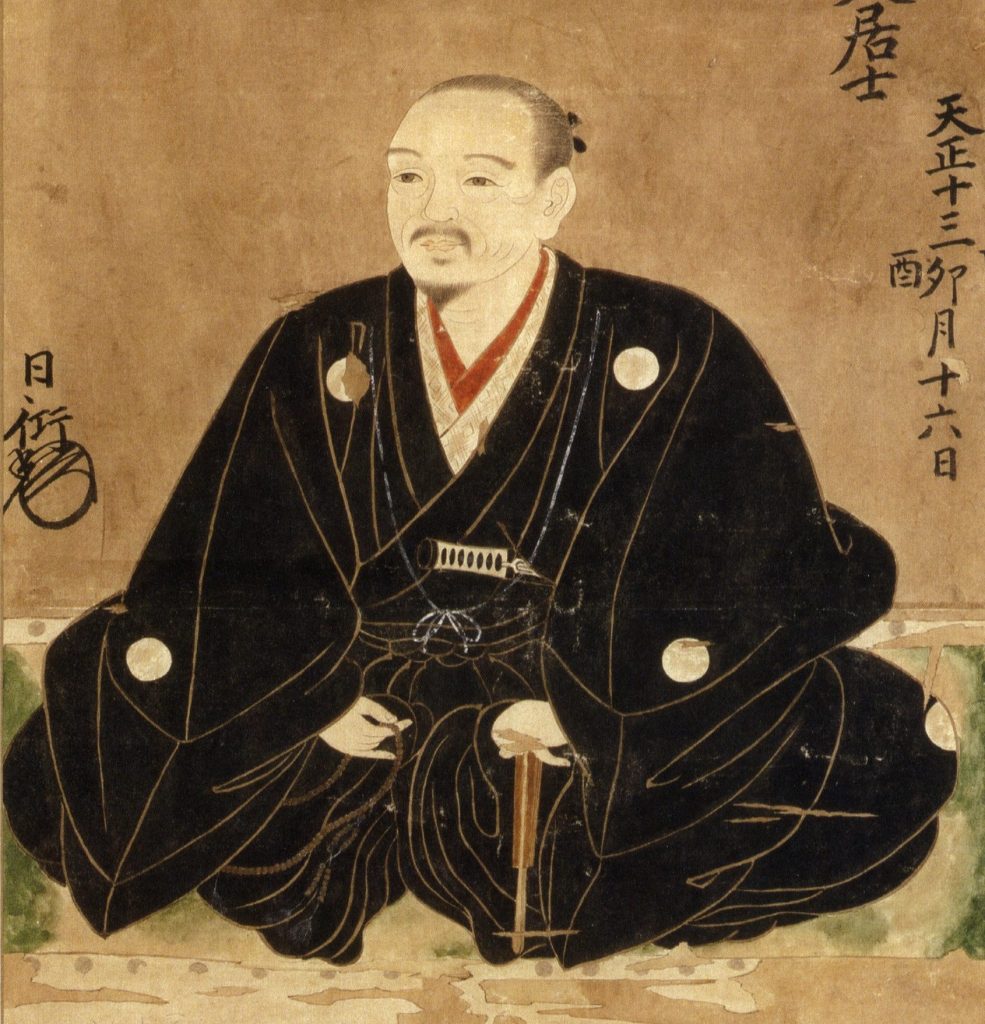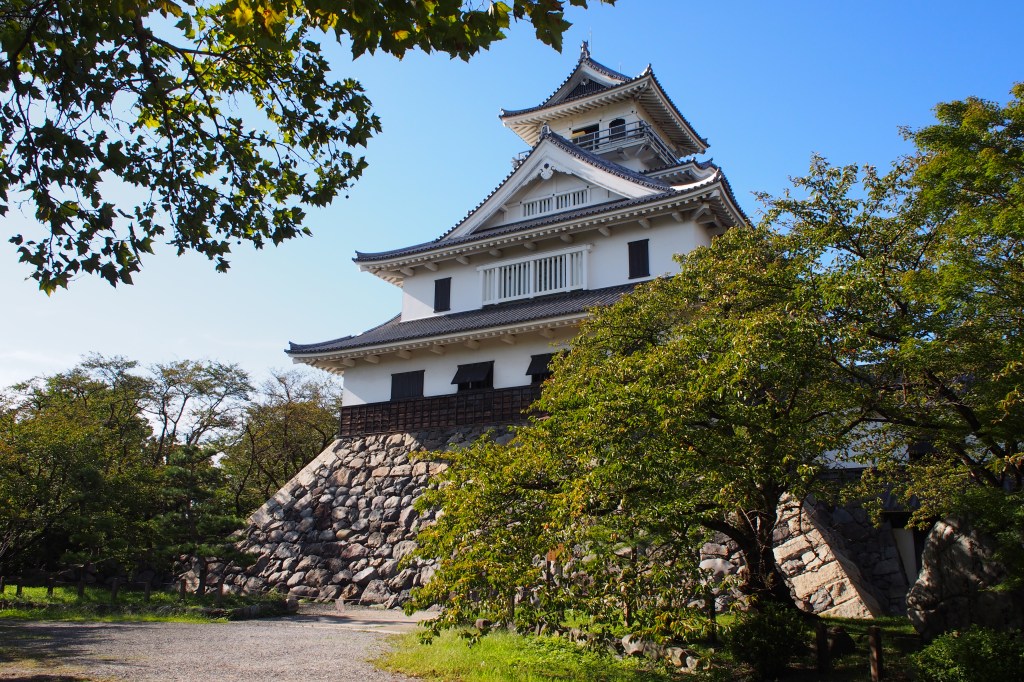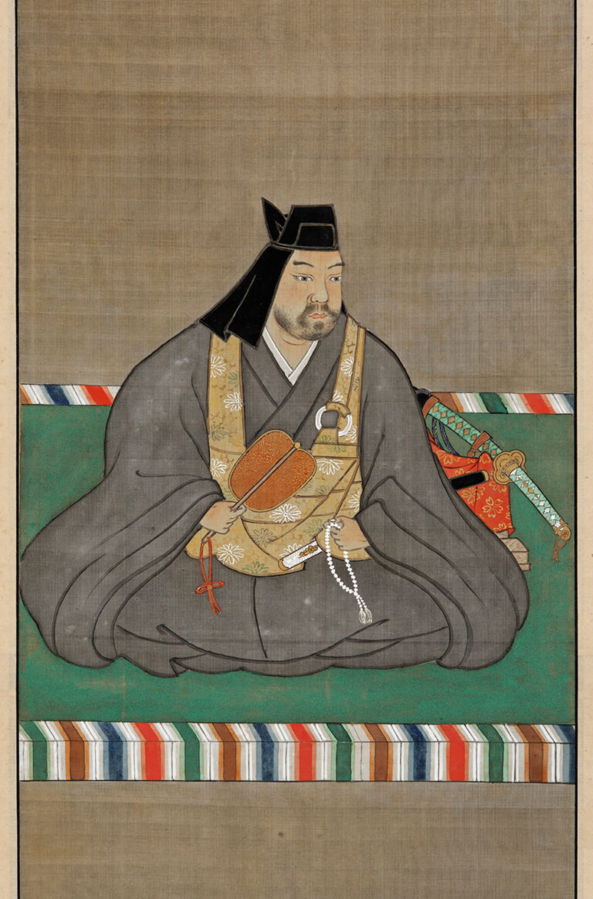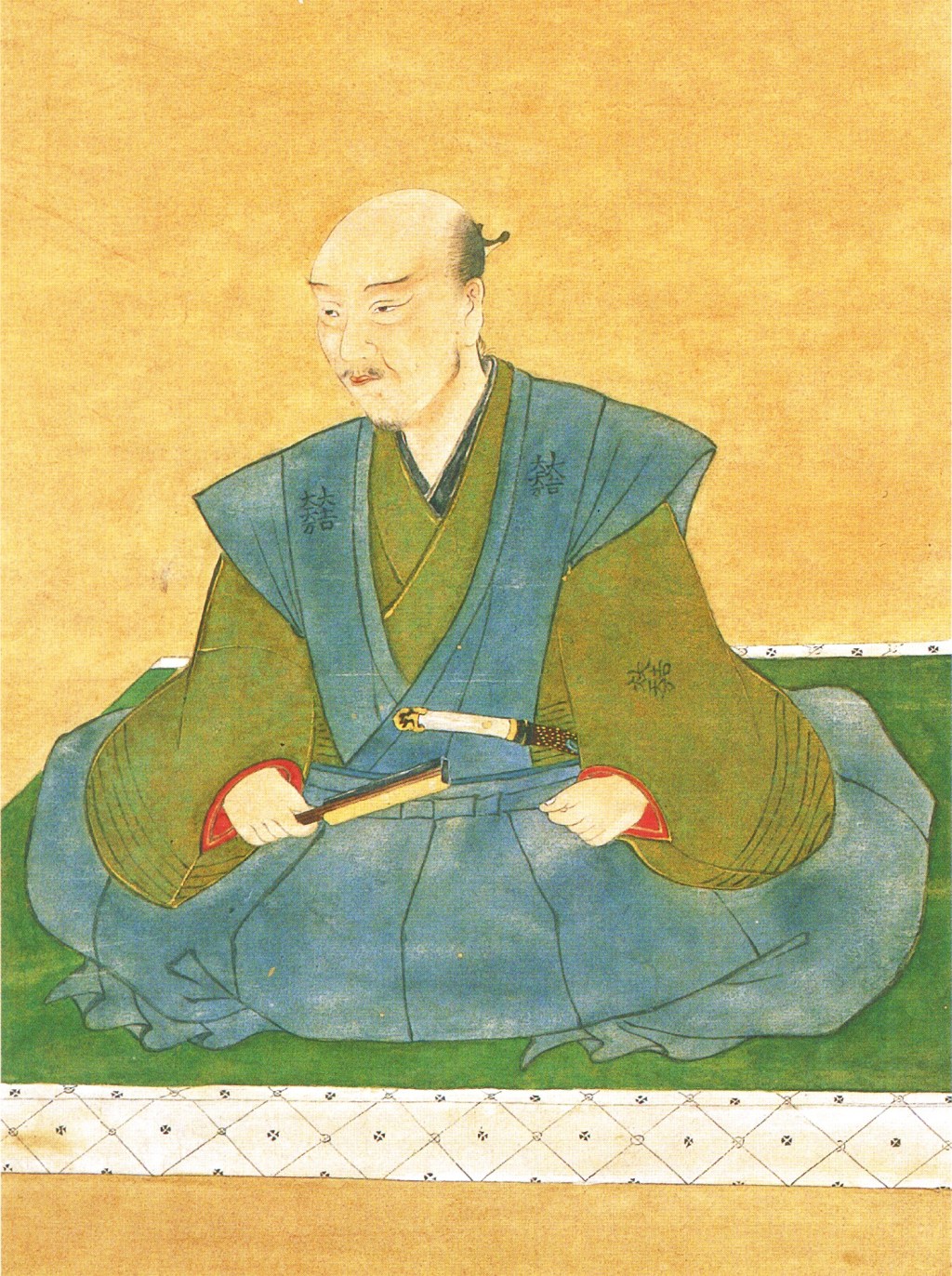
Tag: Toyotomi Hideyoshi

  • The Second Unifier – Toyotomi Hideyoshi. The Final Chapter.

    The Second Unifier – Toyotomi Hideyoshi. The Final Chapter.

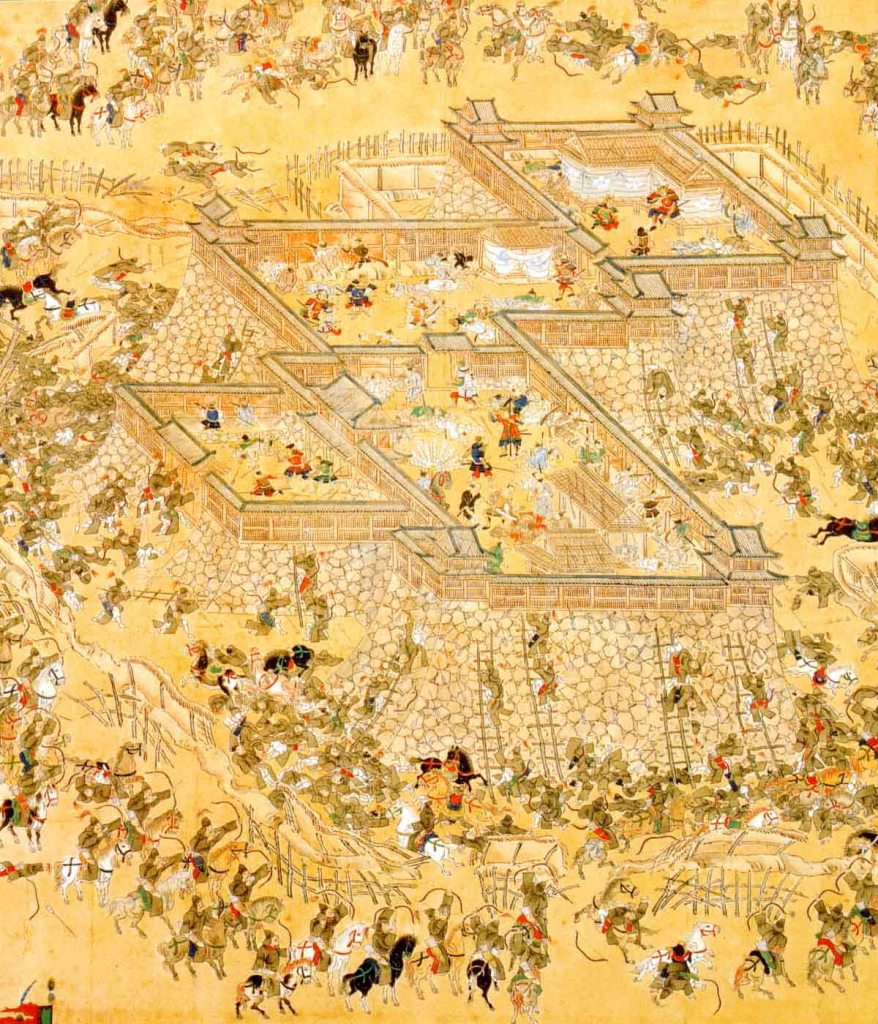
    In 1591, with dominance of Japan secured, Hideyoshi announced his intention to invade Ming China, via Korea, launching the first of two campaigns to subjugate the small kingdom. We’ll take a look at these invasions in more detail later, but in summary, the Japanese landed with a force of some 160,000 veteran warriors and achieved a series of quick successes against the Koreans.

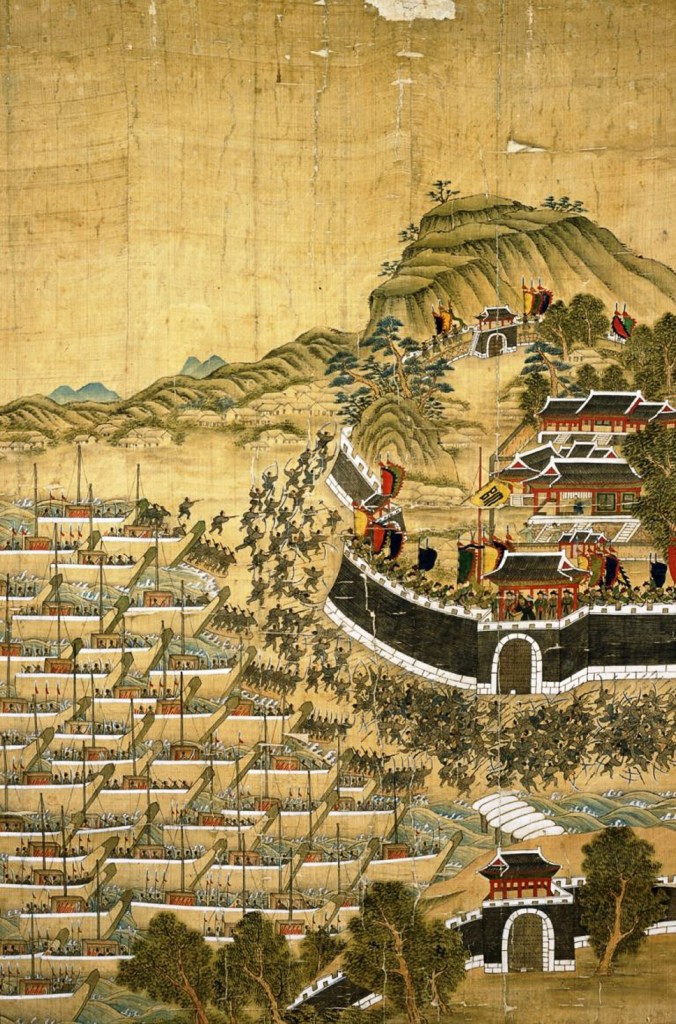
    A contemporary Korean image of the Japanese attack on Busan.

    However, Chinese intervention turned back the invasion, and ultimately led to a stalemate that ended in a negotiated peace in 1593, that saw Japanese warriors remain in the fortresses they have built in the south of the peninsular, from which they would launch a second attempt in 1597, which would end when political changes at home saw the Japanese leave, with both sides declaring ‘victory’.

    Meanwhile, Hideyoshi, who had ordered the invasion but did not travel to Korea himself, was facing problems closer to home. In 1591, his brother, Hidenaga, who had been an important military and political supporter, died. This was followed in short order by Tsurumatsu, Hideyoshi’s two-year-old son and heir, throwing the succession into doubt.

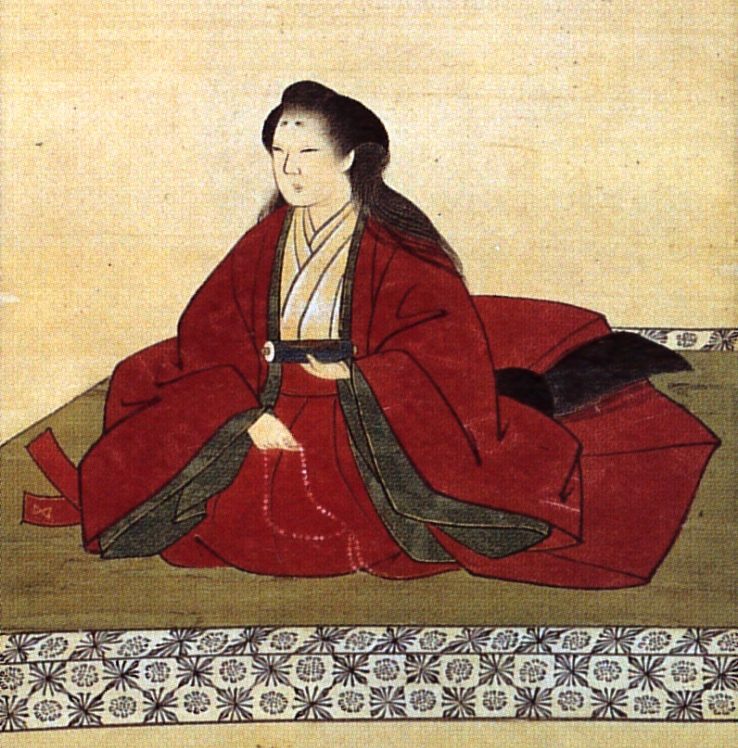
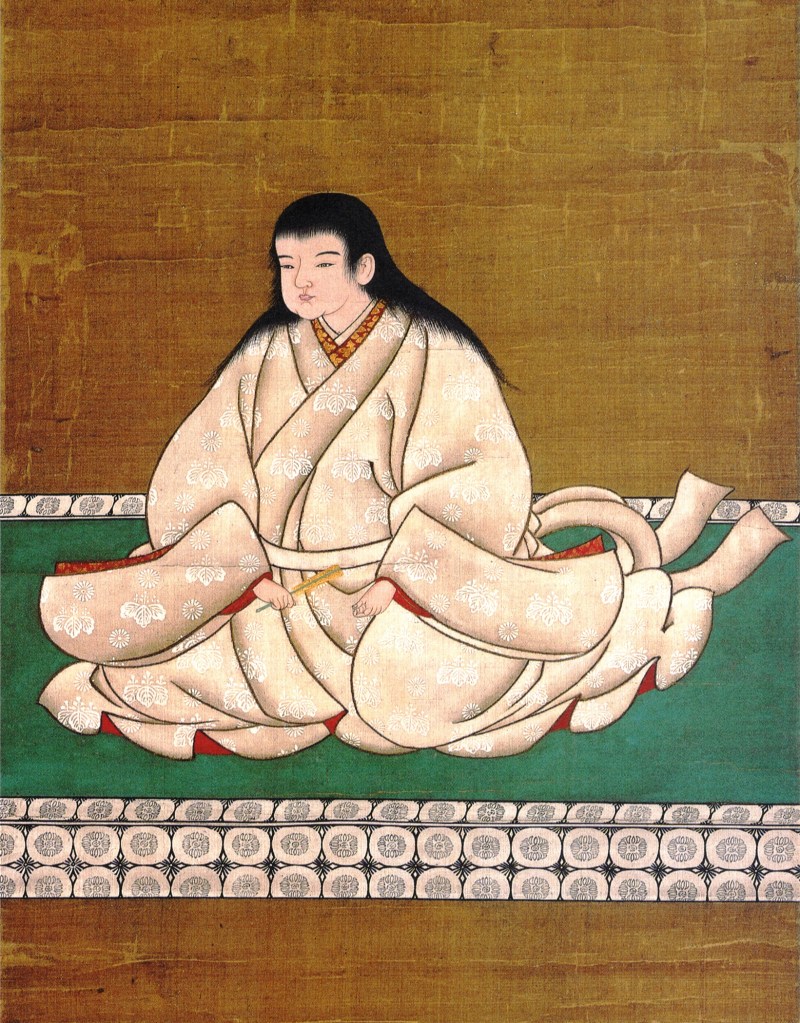
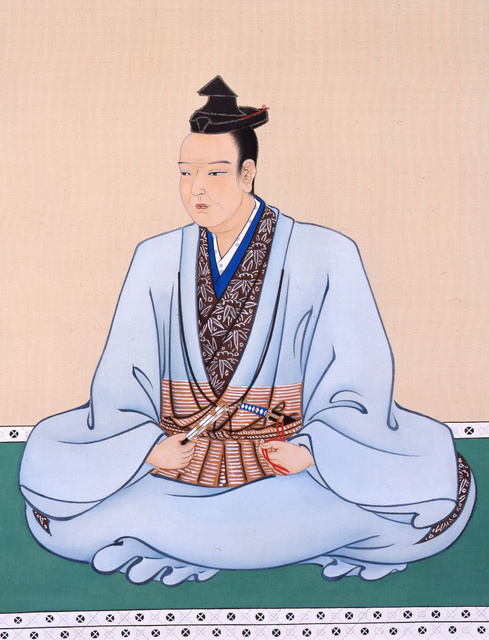
    A stylised image of Tsurumatsu, who was only two when he died.

    In response, Hideyoshi adopted his nephew, Hidetsugu, as heir to the Toyotomi family, and (presumably) eventually to supreme power. This arrangement endured until 1593, when one of Hideyoshi’s concubines, Lady Yodo, gave birth to a second son, Hideyori, whose arrival was apparently widely celebrated.

    That is, widely celebrated by everyone but Hidetsugu, whose position was now under threat. In 1595, rumours began to spread that Hidetsugu was plotting rebellion, and a delegation, led by Ishida Mitsunari, was sent to his residence to investigate. He wrote a five-page letter declaring himself innocent of the accusations, which was promptly delivered to Hideyoshi.

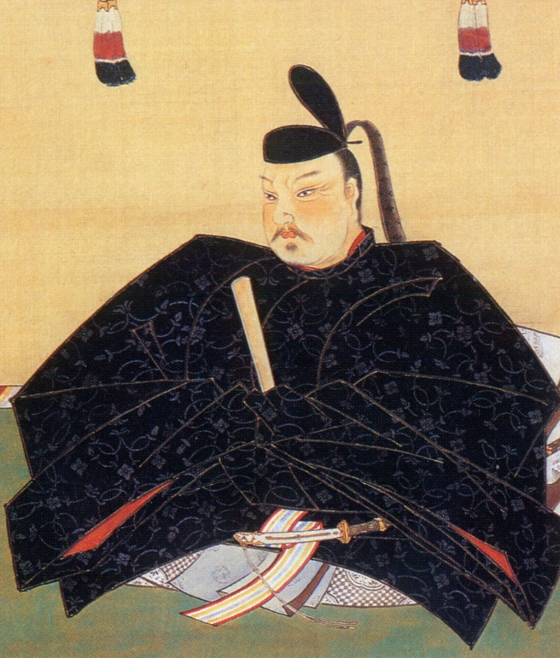
    Toyotomi Hidetsugu

    Hideyoshi then summoned his nephew for an audience, but when Hidetsugu arrived at Fushimi Castle, as ordered, he was denied entry and instead told to shave his head and become a monk. Hidetsugu apparently complied, retiring to Mount Koya. However, even this was not enough, and on August 20th, 1595, an order arrived demanding Hidetsugu commit seppuku.

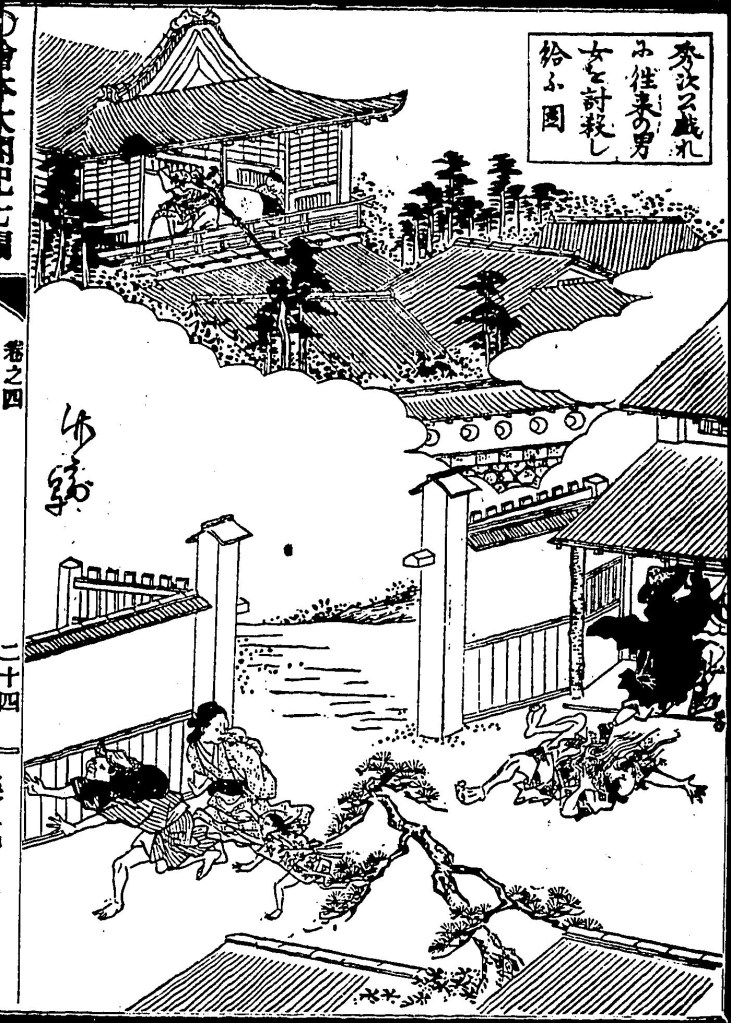
    Hidetsugu swiftly complied, but even this did not satisfy Hideyoshi, who went further and ordered the deaths of Hidetsugu’s entire family. In the end, 39 people, including children, wives, and concubines, were beheaded at Sanjo Kawara, in Kyoto, and dumped in a mass grave. Some sources say that the commoners who came to watch were so disgusted with the manner of the executions that they began hurling insults at the magistrates responsible, and in the aftermath, a memorial stone dedicated to “Hideyoshi’s Evil” was erected.

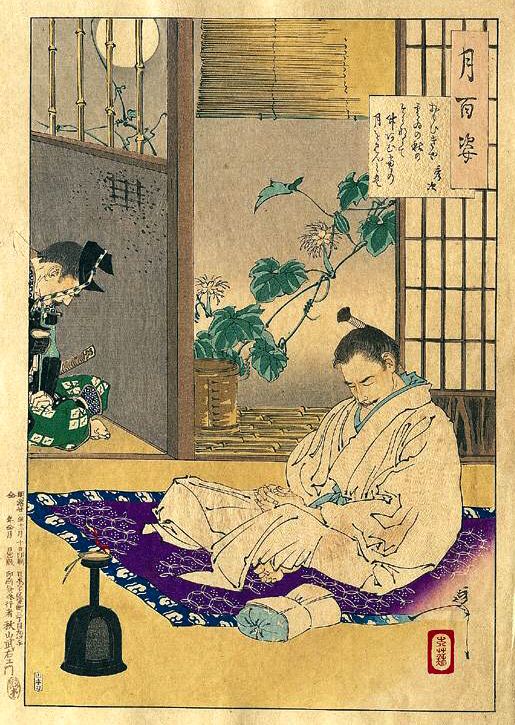
    A 19th-century depiction of Hidetsugu committing seppuku. Even his death did not spare his family from Hideyoshi’s wrath.

    Theories around why Hideyoshi ordered his nephew’s death, and why it was carried out with such thorough brutality, have swirled since the moment Hidetsugu’s head was struck off. A common view is that Hidetsugu really was planning to rebel, or at least Hideyoshi believed he was, and the purge that followed was simply ensuring no one survived to take revenge.

    Another theory is that Hidetsugu himself had earned a reputation as a violent lunatic, routinely hacking people down in the street, and even being known to take potshots at commoners with a musket, earning him the nickname the “Killing Regent”. Modern scholars are generally sceptical of this reputation, however, citing a lack of contemporary sources referring to what should have been a fairly well-known situation.

    A much later depiction of Hidetsugu (top left) taking potshots at passersby. Images like this served to discredit Hidetsugu’s memory, but sources from his lifetime make no mention of such behaviour, except in reporting rumours.

    An addition to this theory is that Ishida Mitsunari, and his associates, deliberate sought to slander Hidetsugu in the eyes of Hideyoshi, though again this is now widely seen as a latter invention, written by authors in the Edo Period, decades after the events, and writing at a time when there was active interest in painting both Hideyoshi, and Mitsunari in a bad light.

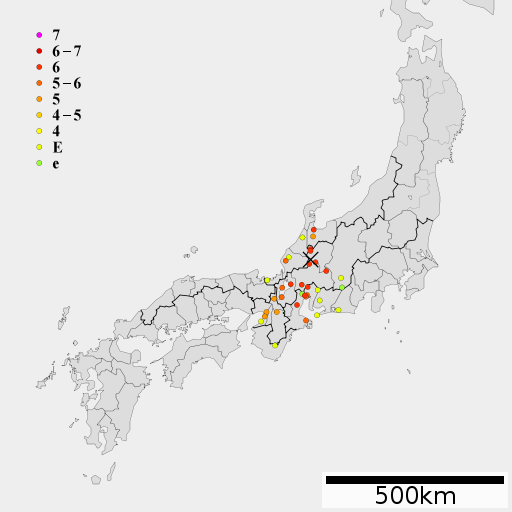
    All of this paints Hideyoshi in an increasingly tyrannical light, and subsequent events in his reign would not help matters. In 1596, the Keicho-Fushimi Earthquake struck the area around modern Osaka, leading to widespread damage and the deaths of more than a thousand people. Earthquakes are nothing out of the ordinary in Japan, but damage to several temples around Kyoto prompted an inspection by Hideyoshi himself.

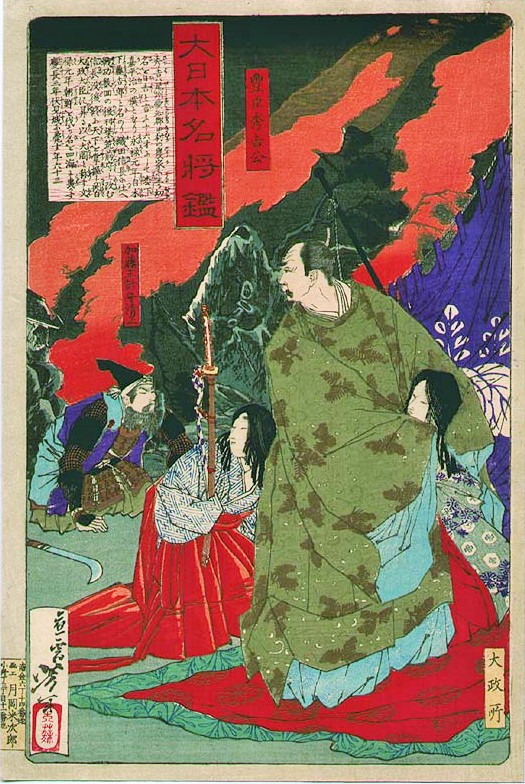
    A 19th-century depiction of Hideyoshi during the Keicho-Fushimi Earthquake.

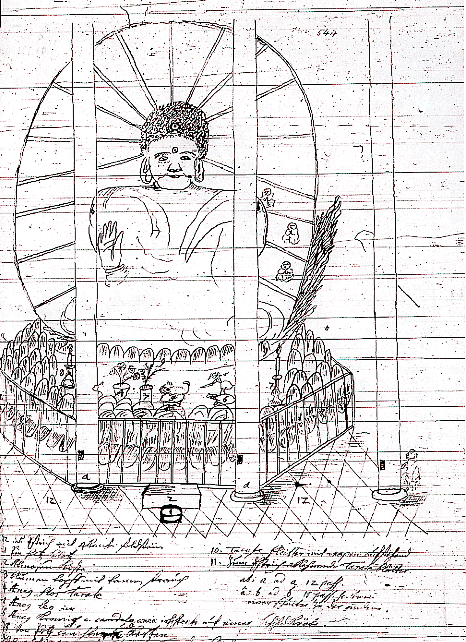
    At the Hokoji Temple, Hideyoshi had ordered the construction of a “Great Buddha”, which was said to be over 19m tall, making it one of the largest in history. However, in order to speed up construction, Hideyoshi is said to have ordered the construction changed from the traditional bronze to wood. When the earthquake struck, the Buddha was badly damaged as a result of its lighter construction.

    It is said that Hideyoshi, enraged at the damage caused to so expensive a monument, took a bow and shot an arrow into the Buddha’s forehead. Such an act of sacrilege was widely condemned, but scholars disagree over whether it actually happened, as the only sources (again) come from much later. The contemporary sources only say that Hideyoshi, upon inspecting the damage, ordered the Buddha and the hall containing it to be dismantled.

    A sketch by Dutch merchant Engelbert Kaempfer, showing the great Buddha as it appeared in 1691.

    On a side note, both structures would be reconstructed by Hideyoshi’s successor, Hideyori, and the re-consecration of the site would indirectly lead to the downfall and destruction of the Toyotomi Clan in 1615, but that’s a story for another time.

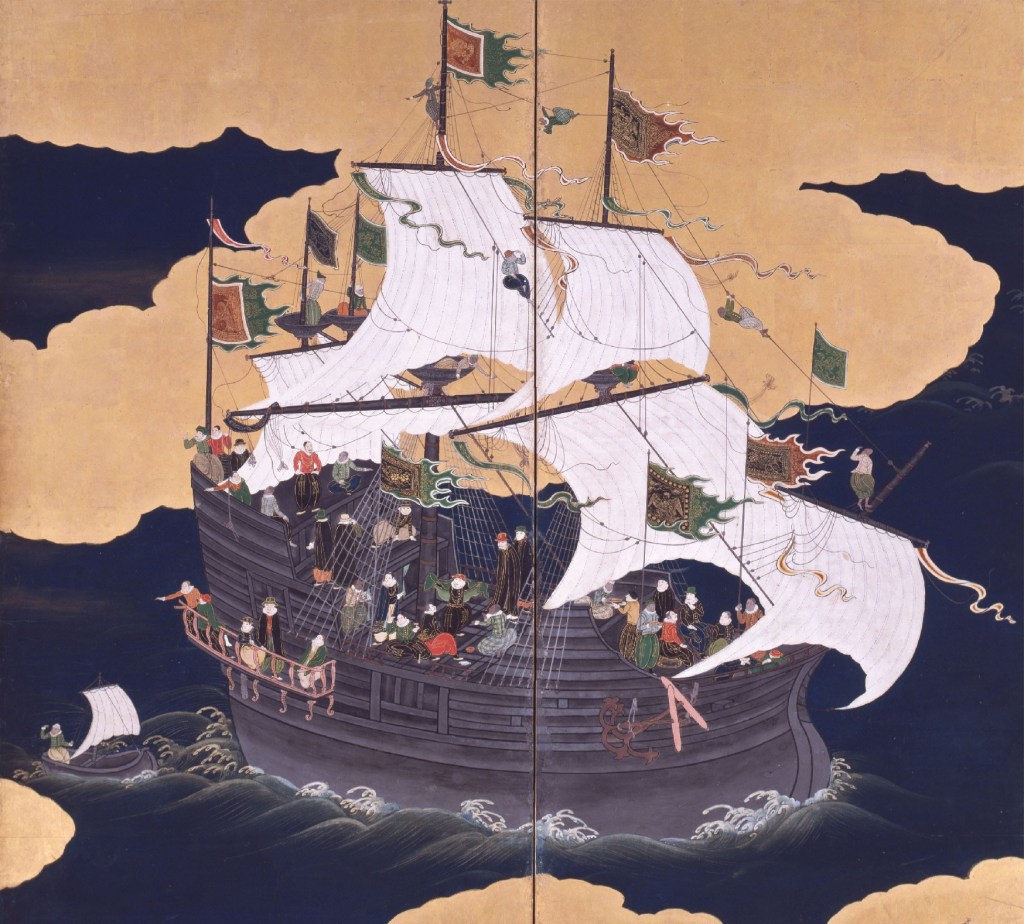
    As we’ve discussed previously, Hideyoshi had issued an order expelling Christian missionaries from Japan back in 1587, but it had generally gone unenforced. That changed in 1596, when the Spanish Galleon, San Felipe, wrecked off the coast of Shikoku. In the immediate aftermath, the local lord (who happened to be a Chosokabe) confiscated the ship’s cargo, and the Spanish complained to Hideyoshi.

    A European Ship in Japanese waters around the late 16th Century.

    It seems that Hideyoshi himself didn’t much care about the confiscated Spanish treasure; however, one of the crew aboard the San Felipe, a man known as de Hollandia, proved to be a bit of a blowhard. He boasted to the local Japanese authorities that the Spanish Empire was vast, and he produced a map of the world to prove his point.

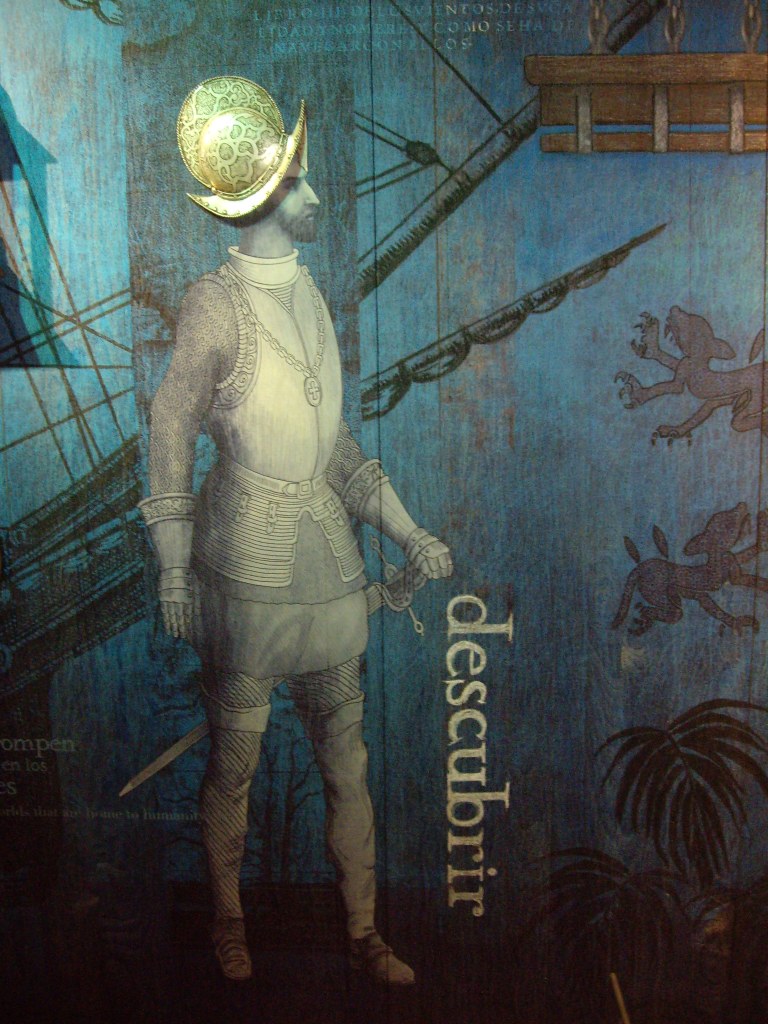
    The Japanese were shocked that the Spanish holdings were so extensive, and when they asked how Spain had come to acquire such territory, de Hollandia made the fateful mistake of claiming that missionaries had gone in first to convert the population, who then served as a vanguard for the Conquistadors who followed.

    The classic image of a Conquistador, this one in Seville, Spain. Though the Conquistadors were very successful in the Americas and the Philippines, they never set foot in Japan, though Hideyoshi had reason to fear they might.
    By CarlosVdeHabsburgo – Own work, CC BY-SA 3.0, https://commons.wikimedia.org/w/index.php?curid=24964604

    Hideyoshi may not have cared about treasure, but he was definitely paying attention now. He took the silver for himself and then ordered all Spanish Friars in Osaka arrested, along with several Japanese converts. In the end, 26 were taken to Nagasaki and publicly executed

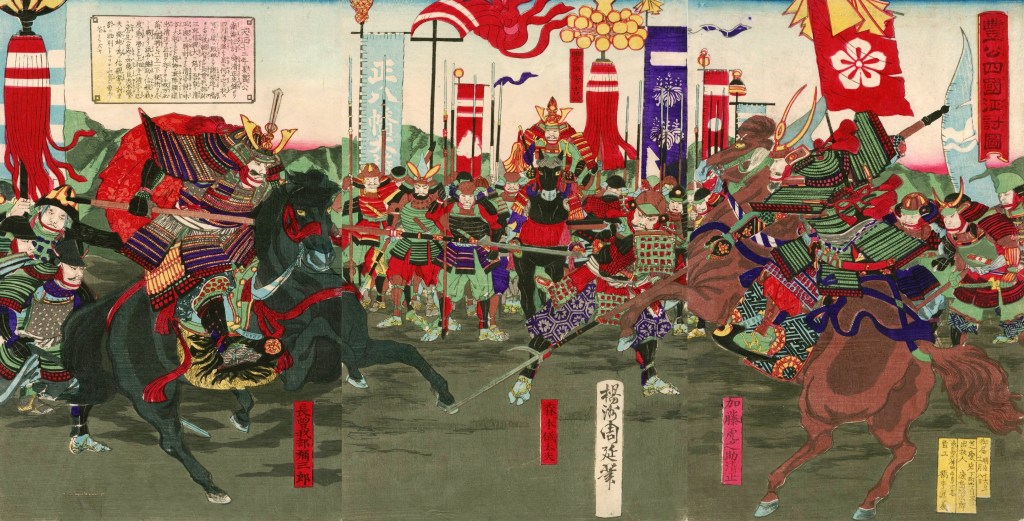
    1596 also saw the restart of conflict in Korea, when negotiations with the Chinese broke down, and Hideyoshi ordered a second invasion, dispatching 140,000 men to reinforce the garrisons already in place. This time, instead of attempting to take the whole of Korea, Hideyoshi planned a more limited campaign, advancing into Gyeongsang Province and securing defensible positions there to serve as staging grounds for another round of conquest later.

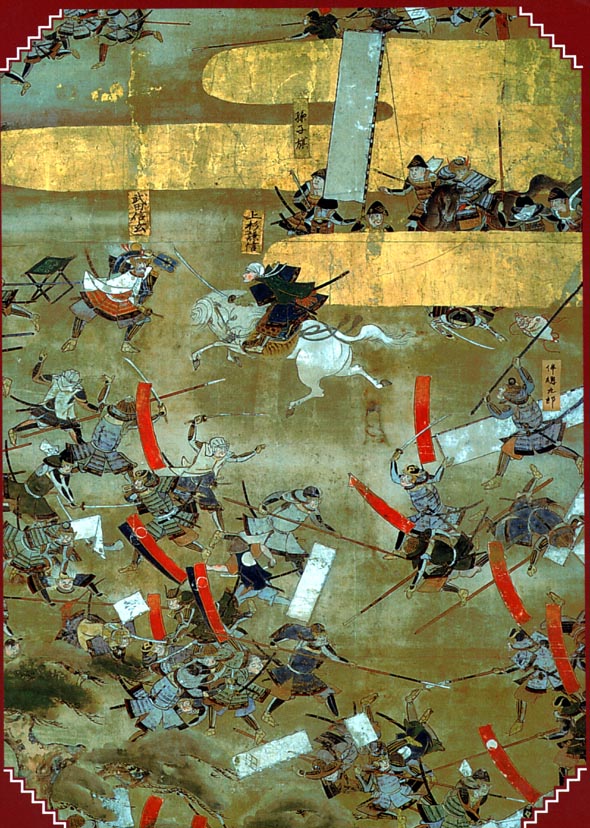
    An image depicting the fighting around Ulsan, site of some of the fiercest battles of the second invasion.

    By late 1597, however, Hideyoshi knew he was nearly done. His son and heir, Hideyori, was just a child, and he knew that his succession was far from guaranteed. In order to guarantee a peaceful transfer of power, he summoned five powerful Daimyo to Fushimi, making them swear to rule the realm as a Council of Regents (or Elders) until Hideyori came of age.

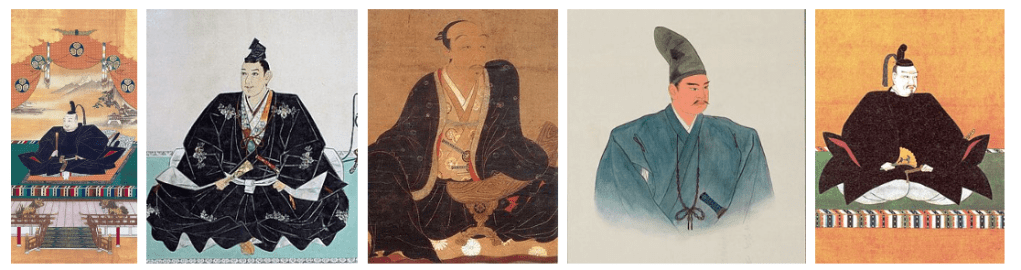
    The five regents were Ukita Hideie, Maeda Toshiie, Uesugi Kagekatsu, Mori Terumoto, and Tokugawa Ieyasu. Of the five, Ieyasu was far and away the most powerful, though he was not strong enough to oppose the other four directly, especially the venerable Maeda Toshiie and Mori Terumoto. This was presumably the point, however, as Hideyoshi wanted to create a council that was made up of men strong enough to rule, but not strong enough to rule alone.

    The Council of Five Elders, from left to right: Tokugawa Ieyasu, Ukita Hideie, Maeda Toshiie, Uesugi Kagekatsu, and Mori Terumoto. Of the five, Ieyasu was the most powerful, and it became the task of the other four to rein him in.

    Hideyoshi passed away in August 1598, and the order he had done so much to create would not long outlive him. The council he had created fell apart within a year, following the death of Maeda Toshiie in 1599 and the political manoeuvring of Tokugawa Ieyasu, who won the decisive Battle of Sekigahara in 1600 and was declared Shogun in 1603.

    Though Hideyori would never rule in his own right, he would continue on as a living example of Hideyoshi’s legacy, but he would eventually fall foul of the rising power of the Tokugawa, and Hideyoshi’s line would come to an end in 1615, though, once again, we are getting ahead of ourselves.


    Sources
    https://ja.wikipedia.org/wiki/%E8%B1%8A%E8%87%A3%E7%A7%80%E5%90%89
    https://ja.wikipedia.org/wiki/%E3%82%B5%E3%83%B3%EF%BC%9D%E3%83%95%E3%82%A7%E3%83%AA%E3%83%9A%E5%8F%B7%E4%BA%8B%E4%BB%B6
    https://ja.wikipedia.org/wiki/%E6%85%B6%E9%95%B7%E4%BC%8F%E8%A6%8B%E5%9C%B0%E9%9C%87
    https://ja.wikipedia.org/wiki/%E6%96%B9%E5%BA%83%E5%AF%BA%E9%90%98%E9%8A%98%E4%BA%8B%E4%BB%B6
    https://ja.wikipedia.org/wiki/%E6%85%B6%E5%B0%9A%E9%81%93
    https://ja.wikipedia.org/wiki/%E6%96%B9%E5%BA%83%E5%AF%BA
    https://en.wikipedia.org/wiki/Yodo-dono
    https://ja.wikipedia.org/wiki/%E8%B1%8A%E8%87%A3%E7%A7%80%E6%AC%A1
    https://ja.wikipedia.org/wiki/%E6%96%87%E7%A6%84%E3%83%BB%E6%85%B6%E9%95%B7%E3%81%AE%E5%BD%B9

  • The Second Unifier – Toyotomi Hideyoshi. Part Six.

    The Second Unifier – Toyotomi Hideyoshi. Part Six.

    The mon of the Toyotomi Clan.

    By the late 1580s, Hideyoshi was at the very pinnacle of political and military power in Japan. Jesuit records from the time name him “tyrant” and suggest that he has achieved more power over the realm than any warlord before him.

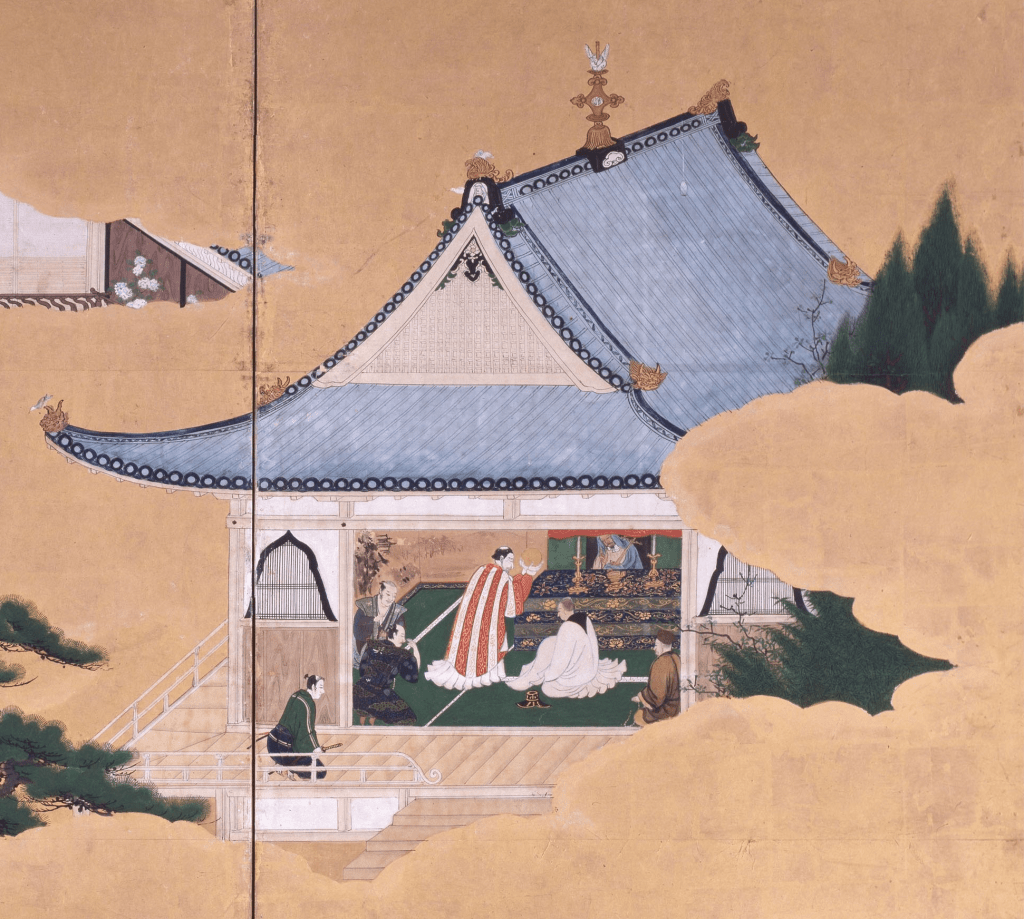
    After the successful conclusion of the Kyushu Campaign, Hideyoshi ordered a new palace built in Kyoto. Called Jurakudai (or Jurakutei in some sources), Toyotomi moved his political base there from Osaka Castle in early 1588, inviting the Emperor Go-Yozei for a feast in April 1588 and obliging powerful Daimyo (such as Tokugawa Ieyasu) to travel there and pay homage to him.

    An image of the Emperor visiting Jurakudai.

    Having secured personal political power, Hideyoshi then turned his attention to pacifying the realm at large. Through his military campaigns, he had subdued most of the powerful Daimyo in the realm, but there remained the issue of establishing peace at the local level as well.

    The Sengoku Jidai exists in the popular imagination as more than a century of conflict, featuring epic clashes between armies of Samurai loyal unto death, and iconic lords like Takeda Shingen, Oda Nobunaga, and Uesugi Kenshin, who were locked in a titanic struggle for ultimate control of the realm.

    Uesugi Kenshin and Takeda Shingen engaged in a duel that probably never happened but remains an enduring, if inaccurate, image of the Sengoku-era battlefield.

    Whilst there is certainly truth to this image, much like any period of civil war, Japanese society at large had become incredibly violent during the 16th century. At the local level, the decentralised nature of Daimyo rule led to the emergence of Jizamurai, literally “Local Samurai”. These men often started out as armed peasants, usually levied into the armies of some local lord, and sent home again when the campaign ended.

    Throughout the 16th century, these Jizamurai gradually achieved military and political influence over their local communities, often being allowed to collect tax revenue on behalf of their lord in exchange for military service, similar to a Knightly Manor in medieval Europe.

    This situation worked fine whilst the realm was fractured into dozens of minor domains, but as consolidation followed conquest in the latter half of the 16th century, tensions between “Samurai” and “Jizamurai” became more of an issue. When a lord was defeated, he was usually killed or deprived of his land, meaning that the Jizamurai would often find themselves serving a new lord to whom they had no personal loyalty, leading to frequent conflicts.

    Ashigaru on campaign. By the late 16th century, the distinction between Warrior and Peasant was often unclear to the point of being non-existent.

    On a societal level, the distinction between Jizamurai and peasants was often academic. Though technically of a higher social status, a Jizamurai usually lived in the village, amongst the peasantry, who would themselves often have access to weaponry and a far greater loyalty to their local Jizamurai than to some powerful Daimyo whom they never saw.

    This led to frequent Peasant Uprisings throughout the Sengoku Period, most famously the Ikko-Ikki, who were motivated by religious fervour but were largely made up of peasants and Jizamurai. It wasn’t just political violence; feuds between villages were common and often escalated into violence, as rival communities would quickly resort to the sword to settle disputes over territory, waterways, and other local matters.

    In 1587, Hideyoshi passed a law forbidding the use of force to resolve such disputes. Though the exact wording of the law has been lost, by looking at the wording of laws from the later Edo Period, which often referred to ‘precedents’ (i.e., earlier laws), we can infer what Hideyoshi’s decrees may have looked like.

    If any villagers or other people in a village engage in a dispute over mountains or waters, using bows, spears, or guns to fight amongst themselves, that entire village shall be punished. – From a decree by Shogun Tokugawa Hidetada -1610

    Scholars debate exactly what Hideyoshi intended with this law, with some suggesting that he meant to disarm and pacify the peasants, whilst others say it was more to do with establishing who had weapons, and who had the right to weapons, part of an ongoing centralisation campaign in which a clearer line was to be drawn between Warrior and Peasant.

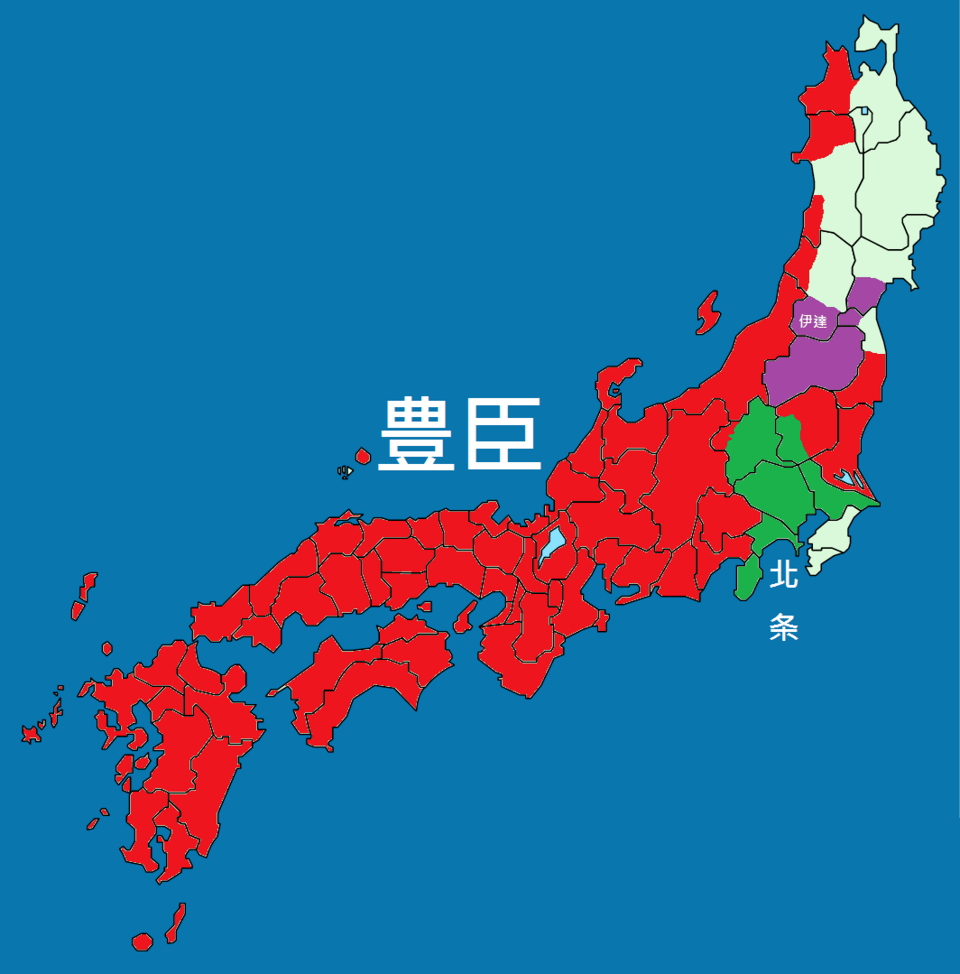
    In 1589, Hideyoshi celebrated the birth of a son, Tsurumatsu, whom he swiftly named as his heir, securing his dynasty for the foreseeable future. The following year, after a series of political slights, he launched a decisive campaign against the Hojo, lords of the Kanto, crushing them in the Odawara Campaign.

    A later, heavily stylised depiction of Hideyoshi’s son, Tsurumatsu.

    Also in 1590, he crushed the defiant clans of Northern Japan in a swift campaign, and it is at this point that the “Sengoku Jidai” is said to have come to an end. For the first time in more than a century, the country was under the control of one man, and the realm would never again fracture as it once had. Despite this, one decision made by Hideyoshi in the aftermath of the Odawara Campaign had already sown the seeds of his clan’s ultimate downfall.

    With the destruction of the Hojo, Hideyoshi offered the five provinces of the Kanto to Tokugawa Ieyasu, in exchange for the three he had originally ruled. At the time, this move was seen as political savvy. It positioned the potentially rebellious Ieyasu farther from Kyoto, and though the five Kanto provinces were nominally richer than the three Ieyasu had given up, they had recently been conquered and were potentially volatile, meaning the move weakened Ieyasu in the short term.

    Tokugawa Ieyasu.

    Hideyoshi, however, had not considered Ieyasu’s political and economic acumen. His base in the Kanto would eventually serve as a springboard for his own rise to power, demonstrated perhaps most clearly by the fact that Japan’s modern capital, Tokyo, is on the same site as Ieyasu’s was, more than 430 years after he moved there, but we’re getting ahead of ourselves.

    The threat from Ieyasu was not Hideyoshi’s only concern, however. In 1591, his brother, Hidenaga, who had proven to be an extremely competent commander and political ally, died in February, followed by his son and heir, the two-year-old Tsurumatsu, in September of the same year.

    Toyotomi Hidenaga

    Following these deep personal and political blows, Hideyoshi adopted his nephew, Hidetsugu, and then retired, handing control of the clan over to him. As was common at the time, Hideyoshi retained true political power; however, becoming known as the Taiko, a title of respect for former regents.

    Also in 1591, with Japan secured, Hideyoshi announced his intention to invade China, launching a brutal invasion of Korea to use it as a base for his main objective. We’ll give the Korean Wars their own post, but for now, we can say that the invasions both highlighted Hideyoshi’s power and brought about political divisions that would ultimately destroy his legacy.


    Sources
    https://ja.wikipedia.org/wiki/%E8%B1%8A%E8%87%A3%E7%A7%80%E5%90%89
    https://ja.wikipedia.org/wiki/%E5%A4%AA%E9%96%A4
    https://ja.wikipedia.org/wiki/%E8%B1%8A%E8%87%A3%E7%A7%80%E9%95%B7
    https://ja.wikipedia.org/wiki/%E6%B7%80%E6%AE%BF
    https://ja.wikipedia.org/wiki/%E8%B1%8A%E8%87%A3%E9%B6%B4%E6%9D%BE
    https://ja.wikipedia.org/wiki/%E5%BE%8C%E9%99%BD%E6%88%90%E5%A4%A9%E7%9A%87
    https://ja.wikipedia.org/wiki/%E5%88%80%E7%8B%A9
    https://ja.wikipedia.org/wiki/%E5%85%B5%E8%BE%B2%E5%88%86%E9%9B%A2
    https://ja.wikipedia.org/wiki/%E5%96%A7%E5%98%A9%E5%81%9C%E6%AD%A2%E4%BB%A4
    https://ja.wikipedia.org/wiki/%E6%B5%B7%E8%B3%8A%E5%81%9C%E6%AD%A2%E4%BB%A4
    https://ja.wikipedia.org/wiki/%E8%81%9A%E6%A5%BD%E7%AC%AC%E8%A1%8C%E5%B9%B8
    https://ja.wikipedia.org/wiki/%E8%81%9A%E6%A5%BD%E7%AC%AC
    https://ja.wikipedia.org/wiki/%E5%9C%B0%E4%BE%8D

  • The Second Unifier – Toyotomi Hideyoshi. Part Five.

    The Second Unifier – Toyotomi Hideyoshi. Part Five.

    In 1586, the powerful Tensho Earthquake brought about a temporary halt to Hideyoshi’s campaign to subdue the entire realm. In the aftermath, he had made peace with, then accepted the formal submission of Tokugawa Ieyasu, and now turned his attention to Japan’s southern island, Kyushu.

    Kyushu.

    As we’ve looked at in previous posts, the most powerful clan in Kyushu at this time were the Shimazu, who were on the verge of conquering the entire island, and were putting enormous pressure on their long-term rivals, the Otomo, who reached out to Hideyoshi for help. Hideyoshi responded by issuing a ceasefire order, the sobujirei, though scholars disagree if this was an order issued on a case-by-case basis, or a formal law brought in my Hideyoshi.

    Regardless of the legal basis, the Otomo swiftly agreed, but the Shimazu remained defiant, with the head of the clan, Shimazu Yoshihisa, going as far as suggesting that the Shimazu, a clan with its long and proud lineage, would never submit to a peasant ‘upstart’ like Hideyoshi. Perhaps unsurprisingly, Hideyoshi didn’t take kindly to this and so ordered the invasion of Kyushu, officially in support of the Otomo.

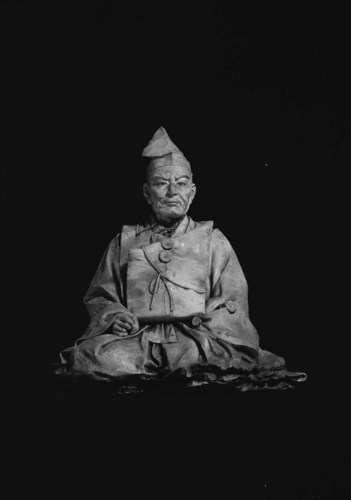
    A statue of Shimazu Yoshihisa. He was the head of a proud clan and believed he had no reason to fear the ‘upstart’ Hideyoshi. He would be proved wrong.
    Ginger1192 – 投稿者自身による著作物, CC 表示-継承 3.0, https://commons.wikimedia.org/w/index.php?curid=24854517による

    At first, Hideyoshi seems to have tried to avoid committing his own troops to the invasion, instead relying on forces provided by the Mori, Chosokabe and their vassals to do the bulk of the fighting. This strategy may have been wise from a manpower preservation point of view, but the Shimazu proved more than capable of living up to their lineage, defeating the initial landings and giving Hideyoshi the proverbial bloody nose in the process.

    Much like the independent clans of Kii Province and the Chosokabe of Shikoku, however, the Shimazu were about to learn that Hideyoshi was a different kind of ruler, able to marshal resources that even the might of Kyushu could not hope to match. Taking the field himself, Hideyoshi is said to have amassed an army of some 300,000, with all the requisite supplies and resources to support such a massive force.

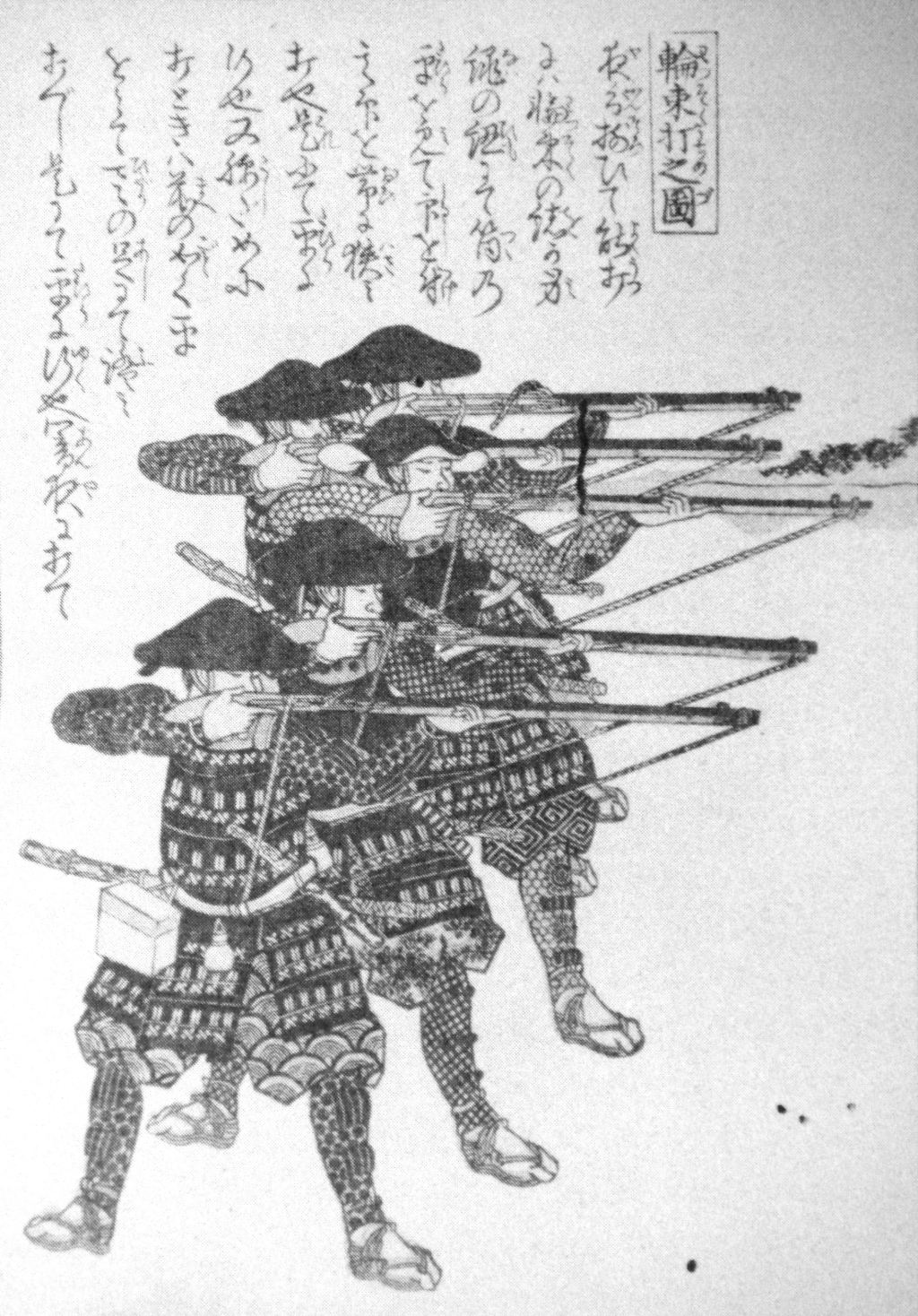
    Ashigaru. Far from the popular image of massed ranks of ferocious samurai, armies in the late Sengoku Period were largely made up of semi-professional troops armed with firearms, spears, and mass-produced swords.

    This was possibly the largest army ever assembled in Japan before the modern era (though sources vary), and the Shimazu were swiftly overwhelmed. It is important to note that, despite the overwhelming advantage in numbers, Hideyoshi’s force was not a single, massive bludgeon. He had proven himself a skilled strategist, able to deploy significant force in key areas, using innovative tactics to wear down defenders and capture strategic castles and other territory, rarely relying on brute force to break enemy forces.

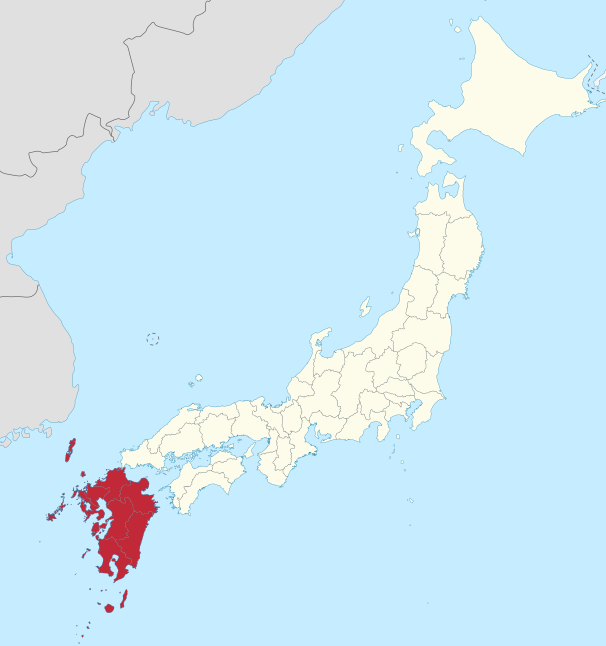
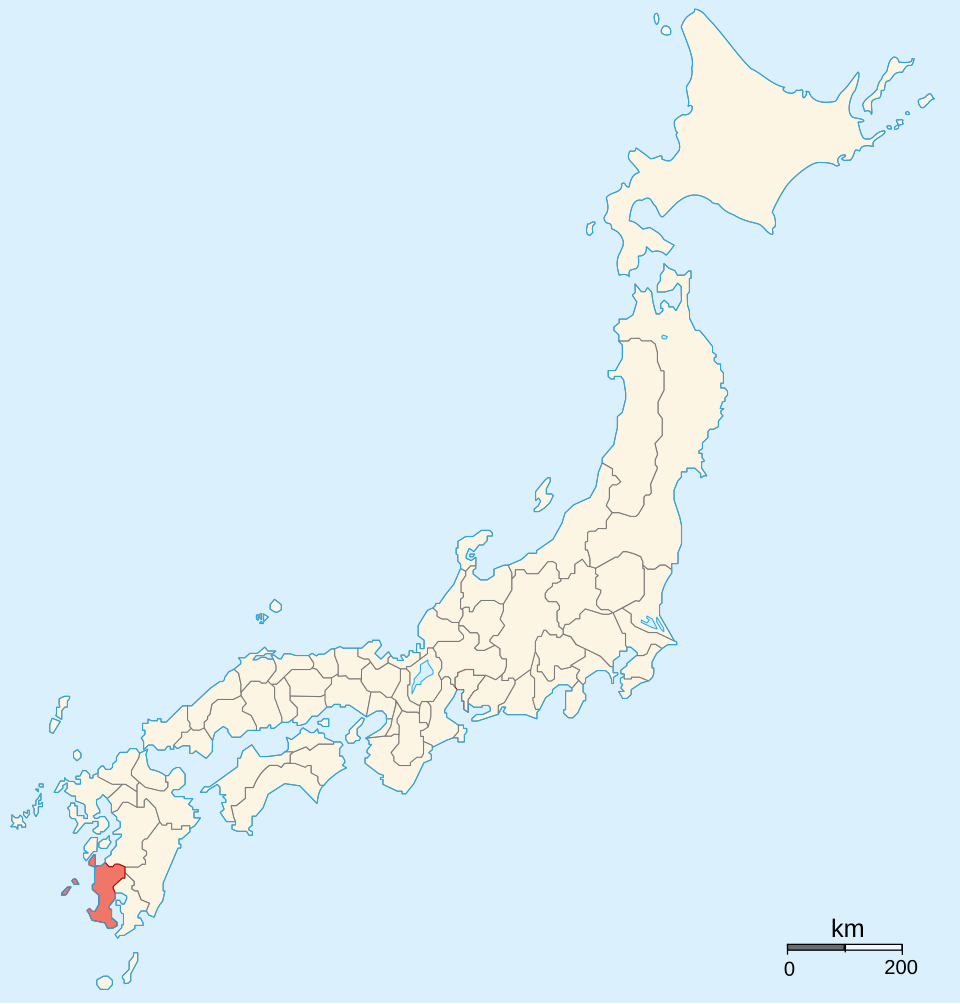
    The Shimazu, much like the Chosokabe before them, fought bravely, but they were outmatched from the start, and eventually, Yoshihisa, who had claimed his clan would never submit to an ‘upstart’, was forced to seek peace. The terms were harsh; the Shimazu were forced to give up almost all of Kyushu, and were confined to Satsuma Province in the southwest of the island (in the western half of modern Kagoshima Prefecture).

    Satsuma Province.
    By Ash_Crow – Own work, based on Image:Provinces of Japan.svg, CC BY 2.5, https://commons.wikimedia.org/w/index.php?curid=1691755

    The rest of Kyushu was divided up amongst Hideyoshi’s supporters, with the Otomo (who the invasion had nominally been in support of) receiving some, but not all of their lands back.

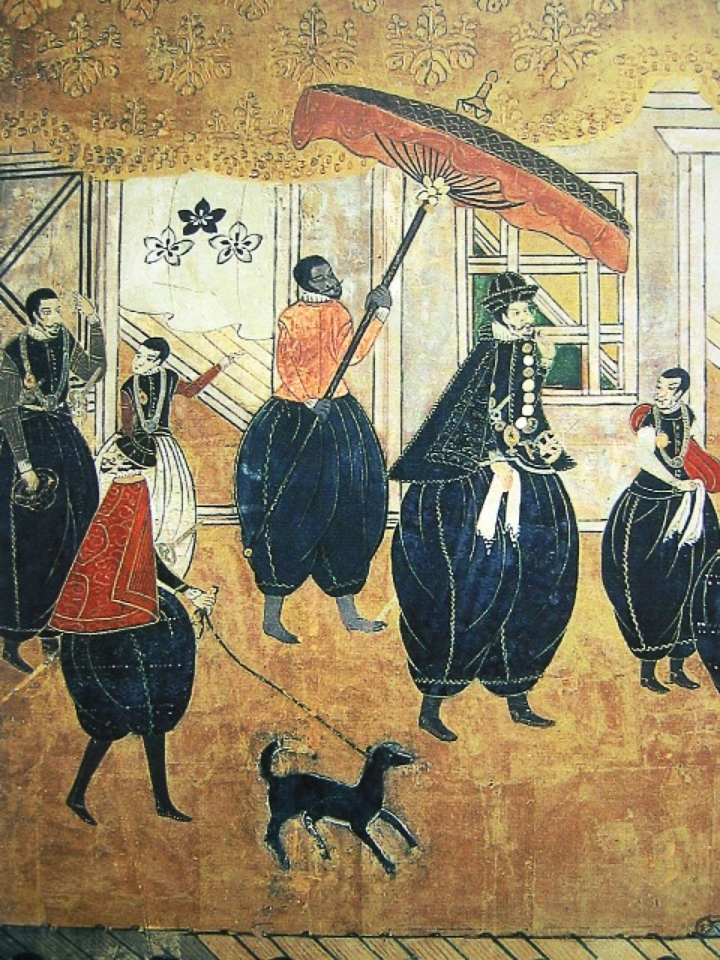
    It is at this point that Hideyoshi turned his attention to a group that have only been briefly mentioned thus far, but who had a significant presence on Kyushu, the Jesuits. We’ll have a detailed look at Portuguese activities in Japan in their own post, but to summarise, after the first arrival of Portuguese merchants in Japan in 1543, they had slowly, but steadily expanded their influence through commerical interests, and the spread of Christianity, ultimately being based at the port of Nagasaki.

    A contemporary depiction of a Portuguese trading ship of a type commonly seen at Nagasaki.

    Outside of Kyushu, the attitude of powerful Daimyo towards these Christians seems to have been fairly ambivalent, with most tolerating their presence, but few converting to the foreign religion. Hideyoshi himself issued permits for Christian priests to preach their religion in Osaka, and, according to some sources, he asked Jesuit Priest Gaspar Coelho to assist him in building an armada to be used in the conquest of China once Japan had been unified.

    This changed after the subjugation of Kyushu. Sources differ on exactly what occurred, with some blaming the machinations of the native Japanese Buddhist clergy, but the short version is that Hideyoshi became aware of the fact that Nagasaki had effectively been handed over to complete Portuguese control. They had fortified it and were apparently using it as a port through which non-Christian Japanese were sold out of the country as slaves.

    A contemporary image of Portuguese at Nagasaki. Though the trade was primarily in silks, spices, and silver, rumours of Japanese slaves being transported out of the country were enough to earn Hideyoshi’s ire.

    The issue of Japanese being sold as slaves by Portuguese merchants remains controversial (surprise, surprise), with debates raging over the extent of the practice and how involved the Japanese themselves were. There are contemporary sources which indicate that Japanese slaves could be found across Asia, and the concept of ‘unfree labour’ was already well established in Japan at this time, ranging from effective serfdom to labourers convicted to a term of service as punishment for a crime.

    Another issue is that one of the primary sources describing Portuguese involvement in slavery also describes them as a people that skin cows and horses alive, and eat the meat raw with their bare hands, suggesting that the purpose of such ‘records’ was more about demonising the Portuguese than recording actual events.

    A contemporary depiction of Portuguese in Japan. Though not all sources paint them in a negative light, the foreign visitors were often looked on as strange and even barbarous by comparison.

    Regardless of how extensive the trade was, it provided a convenient enough excuse for Hideyoshi to act. Though highlighting the fortifications at Nagasaki, and the selling of Japanese as slaves, modern historians more generally agree that the move against the Christians was more about consolidating power, as Hideyoshi believed that Christian theology was a direct threat to the traditional Japanese belief in a divine Emperor, from whom Hideyoshi’s power ultimately derived.

    Another theory is that Hideyoshi wanted to control trade with the West, believing (erroneously) that the trade was controlled by the Jesuits, when in reality, religious and commercial interests were separate, and often in conflict (the Jesuits, for example, actively opposed enslaving Japanese) This theory suggests that Hideyoshi hoped that removing the priests would allow him to take direct control of the trade.

    A contemporary image of a Christian Mass in Japan. Hideyoshi believed that the priests controlled the merchants.

    Whether he was motivated by political, religious, or economic reasons (or all three), Hideyoshi issued what became known as the Bateren expulsion order (bateren being the Japanese word for Christian priests, derived from the Latin Patren) in 1587. What followed was a brief campaign of repression against Christianity; the Jesuit base in Kyoto was burned, and territory around Nagasaki was seized.

    Ultimately, however, Hideyoshi seems to have largely ignored his own order, keeping several Christian priests as interpreters and scribes, and allowing trade to continue practically unmolested. For now, at least, Hideyoshi had bigger problems than Christian priests.

    Hojo Ujinao

    Sources
    https://ja.wikipedia.org/wiki/%E8%B1%8A%E8%87%A3%E7%A7%80%E5%90%89
    https://ja.wikipedia.org/wiki/%E4%B9%9D%E5%B7%9E%E5%B9%B3%E5%AE%9A
    https://ja.wikipedia.org/wiki/%E3%83%90%E3%83%86%E3%83%AC%E3%83%B3%E8%BF%BD%E6%94%BE%E4%BB%A4
    https://ja.wikipedia.org/wiki/%E4%B9%9D%E5%B7%9E%E5%9B%BD%E5%88%86
    https://ja.wikipedia.org/wiki/%E6%83%A3%E7%84%A1%E4%BA%8B%E4%BB%A4
    https://en.wikipedia.org/wiki/Slavery_in_Japan

  • The Second Unifier – Toyotomi Hideyoshi. Part Four.

    The Second Unifier – Toyotomi Hideyoshi. Part Four.

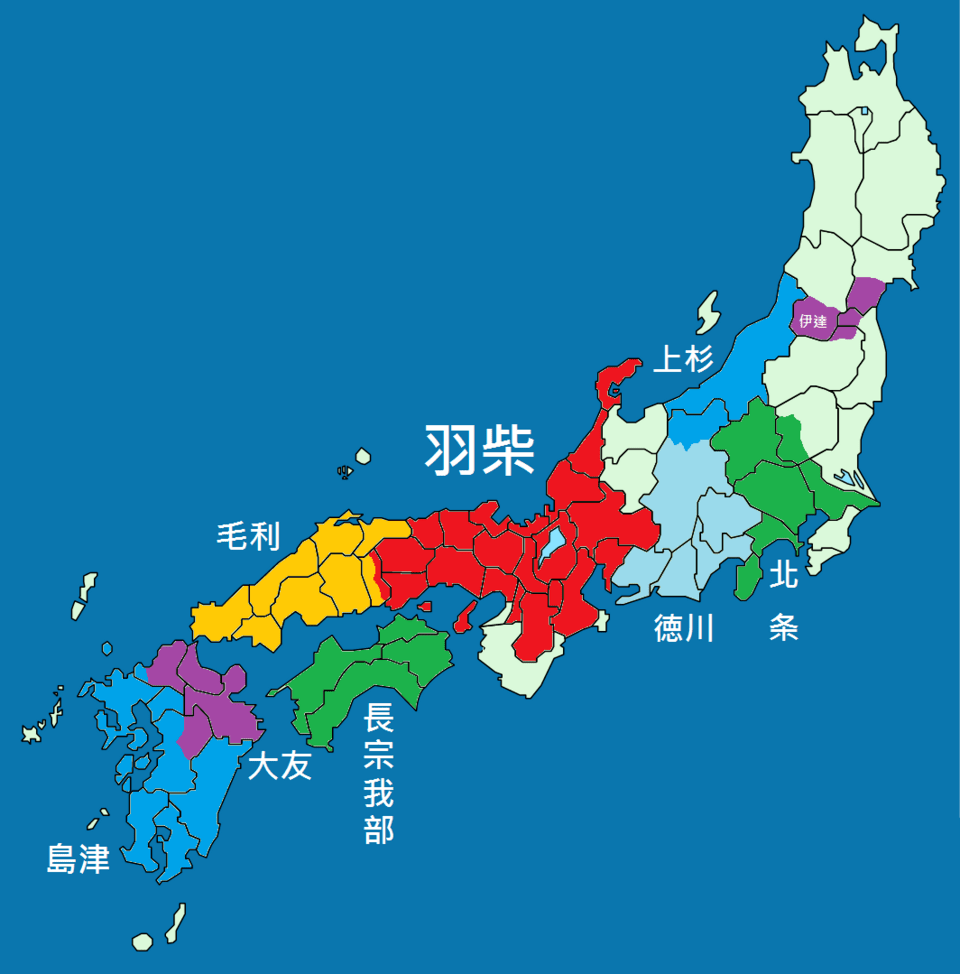
    Despite an ultimately unsuccessful campaign against Tokugawa Ieyasu, by late 1584, Hideyoshi was the most powerful man in the realm. Having secured his position as Oda Nobunaga’s successor, he dominated central Japan and could call on economic and martial resources that dwarfed those of his rivals.

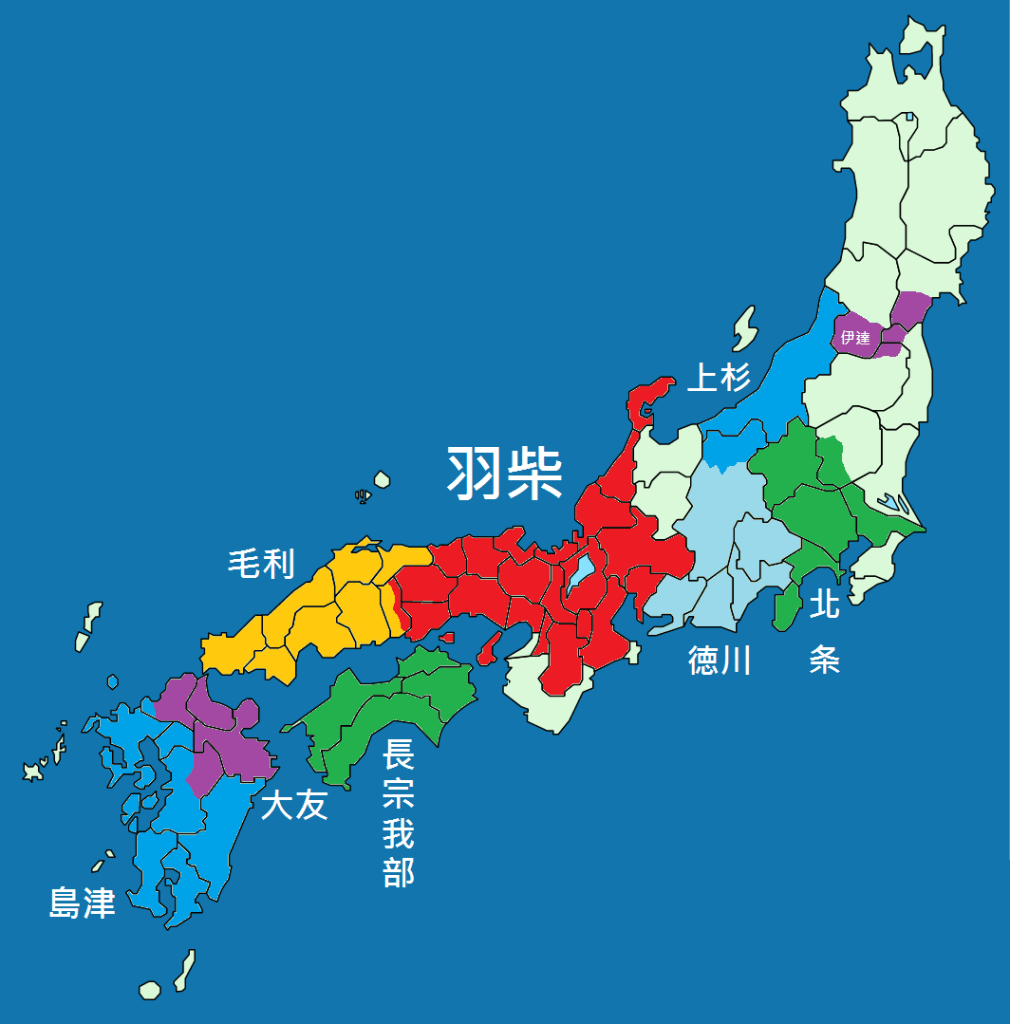
    The strategic situation in late 1584, Hideyoshi controlled the territory in red.
    By Alvin Lee – Own work, CC BY-SA 4.0, https://commons.wikimedia.org/w/index.php?curid=39198357

    Despite this, he was not yet unchallenged. To the west, the Mori remained undefeated, to the east, was Tokugawa Ieyasu, and further away, the Hojo, who had remained untouched by Nobunaga’s conquests, and to the south, in Kii Province, the locals coalesced around fiercely independent religious and social movements that resisted any attempts to impose central rule.

    Meanwhile, Hideyoshi solidified his political power, being elevated to the Third Rank of the nobility in November 1584 and to the Second Rank in March 1585. Around this time, some sources suggest that the Imperial Court even went so far as to offer him the title of Shogun, only for Hideyoshi to refuse, though the exact nature of the offer, if it existed at all, is unclear.

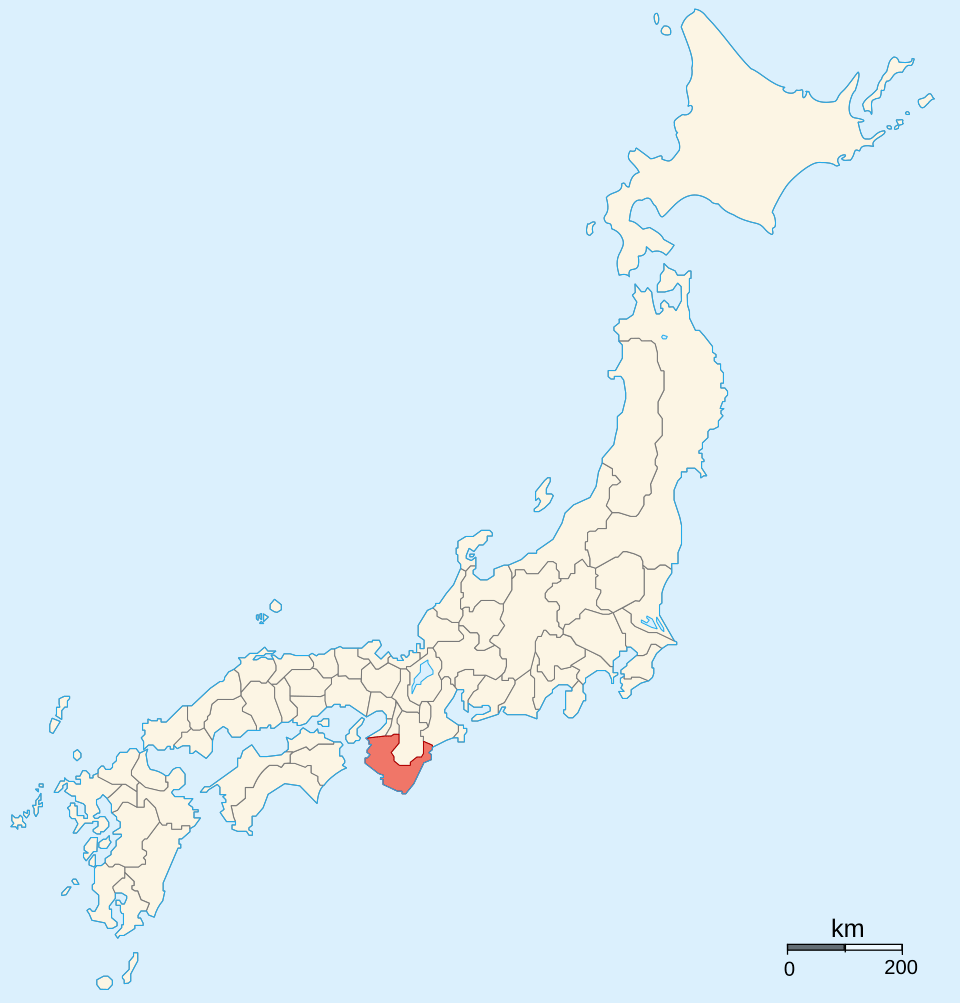
    Kii Province.
    By Ash_Crow – Own work, based on Image:Provinces of Japan.svg, CC BY 2.5, https://commons.wikimedia.org/w/index.php?curid=1683109

    With his position secured, Hideyoshi turned his attention to Kii Province. We’ve spoken about the power of certain religious institutions before, and nowhere was this more apparent than in Kii (sometimes called Kishu). Luis Frois, a well-known Portuguese writer at the time, referred to the area as under the control of five “Great Republics”, which weren’t democracies in the way we’d recognise today, but were strongly independent polities with extensive territories, economic might, and military strength.

    In 1570, Nobunaga began what would prove to be a long campaign against the power of the Ikko-Ikki, based at Honganji Temple. The warrior monks of Kii Province were a key ally of the Ikko-Ikki, and in 1576, Nobunaga dispatched an army against them, aiming to reduce their ability to support his enemies elsewhere.

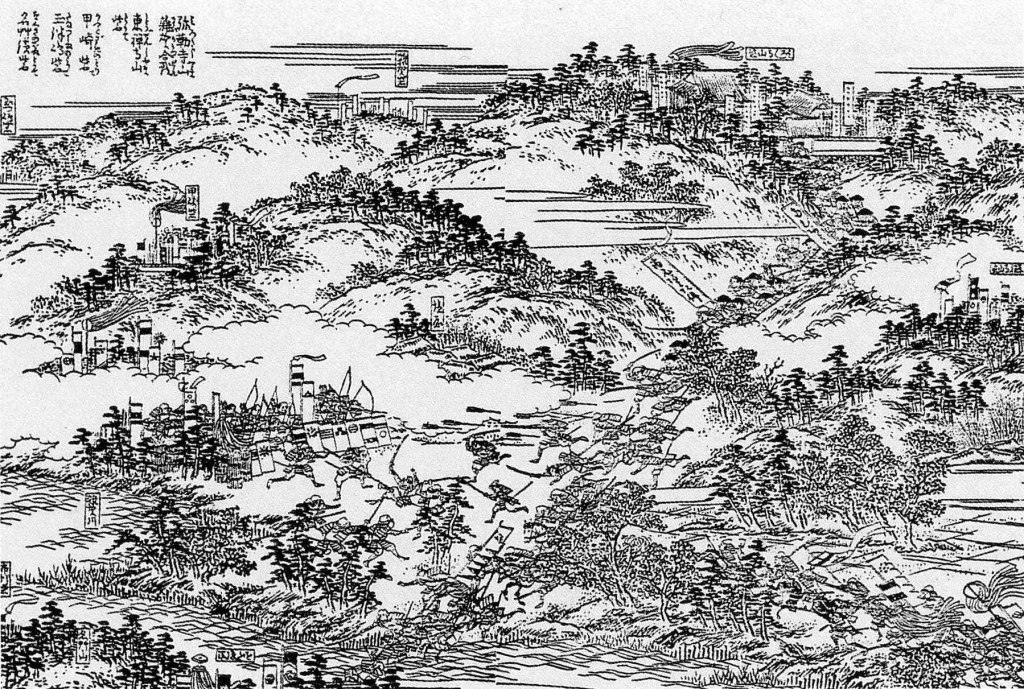
    A semi-contemporary depiction of Nobunaga’s attempts to subdue Kii Province.

    Despite being defeated on the battlefield, the warriors of Kii engaged in guerrilla warfare, led most famously by the Saika-shu, an organisation made up of local samurai and mercenaries, which was well known for its heavy (and skilful) use of firearms. Nobunaga eventually signed a peace treaty and withdrew, allowing his enemies to claim that they had actually defeated him.

    Nobunaga’s death in 1582 put an end to any further campaigning, and for a time, at least, Kii Province was left alone, though no one believed the peace would last. In early spring 1586, Hideyoshi, at the head of an army of some 100,000 men, invaded with the intention of crushing the independent ‘Republics’ for good.

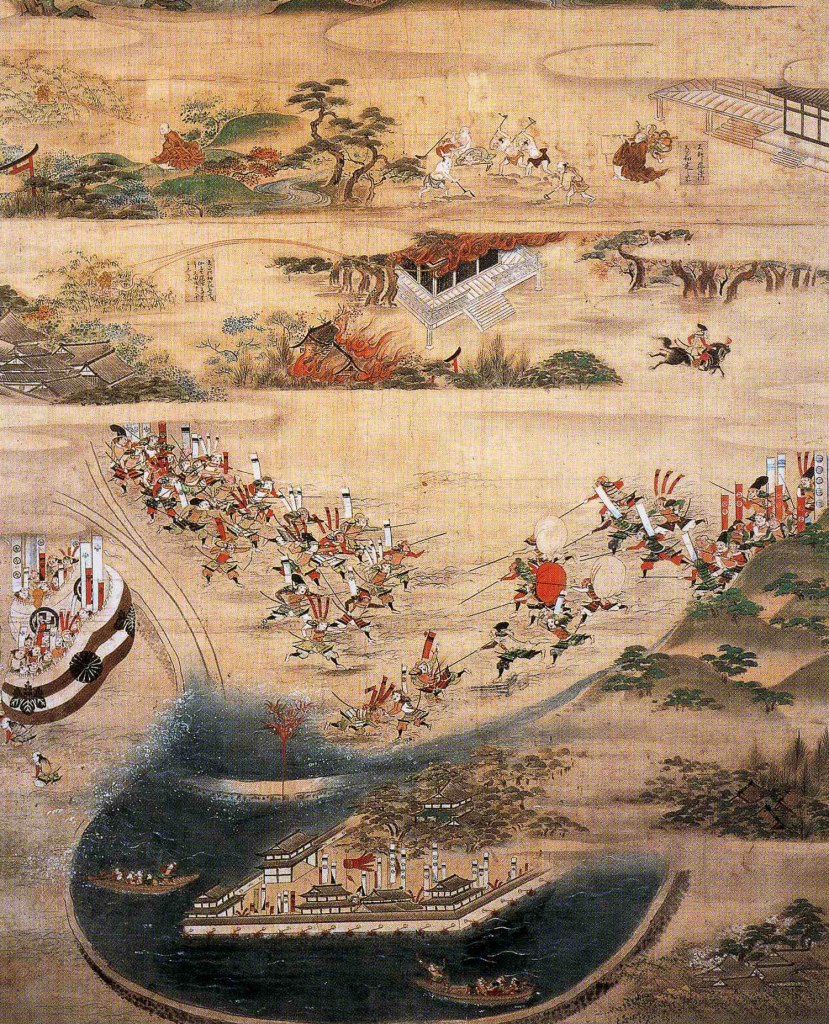
    A depiction of Hideyoshi’s attack on Kii Province.

    The campaign was a true demonstration of Hideyoshi’s new power. Though the Saika-shu and others fought bravely, they were swiftly overwhelmed. Some scholars speculate that the Saika and their allies underestimated Hideyoshi. In the earlier Sengoku Period, it had often been enough to inflict heavy casualties in an initial battle, which would force the attackers to either negotiate or back off.

    These tactics had worked against Nobunaga, who had ultimately been unable to secure decisive control over Kii, for fear of tying down too many men. Hideyoshi had no such hesitation, and even though his losses were heavy, he kept pushing on, and the Saika, who were often hugely outnumbered, were swept aside.

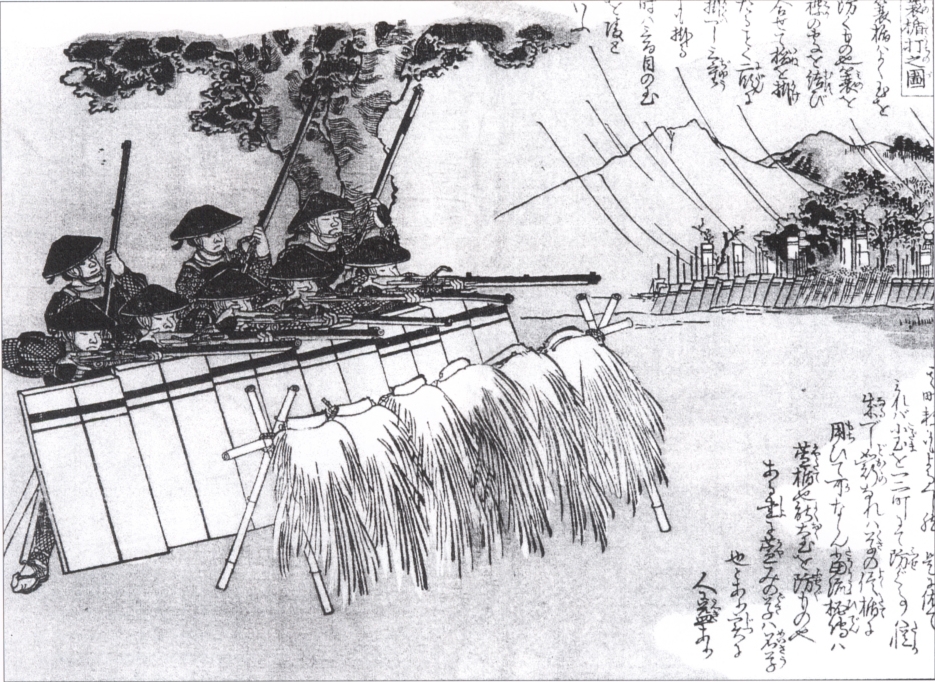
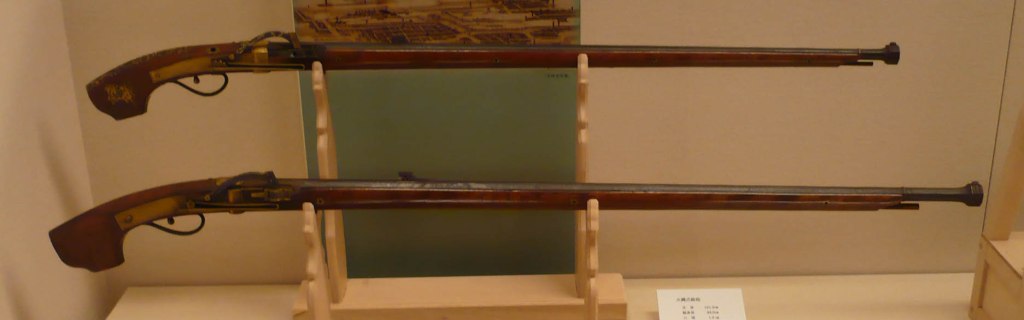
    Firearms of the type used effectively, but ultimately unsuccessfully by the Saika-shu.

    Hideyoshi was able to secure control of Kii in the short term, but his hold over it was always fragile, and there would be several more outbreaks of rebellion in the coming years. In fact, it wouldn’t be until 1614, long after Hideyoshi had passed away, that Kii could be truly said to have been pacified.

    After this, Hideyoshi turned his attention to Shikoku and the powerful Chosokabe Clan. Once allies of Nobunaga, the Chosokabe had fallen foul of his ambitions and had been under threat of invasion at the time of his death at Honnoji.

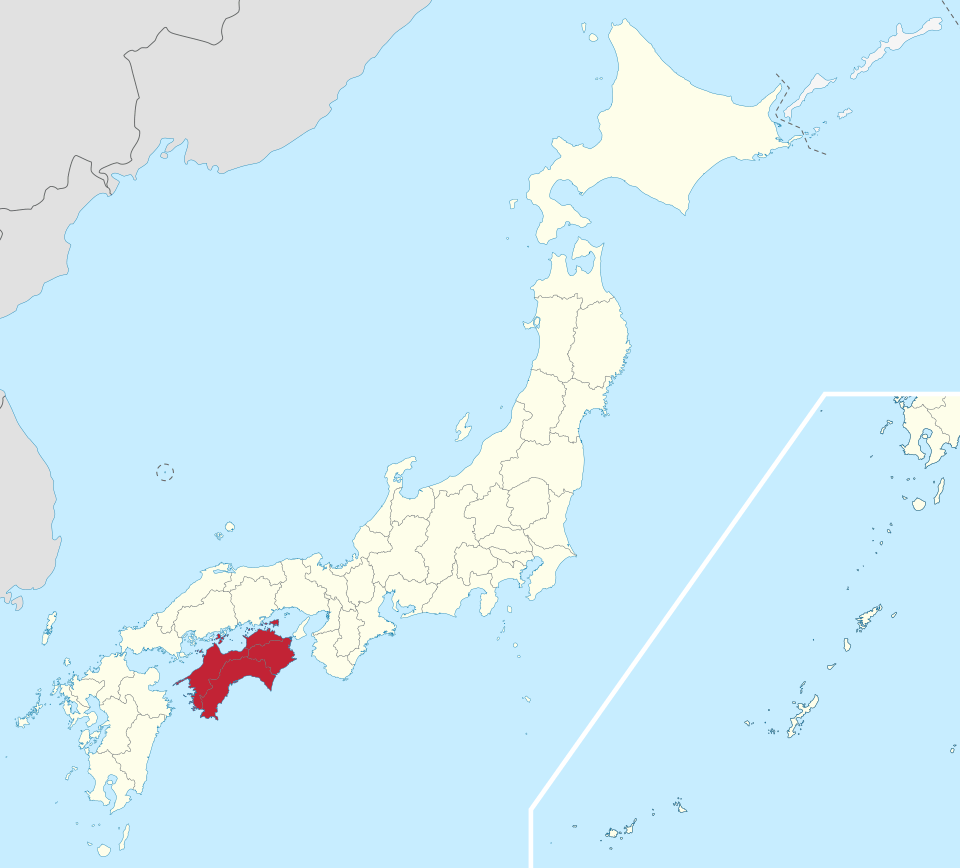
    Shikoku.
    By TUBS – This vector image includes elements that have been taken or adapted from this file:, CC BY-SA 3.0, https://commons.wikimedia.org/w/index.php?curid=16385942

    An army under Nobunaga’s third son, Nobutaka, had been gathered at Sumiyoshi (in modern Osaka) with the purpose of attacking Shikoku; in fact, they had been meant to set out on the same day that Nobunaga was killed, and news of his death demoralised the army, some of which simply went home.

    In the aftermath of Nobunaga’s death, the Chosokabe had consolidated control of all of Shikoku and lent support to opponents of Hideyoshi, notably Shibata Katsuie, Tokugawa Ieyasu, and the Saika-shu of Kii Province. None of these enemies had been able to overcome Hideyoshi, however, and it was probably no surprise when he turned his vengeful eye on the Chosokabe themselves.

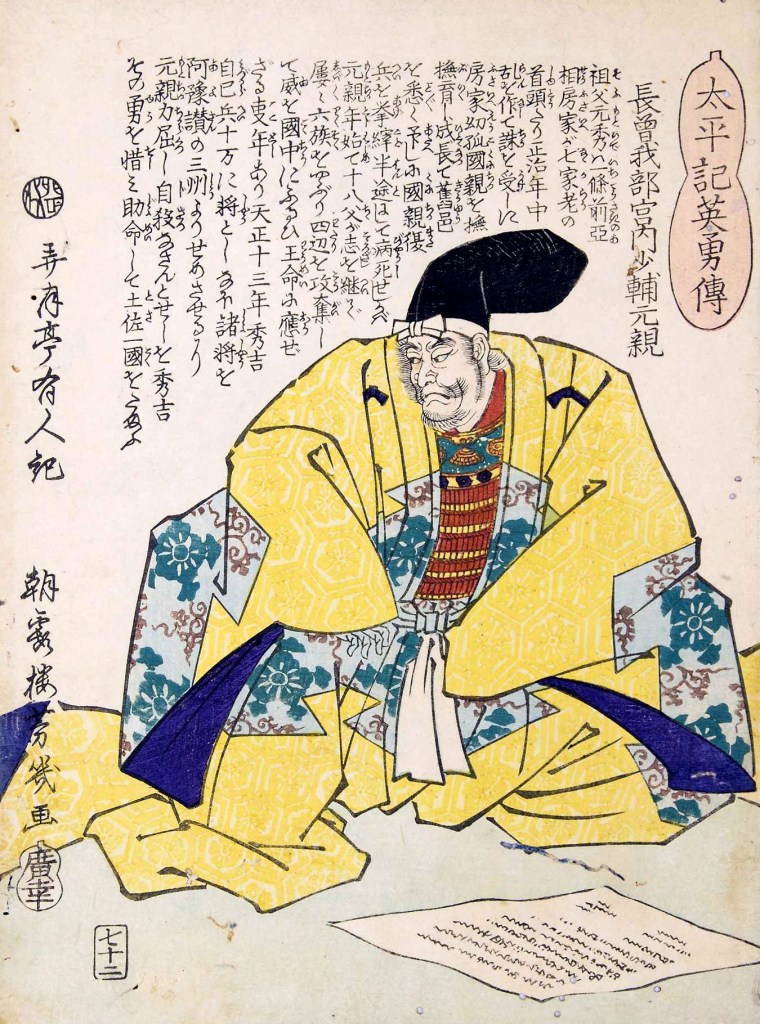
    Chosokabe Motochika, Lord of the Chosokabe at the time of Hideyoshi’s invasion.

    There were some attempts at negotiation, but Hideyoshi’s demands that the Chosokabe give up three of the four provinces of Shikoku were unacceptable. The strategic situation for the Chosokabe was made worse when the Mori, one-time antagonists of Hideyoshi, instead made a permanent peace with him. Some sources suggest that it was at this point that the Mori submitted to Hideyoshi outright.

    With the support of the Mori and their powerful navy, Hideyoshi launched a three-pronged attack on Shikoku, which the Chosokabe were hard-pressed to oppose. Outnumbered some 3 to 1, the Chosokabe fought bravely, but the campaign was over quickly. From June to August 1585, there was a series of battles and sieges that invariably resulted in Chosokabe defeat.

    A 19th-century depiction of the Invasion of Shikoku.

    Eventually, despite claiming he would rather fight to the end, Chosokabe Motochika surrendered at the urging of his senior vassals. As punishment for his defiance (or reward for his surrender), Hideyoshi confiscated three of the four Shikoku Provinces, leaving the Chosokabe with their home province of Tosa and an obligation to provide Hideyoshi with up to 3,000 troops for any future campaign and hostages to ensure the peace.

    During the Shikoku Campaign, which was led by his brother, Hideyoshi was appointed Kampaku by the Imperial Court. This was a result of a political crisis that had been ongoing since before Nobunaga’s death in 1582. At the time, the Imperial Court had (allegedly) invited Nobunaga to become Shogun, or Kampaku (Regent). Both contemporary and modern scholars disagree on Nobunaga’s response to this offer, but his death in June of that year ultimately rendered it moot.

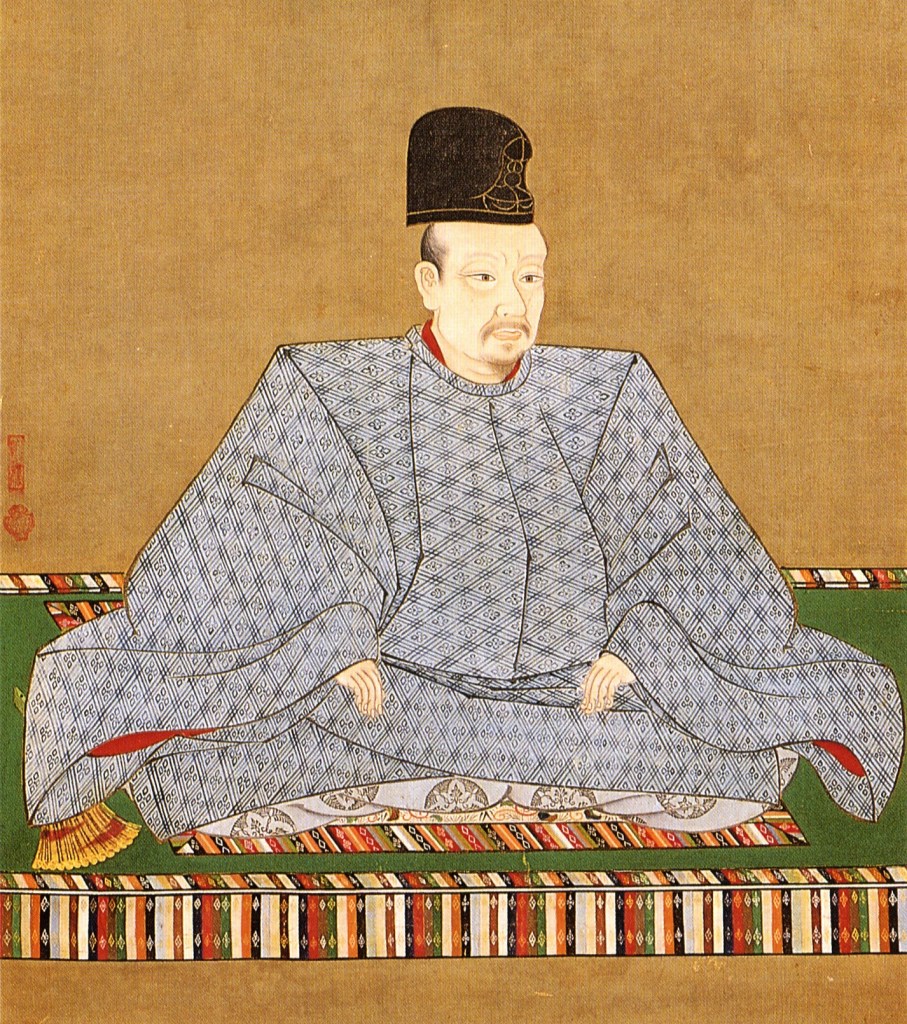
    Emperor Go-Yozei, who was the sovereign during this time.

    What followed was a drawn-out political squabble between rival factions at court over who would ultimately take the position of Regent. We’ve spent a lot of time looking at how the Imperial Court was a decorative but ultimately impotent organisation by this point, and any title the Emperor might bestow would be largely symbolic without any external political power to back it up.

    Into this silk-clad quagmire stepped Hideyoshi. Traditionally, the position of Regent had rotated amongst five prestigious warrior families, of which Hideyoshi was not a member. To overcome this issue (which was one of tradition, rather than law), he was formally adopted as the son of Konoe Sakahisa (who was less than a year older than him) in July 1585, being named Kampaku shortly afterwards.

    Konoe Sakahisa, who formally adopted Hideyoshi.
    Leehiroki258 – 投稿者自身による著作物, CC 表示-継承 4.0, https://commons.wikimedia.org/w/index.php?curid=162775880による

    There was supposedly an agreement in which the childless Hideyoshi would take the position as a temporary solution to the crisis, before handing it over to the Konoe family’s chosen heir at a later date. Hideyoshi had other ideas, however. In 1586, he petitioned the Emperor for a new family name, which the Emperor duly bestowed. From then on, Hideyoshi would be known as Toyotomi Hideyoshi, the name by which he is best remembered in English sources.

    Hideyoshi would then adopt the Emperor’s younger brother, Prince Hachijo, as his son and eventual successor. This was a clear breach of the agreement with the Konoe, but since Hideyoshi was the most powerful man in the realm, and the proposed heir was a member of the Imperial Family, there was nothing anyone could do about it.

    Prince Hachijo

    Hideyoshi went further, seeking to replace the powerless Imperial aristocracy with a new “Samurai Nobility”. For centuries, the ‘Nobles’ had held all the prestige, but practically none of the actual power, which was in the hands of the Samurai after long years of civil war.

    Hideyoshi sought to address this by bestowing titles on some of the other powerful Daimyo, including Tokugawa Ieyasu and Ishida Mitsunari, appointments that would have long-term political repercussions.

    Ishida Mitsunari, we haven’t talked about him much, but he’s going to become very important later.

    Another attempt was made to force obedience from Ieyasu when Hideyoshi demanded that he hand over hostages to ensure ongoing peace. Ieyasu refused, and Hideyoshi began planning a large-scale military campaign to finally bring Ieyasu to heel. The massive Tensho Earthquake in January 1586 caused severe damage to Hideyoshi’s capital at Osaka and several other castles and staging areas, bringing an end to the plans, and causing Hideyoshi to adopt a more conciliatory policy towards Ieyasu.

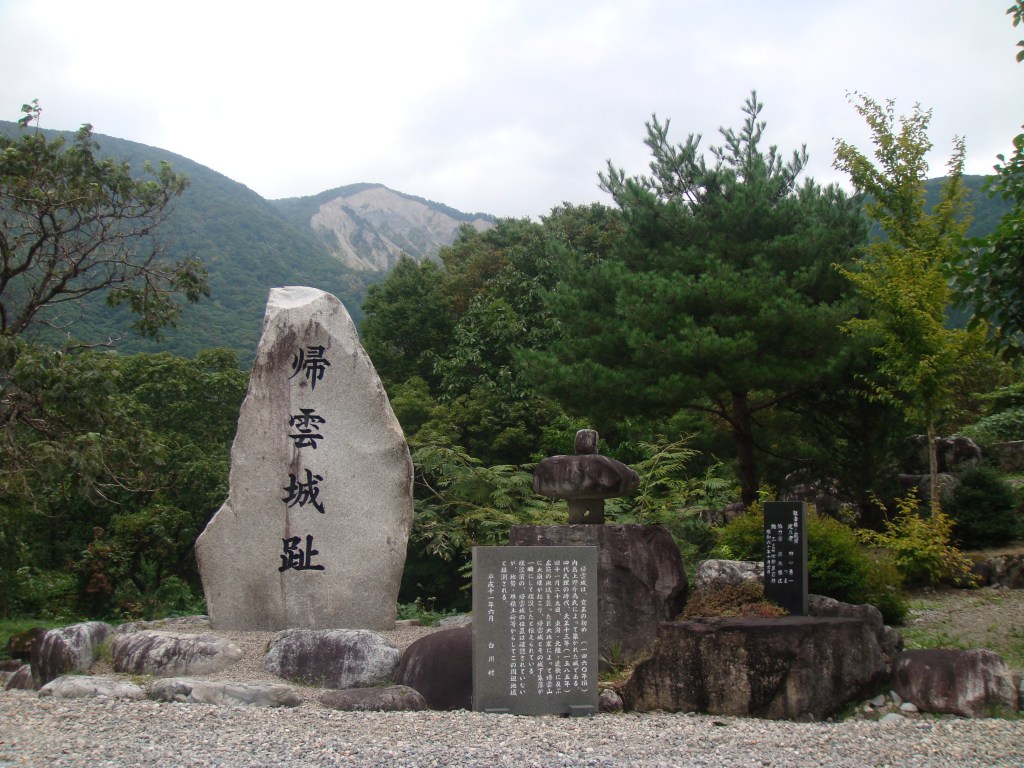
    A monument at the site of Kaerikumo Castle, which was destroyed in a landslide during the 1586 earthquake. The evidence of the landslide can be seen on the hill in the background.

    Later that year, Ieyasu would marry Hideyoshi’s younger sister, Princess Asahi, and he would later travel to Kyoto and swear allegiance to Hideyoshi as Regent. Despite this nominal submission, Hideyoshi had failed to subdue Ieyasu, whose military power remained intact.

    Sources
    https://ja.wikipedia.org/wiki/%E8%B1%8A%E8%87%A3%E7%A7%80%E5%90%89
    https://ja.wikipedia.org/wiki/%E6%9C%9D%E6%97%A5%E5%A7%AB
    https://ja.wikipedia.org/wiki/%E9%96%A2%E7%99%BD%E7%9B%B8%E8%AB%96
    https://ja.wikipedia.org/wiki/%E5%85%AB%E6%9D%A1%E5%AE%AE%E6%99%BA%E4%BB%81%E8%A6%AA%E7%8E%8B
    https://ja.wikipedia.org/wiki/%E8%BF%91%E8%A1%9B%E5%89%8D%E4%B9%85
    https://ja.wikipedia.org/wiki/%E5%9B%9B%E5%9B%BD%E6%94%BB%E3%82%81
    https://ja.wikipedia.org/wiki/%E4%B8%B8%E5%B1%B1%E5%9F%8E%E3%81%AE%E6%88%A6%E3%81%84
    https://ja.wikipedia.org/wiki/%E5%9B%9B%E5%9B%BD%E5%9B%BD%E5%88%86
    https://ja.wikipedia.org/wiki/%E5%9B%9B%E5%9B%BD%E5%B9%B3%E5%AE%9A
    https://ja.wikipedia.org/wiki/%E7%B4%80%E5%B7%9E%E5%BE%81%E4%BC%90
    https://ja.wikipedia.org/wiki/%E9%9B%91%E8%B3%80%E8%A1%86
    https://ja.wikipedia.org/wiki/%E6%A0%B9%E6%9D%A5%E8%A1%86
    https://en.wikipedia.org/wiki/Kii_Province
    https://en.wikipedia.org/wiki/1586_Tensh%C5%8D_earthquake
    https://en.wikipedia.org/wiki/Kaerikumo_Castle

  • The Second Unifier – Toyotomi Hideyoshi. Part Three.

    The Second Unifier – Toyotomi Hideyoshi. Part Three.

    Hideyoshi’s victory over Nobunaga’s killer, Akechi Mitsuhide, left him in a strong, but far from unchallenged position. Though Hideyoshi was arguably the strongest of Nobunaga’s remaining supporters, his power was not so great that he could overcome the others on the battlefield.

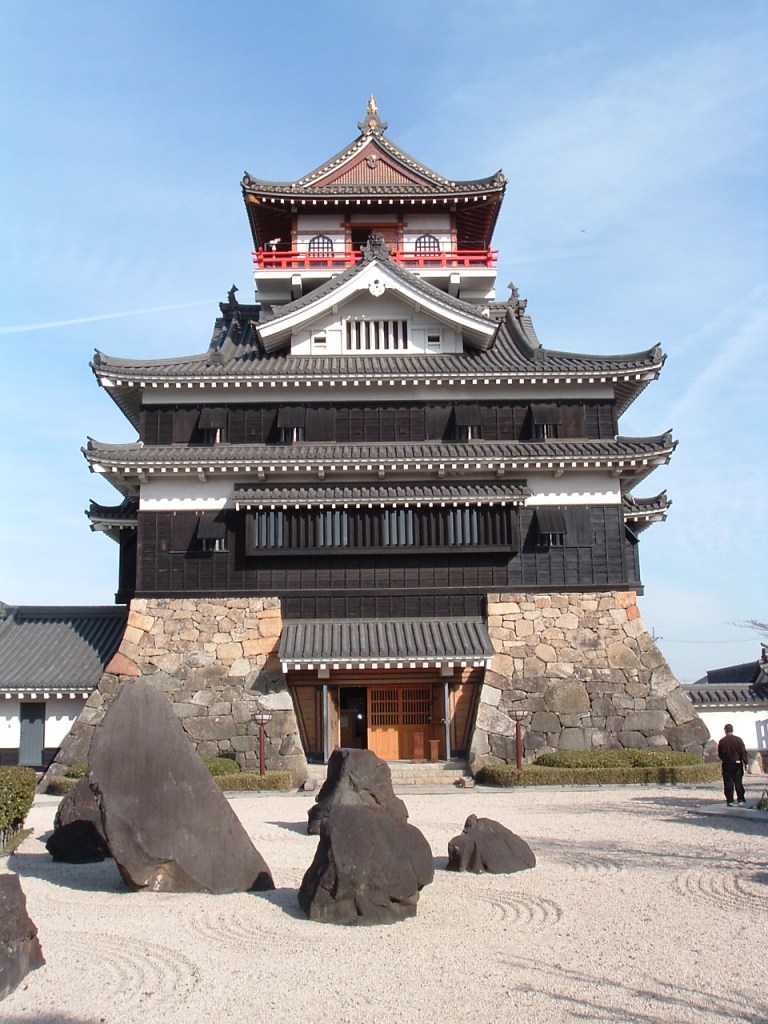
    Instead, a conference was called at Kiyosu Castle on July 16th, 1582. Historians still debate exactly what Nobunaga’s plans had been for his succession, given that his second son, and most obvious heir, Nobutada, had been amongst the dead at the Honnoji Incident. Two camps quickly emerged: Hideyoshi, supporting Nobutada’s son, Hidenobu, and Shibata Katsuie, who supported Nobunaga’s third surviving son, Nobutaka.

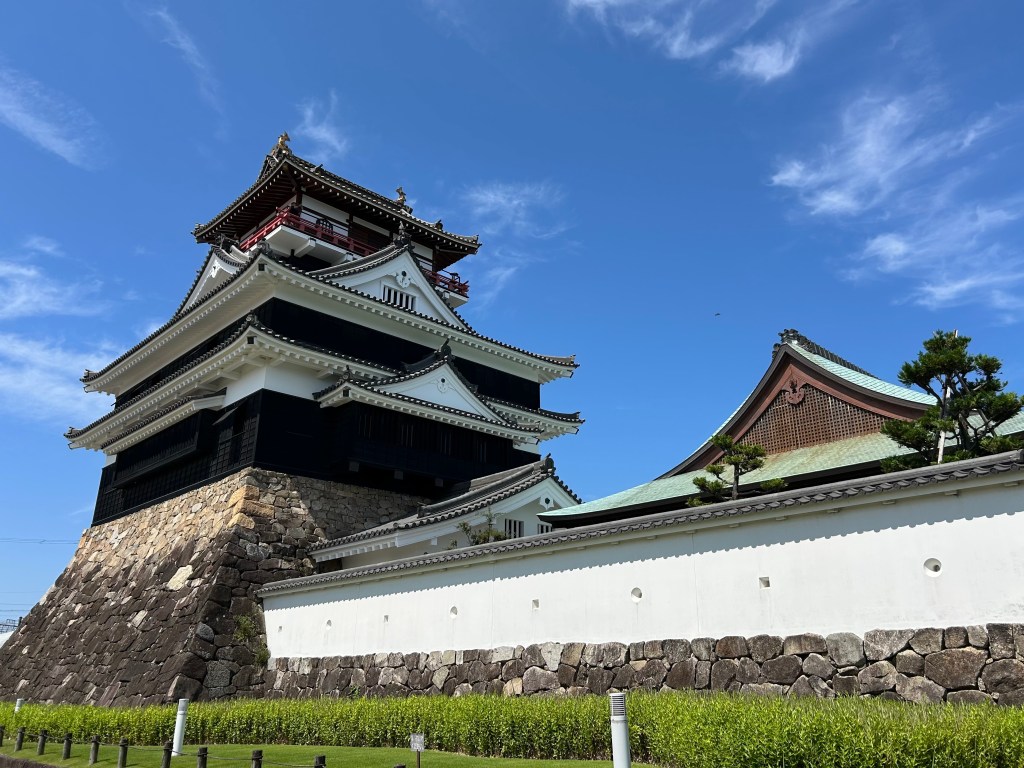
    The reconstructed Kiyosu Castle as it appears today.
    Oliver Mayer, CC 表示-継承 3.0, https://commons.wikimedia.org/w/index.php?curid=230610による

    The exact course of the meeting isn’t clear, but by the end of it, Hideyoshi’s faction was in the ascendancy, and Hidenobu, at just two years old, was declared Nobunaga’s heir, with Nobutaka officially acting as his guardian. There was an attempt to mollify Katsuie by having him marry Nobunaga’s sister, Oichi, a woman of impeccable rank, but the seeds of conflict had already been sown.

    In October 1582, Hideyoshi held Nobunaga’s formal funeral, and played a central, highly visible role in the ceremony, cementing his position as chief amongst Nobunaga’s retainers. Not long after this, Katsuie, supported by Nobutaka, issued letters of impeachment against Hideyoshi, who responded by demanding that Nobutaka, who had custody of the ‘heir’, Hidenobu, return him to Azuchi, as per the Kiyosu Agreement.

    Oda Nobutaka

    When Nobutaka refused, Hideyoshi used this as justification to renounce the agreement and raise an army against him. Katsuie, trapped in the north by snows and the ongoing war with the Uesugi, was unable to send help, and in a short, sharp campaign, Hideyoshi raised an army of some 50,000, forced Nobutaka to retreat, and eventually surrender, handing over Hidenobu and sending his mother and daughter as hostages to secure the peace.

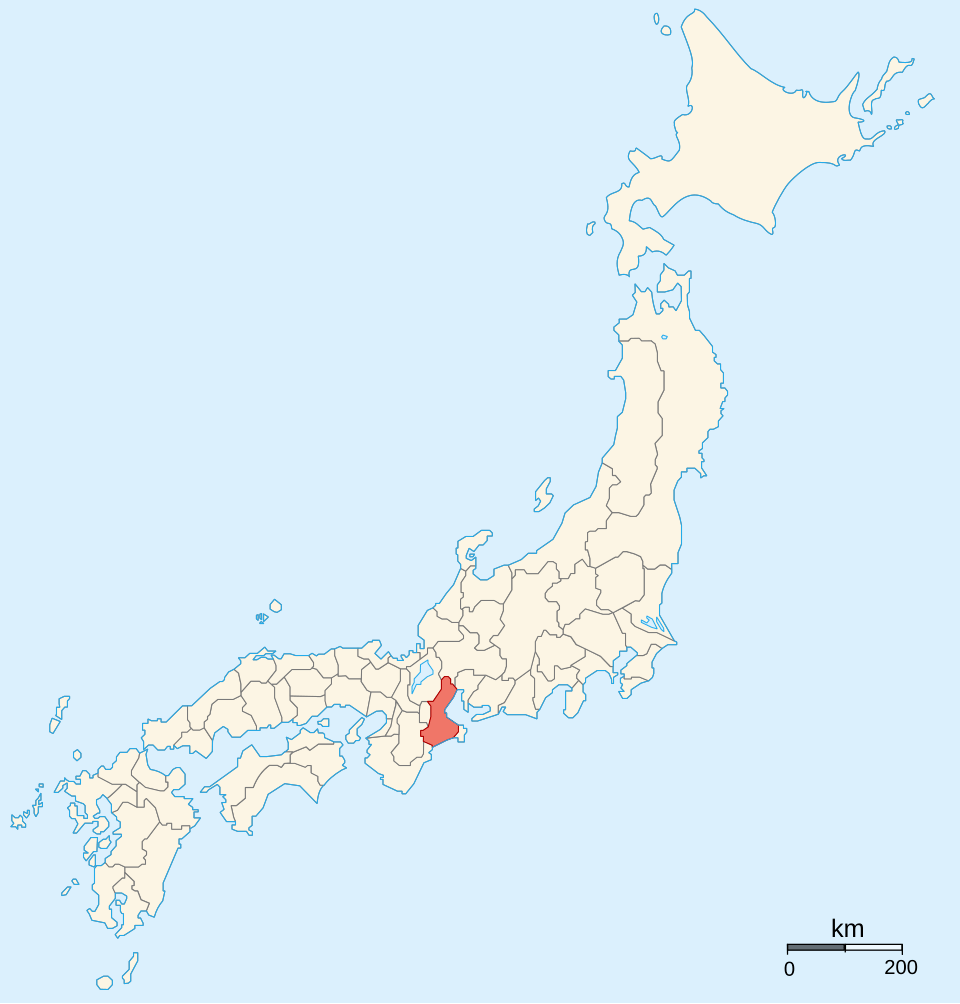
    This victory did not end the war, however, and shortly after the New Year, Takigawa Kazumasu (also known as Sakon) launched successful attacks in Ise Province. Hideyoshi responded with counterattacks against Kuwana and Nagashima Castles, but the attacks failed, and he was forced to withdraw, despite an overall advantage in numbers, leaving northern Ise Province (temporarily) in the hands of his enemies.

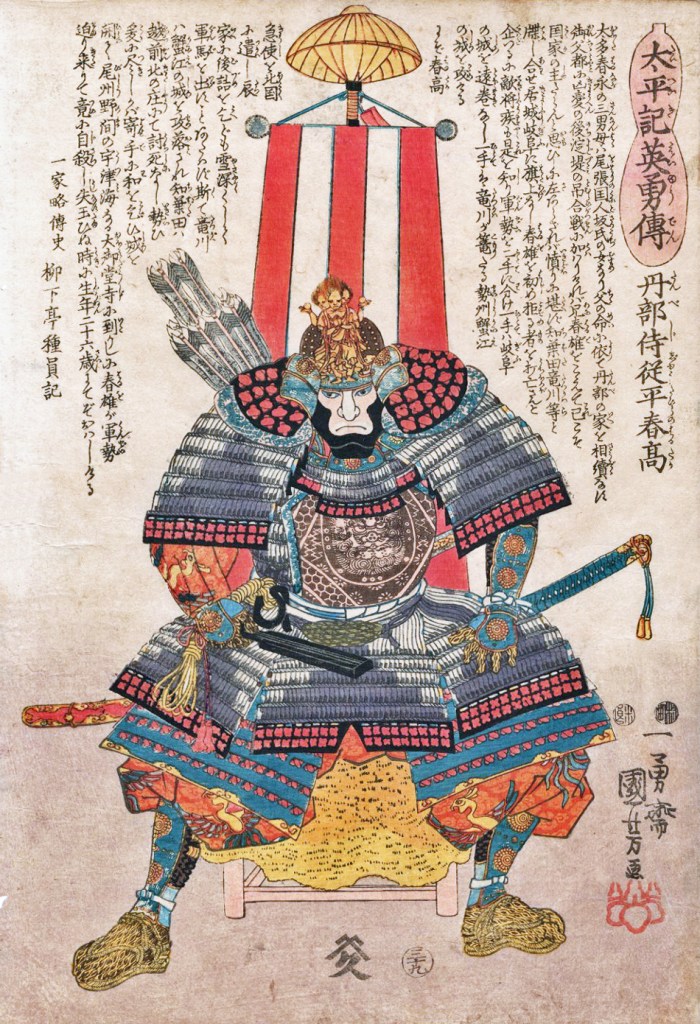
    Ise Province
    By Ash_Crow – Own work, based on Image:Provinces of Japan.svg, CC BY 2.5, https://commons.wikimedia.org/w/index.php?curid=1682471

    The situation got worse for Hideyoshi when Katsuie himself led an army of 30,000 into Omi Province, whilst Nobutaka raised another army at Gifu Castle. Katsuie also made contact with Mori Terumoto, hoping to secure his support in the battle to come. The Mori never outright refused, but instead adopted a ‘wait and see’ approach, as it was not immediately clear which side would win.

    Throughout spring and early summer, the two sides clashed in skirmishes in Ise, Mino, and Omi Provinces, and the momentum would swing back and forth for some time until a decisive engagement near the fortress at Shizugatake. Hideyoshi’s forces were aided by the timely arrival of reinforcements from across Lake Biwa, and the betrayal of Maeda Toshiie, one of Katsuie’s most important generals, who switched to Hideyoshi’s side, for reasons that are still debated.

    A 19th-century depiction of Hideyoshi on the night before the Battle of Shizugatake.

    By all accounts, Katsuie and his army forced tenaciously, but with Toshiie’s betrayal, they were outflanked and outnumbered, and Katsuie was forced to retreat. He got as far as Kitanosho Castle, in modern Fukui, where Hideyoshi’s forces laid siege.

    The night before the final assault, Katsuie held a final banquet with his close family and retainers, whilst his wife, Oichi, made arrangements for her three daughters to be protected by Hideyoshi and avoid what was to come. Despite pleas to save herself, Oichi refused to leave her husband’s side.

    A later depiction of Shibata Katsuie preparing for battle, with Oichi beside him.

    The attack started at dawn, and despite stiff resistance, by midday, the battle was clearly lost, and Katsuie retreated to the main castle, where he and 80 members of his family, including Oichi, killed themselves. Calling it ‘suicide’ is perhaps a bit generous, as the records suggest that a large number of the dead were children. When it was over, Katsuie’s forces ignited a store of gunpowder, blowing the tower apart and bringing a spectacular end to the Shibata Line.

    “Katsuie, a martial artist, fought seven times but was unable to defend himself. He climbed to the ninth floor, the highest level of the main tower, and addressed the entire group, loudly proclaiming, “Watch Shuri’s hara-kiri and learn from it.” The samurai, with their hearts in tears, wet their armor sleeves. As everyone fell silent, Katsuie stabbed his wife, children, and others to death, then committed seppuku with 80 others. It was the hour of the tiger (5:00 PM).”

    Hideyoshi’s letter to Kobayakawa Takakage dated May 15, 1583,

    Just a side note, the actual record of Katsuie’s suicide is pretty harrowing stuff, and it’s always difficult to read about the death of women and children who weren’t guilty of anything other than being related to the losers. This kind of thing was expected, though; even children weren’t generally shown mercy, and though there are notable examples (Oichi’s daughters, for instance), if a child was caught in a siege, they generally died in the same manner as their parents.

    With Katsuie crushed, Hideyoshi was able to extend his direct control over the northern provinces of Koto, Noto, and Echizen, and when Nobutaka committed seppuku, and Kazumasu surrendered, Hideyoshi had established himself as the most powerful man in the realm and while Hidenobu (still just an infant) remained as the nominal ‘heir’ there was no no doubt that Hideyoshi was in charge.

    An image of Hideyoshi carrying Hidenobu at the time of the Kiyosu Conference.

    In 1583, construction began on Osaka Castle, built on the former site of the Ishiyama Hongan-ji Temple complex. It would eventually become Hideyoshi’s base and was widely considered one of Japan’s finest castles. Meanwhile, in the Kanto, a marriage alliance between the Tokugawa and Hojo presented a clear threat to Hideyoshi’s power.

    In early 1584, Oda Nobukatsu, another son of Nobunaga, rebelled against Hideyoshi, quickly gaining the support of Tokugawa Ieyasu and Chosokabe Motochika, who raised armies of their own in opposition to Hideyoshi. Despite a huge advantage in manpower (some sources say 3-to-1), Hideyoshi struggled to achieve a decisive victory.

    Tokugawa Ieyasu

    Some initial success in Ise Province was followed by a defeat at the Battle of Haguro Castle, after which Hideyoshi, who had been waiting at Osaka Castle, took the field himself, meeting Ieyasu near Komaki (near the modern city of the same name). Again, despite a significant manpower imbalance, Ieyasu’s strong position meant that Hideyoshi was unable to force a decisive engagement, and both sides focused on reinforcing castles and constructing new earthworks in anticipation of the fight to come.

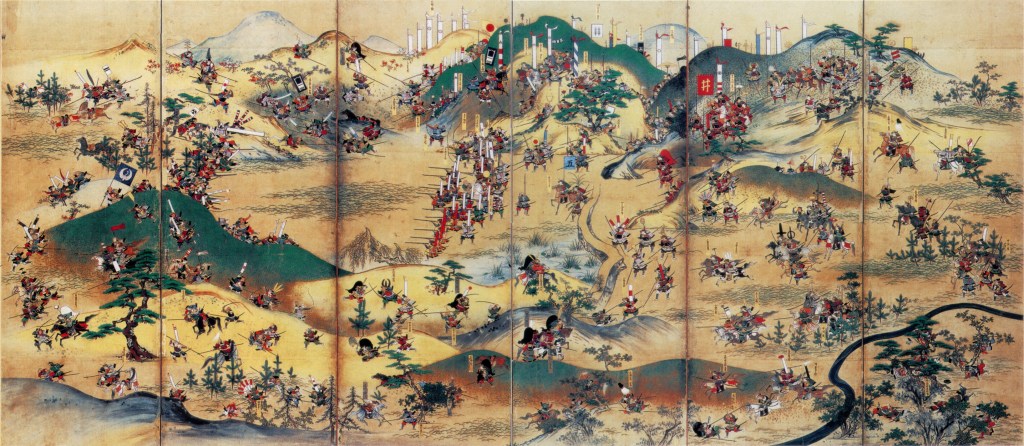
    The campaign that followed is often called the Battle of Komaki and Nagakute, after its two most decisive engagements, but there were actually a series of sieges, counterattacks, and skirmishes over the summer and early autumn of 1584. The fighting would result in a tactical victory for the Tokugawa, as they would arguably have the best of the fighting. On the other hand, the strategic situation favoured Hideyoshi, and he would ultimately be able to secure control over his new territory and the power that went along with it.

    An 18th-Century depiction of the Battle of Komaki and Nagakute.

    In the end, both sides had bigger problems. Ieyasu’s domains were under severe economic strain from the war, and a series of floods, combined with the burden of having a large number of peasants away at war, drained his treasury and threatened famine (this was before a serious earthquake in 1586 compounded his problems).

    For his part, Hideyoshi’s position was not as strong as it appeared. Though he had the advantage in men, he also had powerful enemies elsewhere, enemies that were arguably more pressing problems than Ieyasu, who had proven he could hold Hideyoshi off, but not that he could mount a serious attack of his own.

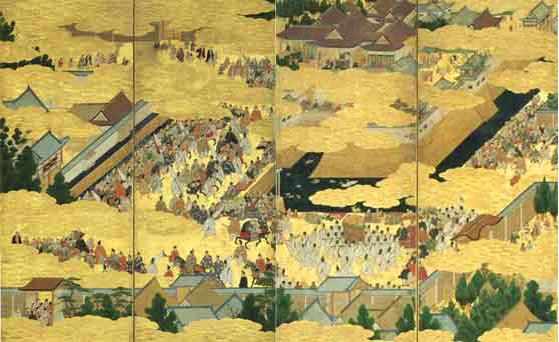
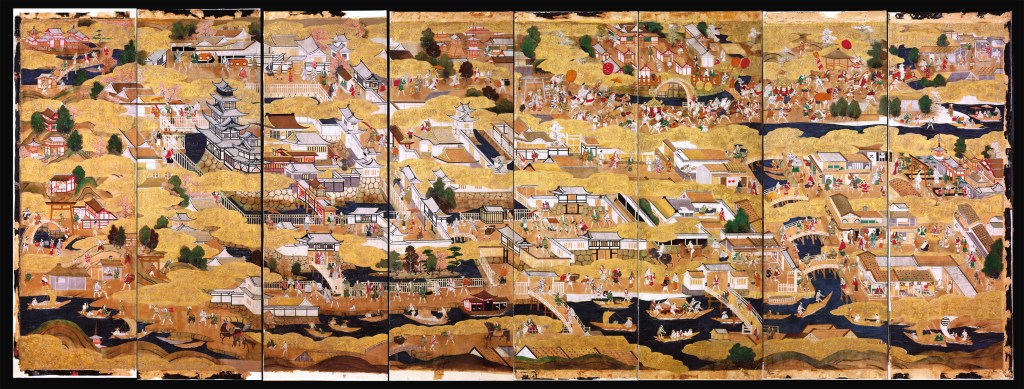
    Osaka as it appeared around 1650. The city would become Hideyoshi’s base, centred at the castle, which appears in the second screen from the left.

    Despite his inability to defeat Ieyasu, by the dawn of 1585, Hideyoshi was effectively the ruler of Japan, already on the verge of surpassing his nominal masters (the Oda), and about to launch the campaigns that would finally bring an end to the centuries of bloodshed.

    Sources
    https://ja.wikipedia.org/wiki/%E8%B1%8A%E8%87%A3%E7%A7%80%E5%90%89
    https://ja.wikipedia.org/wiki/%E5%B0%8F%E7%89%A7%E3%83%BB%E9%95%B7%E4%B9%85%E6%89%8B%E3%81%AE%E6%88%A6%E3%81%84
    https://ja.wikipedia.org/wiki/%E5%B2%A9%E5%B4%8E%E5%9F%8E%E3%81%AE%E6%88%A6%E3%81%84
    https://ja.wikipedia.org/wiki/%E5%B0%8F%E7%89%A7%E5%B1%B1
    https://ja.wikipedia.org/wiki/%E5%A4%A7%E5%9D%82%E5%9F%8E
    https://ja.wikipedia.org/wiki/%E8%B3%A4%E3%83%B6%E5%B2%B3%E3%81%AE%E6%88%A6%E3%81%84
    https://ja.wikipedia.org/wiki/%E5%8C%97%E3%83%8E%E5%BA%84%E5%9F%8E%E3%81%AE%E6%88%A6%E3%81%84
    https://ja.wikipedia.org/wiki/%E6%B5%85%E4%BA%95%E4%B8%89%E5%A7%89%E5%A6%B9
    https://en.wikipedia.org/wiki/Kitanosho_Castle
    https://ja.wikipedia.org/wiki/%E5%89%8D%E7%94%B0%E5%88%A9%E5%AE%B6#%E4%BA%BA%E7%89%A9%E3%83%BB%E9%80%B8%E8%A9%B1
    https://ja.wikipedia.org/wiki/%E6%A1%91%E5%90%8D%E5%9F%8E
    https://ja.wikipedia.org/wiki/%E6%B8%85%E6%B4%B2%E4%BC%9A%E8%AD%B0
    https://ja.wikipedia.org/wiki/%E5%A4%A7%E5%BE%B3%E5%AF%BA
    https://ja.wikipedia.org/wiki/%E7%B9%94%E7%94%B0%E4%BF%A1%E5%AD%9D
    https://ja.wikipedia.org/wiki/%E7%B9%94%E7%94%B0%E7%A7%80%E4%BF%A1
    https://ja.wikipedia.org/wiki/%E7%B9%94%E7%94%B0%E7%A7%80%E4%BF%A1
    https://ja.wikipedia.org/wiki/%E6%9F%B4%E7%94%B0%E5%8B%9D%E5%AE%B6

  • The Second Unifier – Toyotomi Hideyoshi. Part Two.

    The Second Unifier – Toyotomi Hideyoshi. Part Two.

    In 1577, a dispute between Toyotomi Hideyoshi and Shibata Katsuie led to Hideyoshi taking his army home, and leaving Katsuie to battle the mighty Uesugi Kenshin alone, a battle he lost. In the aftermath, Hideyoshi had every reason to fear the wrath of his master, Oda Nobunaga, and he was arguably lucky to keep his head, let alone his position.

    A 19th-century depiction of Hideyoshi in Nobunaga’s service.

    Nobunaga was well known for his ferocity, but he recognised capable subordinates. Hideyoshi had been reckless, but he had also earned a reputation as a good administrator and leader of men, and it wasn’t long before he was back in the Great Lord’s good books. In late 1577, he was dispatched west to contend with the powerful Mori Clan and by the end of the year, he was in control of Harima Province and advancing into neighbouring Tajima.

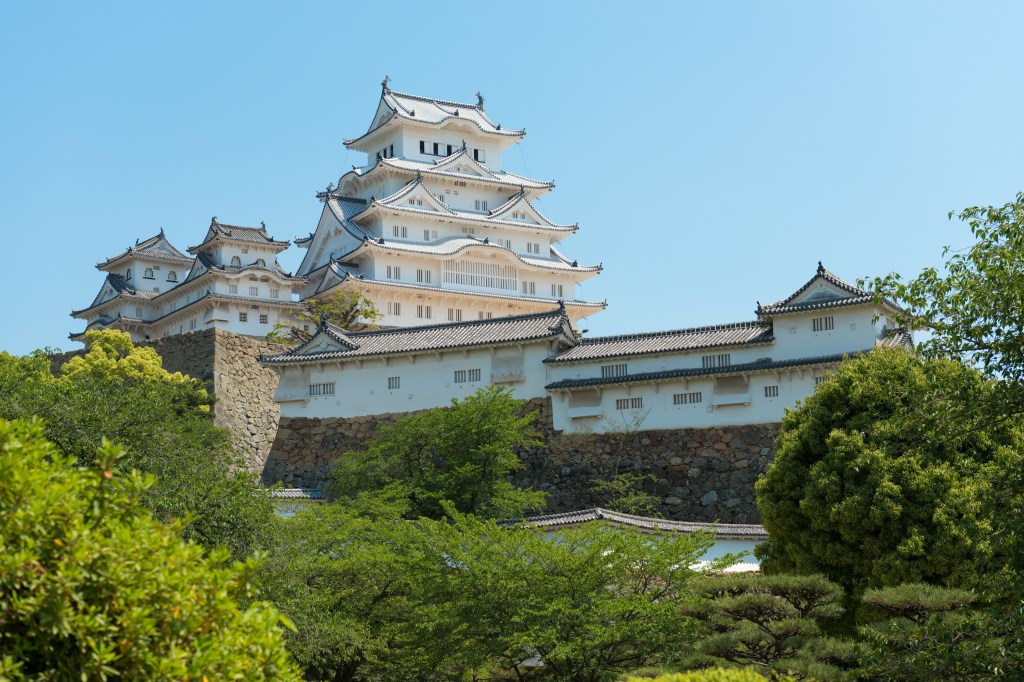
    During this period, Hideyoshi made the famous Himeji Castle his base and used it as a springboard for a series of successful campaigns against the Mori over the next few years. By late 1578, he had subjugated (either through conquest or submission) Bizen and Mimasaka Provinces, in addition to his earlier conquests, and he was poised to advance further when the Araki Clan, based at Arioka Castle, rebelled, obliging him to redeploy his forces to put them down.

    Himeji Castle as it appears today (after renovations in 2015)
    Niko Kitsakis – 投稿者自身による著作物, CC 表示-継承 4.0, https://commons.wikimedia.org/w/index.php?curid=40135622による

    Able to resume his advance in 1580, Hideyoshi secured Tajima Province, bringing the once-mighty Yamana Clan under his control and incorporating many of their former vassals and members of the clan itself into the new administration, a policy widely praised as the reason that Tajima was swiftly pacified.

    By 1581, he had advanced into Bitchu Province and secured Awaji Island for his master, utilising slow but effective siege tactics, starving his enemies into submission, a time-consuming but strength-preserving strategy. One disadvantage, though, was that it meant you were easy to find should your enemy have sufficient strength elsewhere.

    The area that Hideyoshi either conquered or was fighting in during this period.

    In Spring 1582, Hideyoshi led an army of some 30,000 to besiege the mighty fortress at Takamatsu. Strategically vital for control of Bitchu Province, the castle was defended by 3,000 Mori warriors, who quickly called for aid. Mori Terumoto responded and began mustering an army that would eventually number over 50,000. Hideyoshi now faced a problem: already outnumbered, if he tried to take the formidable fortress by storm, he’d deplete his forces further. On the other hand, trying to starve the garrison, who knew help was on the way, would take too long and risk trapping his army between the walls of the fortress and the vengeful spears of the Mori.

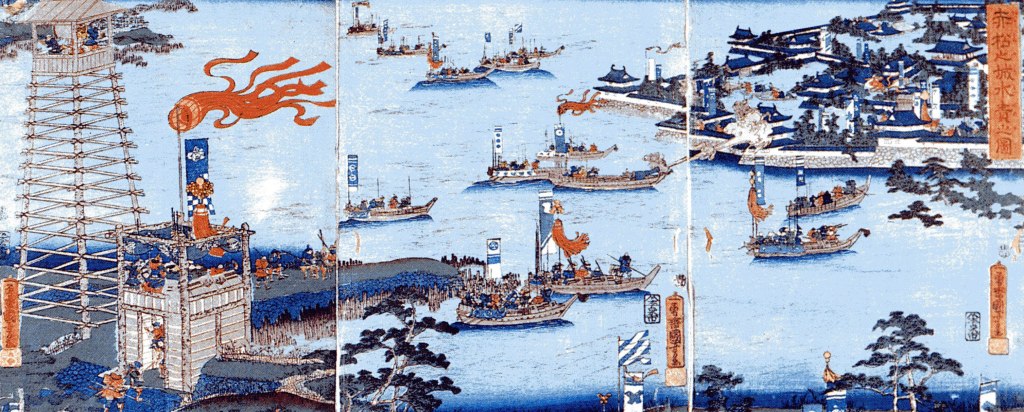
    Hideyoshi responded in a typically inventive fashion. Unable to take the castle by storm, he ordered a levee built and the nearby river dammed, diverting water into Takamatsu itself, flooding the castle to such an extent that the garrison’s food supplies were almost completely ruined and they were reduced to communicating by boat.

    A later depiction of the Siege of Takamatsu Castle. The tower to the left is Hideyoshi’s observation post, and you can see the castle itself flooded in the background.

    Despite this, the castle still held out, and when news arrived that Terumoto was on the march, Hideyoshi sent a message to Azuchi, requesting immediate reinforcement from Nobunaga. Sensing an opportunity to catch the powerful Mori clan in open battle, where they could be destroyed, Nobunaga quickly dispatched Akechi Mitsuhide to reinforce Hideyoshi, while he went to Kyoto to make arrangements for a larger force that would be sent to finish the job.

    As we already know, Mitsuhide never arrived; instead, he turned his forces around and attacked Nobunaga at his base at Honnoji, killing him and his heir. Hideyoshi was well placed to respond to this betrayal, and he swiftly concluded a peace treaty with the Mori (who were apparently initially unaware of Nobunaga’s death). Some have speculated that his rapid reaction is evidence of his involvement, or at least foreknowledge of the plot, though there’s nothing concrete to suggest that he was anything other than in the right place at the right time.

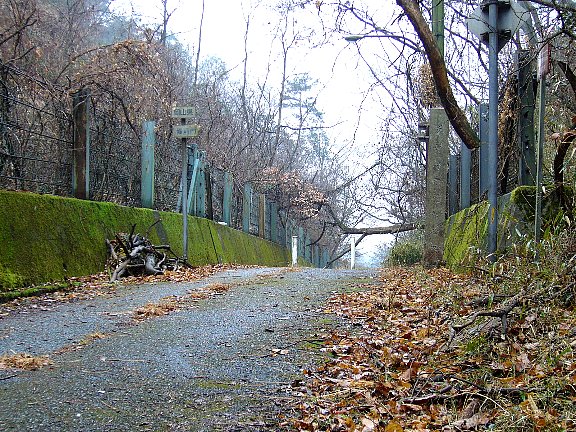
    Funasaka Pass as it appears today. This was one of the narrow routes that Hideyoshi’s army had to contend with during their remarkable march back towards Kyoto.
    Bakkai – 投稿者自身による著作物, CC 表示 3.0, https://commons.wikimedia.org/w/index.php?curid=92337495による

    More to the point, Hideyoshi was far from the only player on the board. Hideyoshi’s former rival, Shibata Katsuie, was to the north, with an army facing the Uesugi, while in the Kanto, Takigawa Kazumasu (sometimes called Sakon) had a large army intended to monitor the Hojo. Nobunaga’s son and heir had been killed during the Honno-ji Incident, but his third son, Nobukatsu, had gathered a force at Sakai (modern Osaka) to conquer Shikoku.

    Any one of these forces could have been the one to avenge Nobunaga’s death and put an abrupt end to Akechi Mitsuhide’s ambitions. Even Tokugawa Ieyasu was a potential avenger, making his famed escape from mortal danger with the (supposed) help of the famous Ninja of Iga. Ieyasu would return to his home in Mikawa and gather his forces, but events would move quickly, and though all parties moved against Mitsuhide, it was Hideyoshi who struck first.

    Tokugawa Ieyasu as he appeared in later life. He was close to Kyoto during the Honnoji Incident and was forced to make a dramatic escape back to Mikawa. Hideyoshi would prove to be faster, but Ieyasu’s time would come.

    In the days following the Honnoji Incident, Mitsuhide moved to consolidate his position. Unfortunately for him, he faced harsh military and political opposition. On the one hand, Nobunaga’s body had not been recovered from the flames, and rumours abounded that he was still alive. Even among those who may have believed Nobunaga was dead, Mitsuhide commanded little respect. He was a traitor, after all, and surrounded by enemies who wished to avenge Nobunaga and take power for themselves.

    Militarily, Mitsuhide was too weak to assert effective control over much territory. He had between 13,000 and 15,000 men, but was obliged to capture and garrison several important castles, whittling his already limited forces down still further. Then there was the speed at which Hideyoshi moved. Mitushide arguably did what he could, and with the limited communications and transportation available at the time, it’s hard to see how he could have moved faster, but Hideyoshi was faster still, and on July 2nd, 1582, just 12 days after Honnoji, the two sides clashed at the Battle of Yamazaki, to the south-east of Kyoto.

    Akechi Mitsuhide. Historians debate why he decided to betray Nobunaga, but within two weeks of the incident, he’d be dead.

    The numbers vary by source, but Hideyoshi is said to have had between 20 and 40,000 men, while Mitsuihides had 10 to 16,000. Despite the long odds, Mitsuhide’s army was well-positioned, and the ground around Yamazaki was boggy, limiting movement and reducing Hideyoshi’s advantage in numbers.

    Mitsuhide probably understood that a defensive victory against difficult odds would have greatly enhanced his prestige, and for most of the day, Hideyoshi’s army took heavy losses in vicious frontal assaults. Around 4pm, however, reinforcements arrived for Hideyoshi, outflanking Mitsuhide’s position, and causing his army to fall back. As the battle moved to higher and drier ground, Mitsuhide’s force was gradually surrounded and forced back.

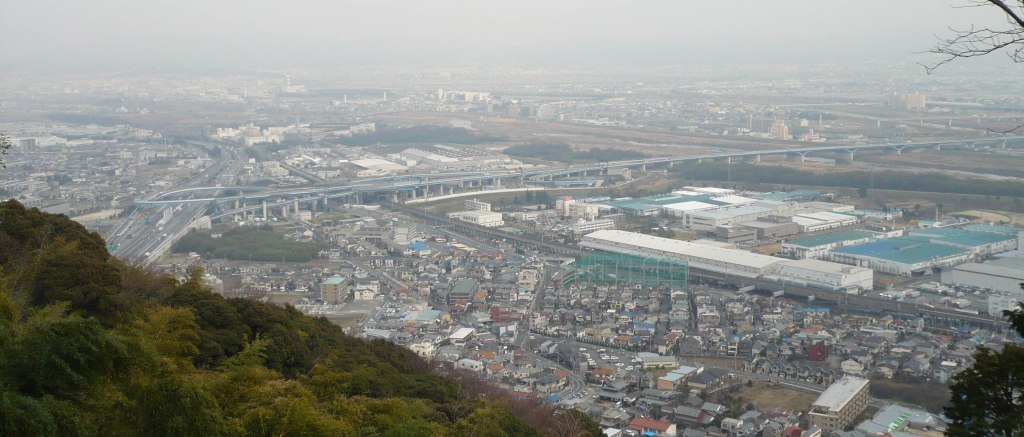
    The battlefield of Yamazaki as it appears today. Historians believe the heaviest fighting took place around the bypass that can be seen in the centre.

    Later sources suggest that the casualties were about the same (around 3,000 each), but under attack from three sides, the morale of Mitushide’s army broke first, and by sunset, their retreat became a rout. When the battle was over, it is said that Mitsuhide had just 700 men remaining. His exact fate isn’t clear; some say he was wounded and committed seppuku, while others suggest he was killed by vengeful peasants or bandits. Either way, his head was brought to Hideyoshi the day after the battle, and then displayed at Honnoji, a powerful statement confirming Hideyoshi as Nobunaga’s ‘avenger’ and giving an enormous boost to his credibility.

    Hideyoshi would spend a few weeks stamping out the last embers of Mitushide’s rebellion, but despite his military successes, he was not unchallenged as Nobunaga’s successor. The other players, who had all been poised to strike, still remained in the field, and each had their own ambition to rule, either directly or through one of Nobunaga’s other sons.

    This would result in the Kiyosu Conference, but we’ll cover that and its consequences next time.

    Sources
    https://ja.wikipedia.org/wiki/%E8%B1%8A%E8%87%A3%E7%A7%80%E5%90%89
    https://ja.wikipedia.org/wiki/%E5%B1%B1%E5%B4%8E%E3%81%AE%E6%88%A6%E3%81%84
    https://ja.wikipedia.org/wiki/%E6%9C%AC%E8%83%BD%E5%AF%BA%E3%81%AE%E5%A4%89
    https://ja.wikipedia.org/wiki/%E4%B8%AD%E5%9B%BD%E5%A4%A7%E8%BF%94%E3%81%97
    https://ja.wikipedia.org/wiki/%E5%B1%B1%E5%90%8D%E5%A0%AF%E7%86%99
    https://ja.wikipedia.org/wiki/%E4%B8%89%E6%9C%A8%E5%90%88%E6%88%A6
    https://ja.wikipedia.org/wiki/%E6%9C%89%E5%B2%A1%E5%9F%8E%E3%81%AE%E6%88%A6%E3%81%84
    https://ja.wikipedia.org/wiki/%E5%A7%AB%E8%B7%AF%E5%9F%8E
    https://ja.wikipedia.org/wiki/%E5%82%99%E4%B8%AD%E9%AB%98%E6%9D%BE%E5%9F%8E%E3%81%AE%E6%88%A6%E3%81%84
    https://ja.wikipedia.org/wiki/%E9%AB%98%E6%9D%BE%E5%9F%8E_(%E5%82%99%E4%B8%AD%E5%9B%BD)

  • The Second Unifier – Toyotomi Hideyoshi. Part One.

    The Second Unifier – Toyotomi Hideyoshi. Part One.

    If the bird will not sing, make it sing.

    Oda Nobunaga’s death in June 1582 left a power vacuum that was ultimately filled by Toyotomi Hideyoshi (then using the family name Hashiba). Hideyoshi’s tale is remarkable even by the standards of the time: from peasant footsoldier to master of the realm, he epitomised the danger and opportunity of the Sengoku Jidai and would be the man most responsible for bringing it to an end.

    Hideyoshi’s origins are suitably mysterious and have been subject to a fair bit of speculation and mythologising, mostly by the man himself. After his rise to power, he is supposed to have spread the rumour that he was a secret bastard of the Emperor, stating that his mother had been a maid in the Imperial Palace and had “grown close to the Emperor’s Body”, which is quite the thing to say about your own mother.

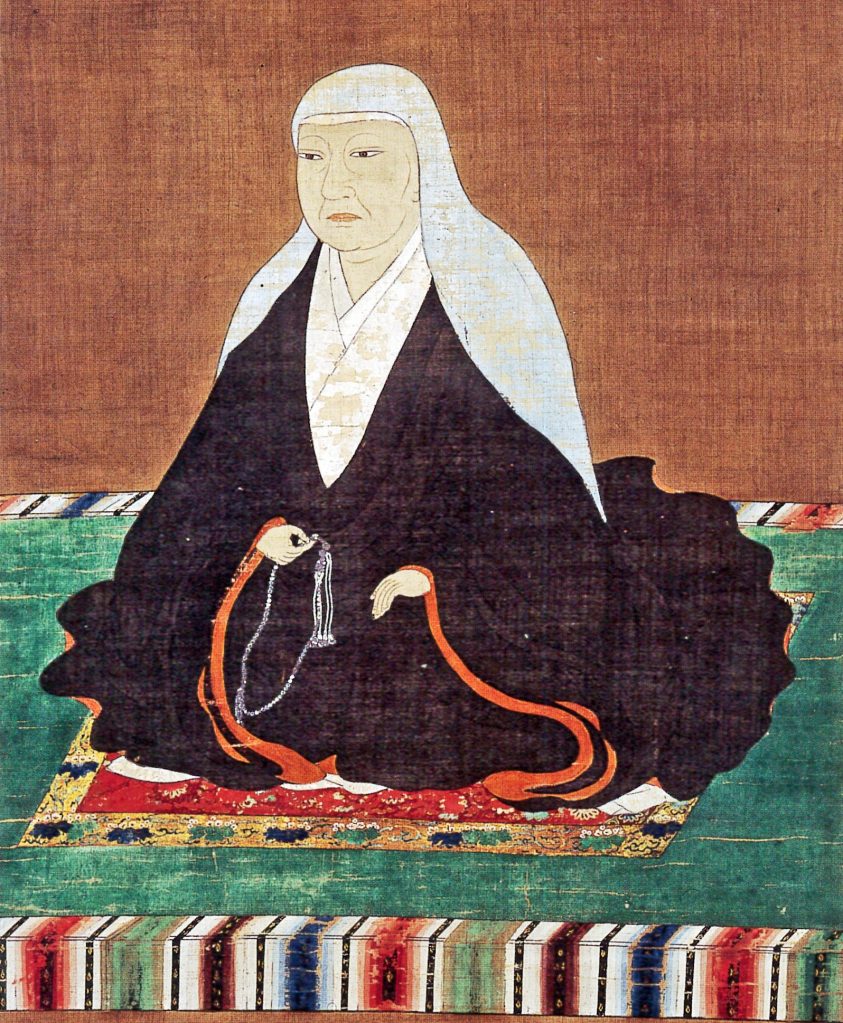
    Hideyoshi’s mother. She is often called Omandokoro, though this is the name she took after becoming a nun, and most sources think her birth name was Naka.

    Less mum-shaming sources suggest that Hideyoshi was born in 1536 or 37 in Owari Province, now part of the modern city of Nagoya. His father, usually recorded as Kinoshita Yaemon, is a similarly mysterious figure, but historians generally agree he was probably of the lower classes, most likely a peasant soldier (Ashigaru). Hideyoshi’s childhood is also poorly recorded, with some sources suggesting his father died when he was 7, after which Hideyoshi entered a monastery, though he left shortly afterwards.

    At the age of 15, he received part of his inheritance and left home to become a wanderer. Sometime later (the dates are unclear), he is recorded as Kinoshita Hideyoshi in the service of the Iio Clan, which, in turn, was a vassal of the Imagawa Clan. It’s not certain exactly when he came into the service of the Oda Clan, but it appears to have been before 1554, when he was serving at Kiyosu Castle (under Oda control) in charge of the kitchens, and in some kind of role in construction or maintenance.

    Kiyosu Castle as it appears today.

    Even this is a matter of some debate, though, as other sources state he didn’t join the Oda until 1558 (though they agree he served at Kiyosu Castle), and a common origin story in English language sources is that he was Nobunaga’s sandal bearer, a story which possibly reflects his role as a kind of ‘military servant’ which might explain how he was able to gain recognition from Nobunaga.

    Even the matter of Hideyoshi’s marriage is subject to debate; it is certain that he married Nene, but her origins and even the year of the marriage aren’t totally clear. Some sources say the marriage took place in 1561, when Nene was 12 or 13, and Hideyoshi was in his 20s. This earlier date is controversial because even though 13 was the age at which girls became adults (legally speaking), it was still considered unusual for a girl to marry as soon as she came of age.

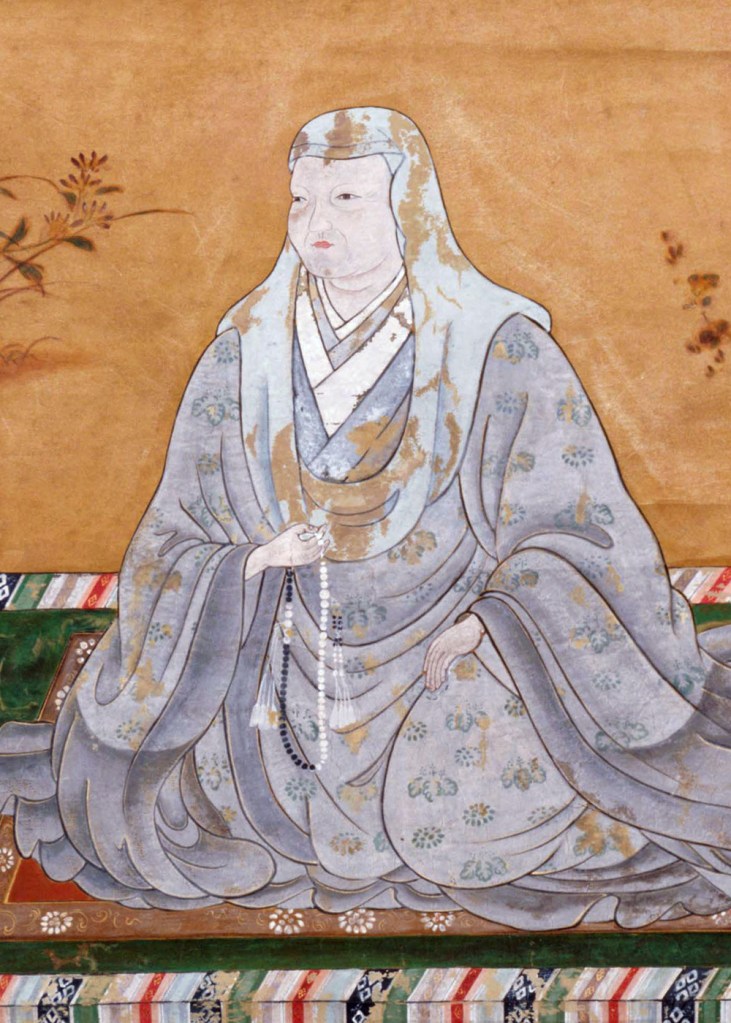
    Hideyoshi’s wife, Nene, who also became a Nun, is often recorded as Kodai-in as a result.

    Another theory is that the marriage took place in 1565, when Nene was 16 or 17, still young by modern standards, but a far more acceptable age at the time. Nene’s adoptive father was Asano Nagakatsu, who would later receive a stipend of 300 Koku from Nobunaga and served as one of his bodyguards. This status suggests that Nagakatsu was of sufficient rank, and the marriage to Nene is often cited as evidence that Hideyoshi was already moving up in the world by the mid-1560s.

    As well as his marriage, further evidence of his rise in Nobunaga’s service appears in 1565 when his name appears as the co-signer on documents assigning fiefs, suggesting he was already one of Nobunaga’s most important vassals. Throughout the back half of the decade, he is recorded as having taken part in several of Nobunaga’s campaigns, notably taking Mitsukuri Castle during the Omi Campaign in 1568.

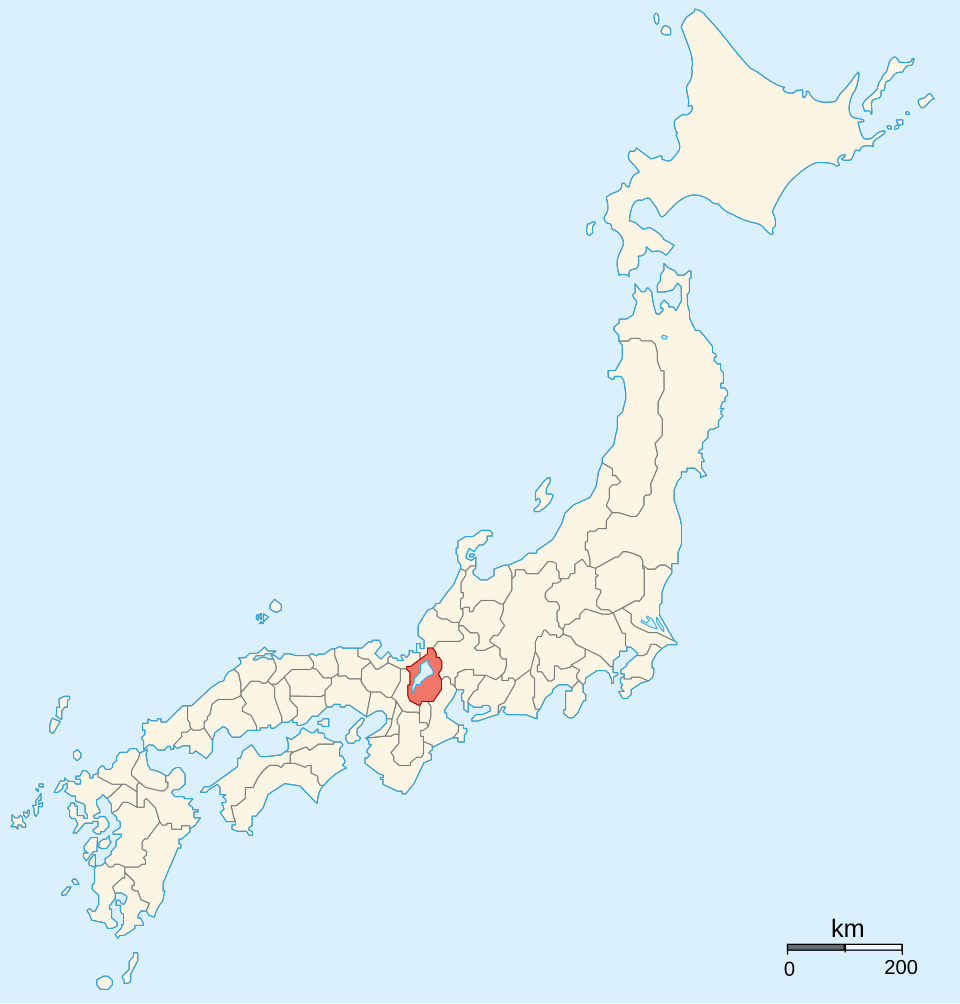
    Omi Province.
    By Ash_Crow – Own work, based on Image:Provinces of Japan.svg, CC BY 2.5, https://commons.wikimedia.org/w/index.php?curid=1690755

    In 1569, in support of the Mori Clan (who were his temporary allies), Nobunaga dispatched a force of some 20,000 to support them against a rebellion, whilst the bulk of the Mori forces were in Kyushu fighting the Otomo clan. This army, led by Hideyoshi, was, by all accounts, a phenomenal success, capturing no fewer than 18 castles in just 12 days and ending the rebellion swiftly.

    A year later, he was part of Nobunaga’s campaign against the Asakura Clan of Echizen Province, which ended when Nobunaga’s brother-in-law, Azai Nagamasa, switched sides, threatening to cut off Nobunaga’s retreat. Though the exact scale of the threat is debated (as I mentioned in my posts on Nobunaga himself), what is certain is that Hideyoshi led the rearguard and was instrumental in ensuring that his master was able to escape.

    Azai Nagamasa, Nobunaga’s brother-in-law, whose betrayal nearly spelt disaster for his campaign.

    After the Battle of Anegawa, in which Nobunaga avenged himself on the Azai-Asakura forces, Hideyoshi was appointed castellan of the strategically important Yokoyama Fortress, from which he would be tasked with keeping up the pressure on the remnants of the Azai-Asakura until their final destruction in 1573.

    I’ve previously mentioned the tradition of changing names among Samurai and how it often leads to confusion when you’re trying to source information about specific figures who may have had several names. While Hideyoshi is generally remembered as “Toyotomi Hideyoshi” in English-language sources, this wasn’t his name until much later. His peasant origins mean that he likely didn’t have a surname at all, and the names he was known by later were either taken from places or bestowed by others.

    Shibata Katsuie
    Niwa Nagahide

    In 1573, Hideyoshi adopted the name Hashiba. The origins of this name are somewhat unclear; a common theory is that he took one character each from Shibata Katsuie and Niwa Nagahide (the Japanese character ‘wa’ can also be pronounced ‘ha’), though this is disputed.

    Along with a name change, the fall of the Azai Clan in 1573 resulted in Hideyoshi receiving their former lands around the shores of Lake Biwa. He based himself at Imahama, which is promptly renamed Nagahama, after Nobunaga. This was not some unique quirk of his, by the way, the ‘giving’ of character from prestigious names was a common occurrence, and was generally treated as a respectful and honoured thing to do.

    Nagahama Castle as it appears today.
    By 663highland, CC BY 2.5, https://commons.wikimedia.org/w/index.php?curid=73322120

    He continued to play a significant role in Nobunaga’s military expansion, serving at the decisive Battle of Nagashino in 1575, and capturing Kiriyama Castle from the powerful Kitabatake Clan of Ise Province the next year. In 1577, Hideyoshi’s star seemed to be on an inexorable rise, but personal rivalries would get in the way.

    Nobunaga dispatched an army under Shibata Katsuie to face Uesugi Kenshin in the north. Now, you may remember from my post about him, but Kenshin was a formidable opponent, a rival to both Hojo Ujiyasu and Takeda Shingen; he was certainly not a man to take lightly. Nobunaga obviously understood this and dispatched reinforcements commanded by Hideyoshi.

    Uesugi Kenshin

    At this point, a simmering feud between Hideyoshi and Katsuie exploded. The exact nature of the argument isn’t recorded in contemporary sources, and later writers could only speculate; however, it is known that Hideyoshi literally took his army and went home. This open defiance of Nobunaga’s orders would have been bad enough, but when Katsuie was defeated shortly afterwards at the Battle of Tedorigawa, Nobunaga was furious.

    Hideyoshi was arguably lucky to keep his head after that, and he would spend some time in the political wilderness. His time would come again, however, and we’ll talk about that next week.

    Sources
    https://ja.wikipedia.org/wiki/%E8%B1%8A%E8%87%A3%E7%A7%80%E5%90%89
    https://ja.wikipedia.org/wiki/%E6%89%8B%E5%8F%96%E5%B7%9D%E3%81%AE%E6%88%A6%E3%81%84
    https://ja.wikipedia.org/wiki/%E9%95%B7%E6%B5%9C%E5%9F%8E_(%E8%BF%91%E6%B1%9F%E5%9B%BD)
    https://ja.wikipedia.org/wiki/%E9%9C%A7%E5%B1%B1%E5%9F%8E
    https://ja.wikipedia.org/wiki/%E9%87%91%E3%83%B6%E5%B4%8E%E3%81%AE%E6%88%A6%E3%81%84
    https://ja.wikipedia.org/wiki/%E5%A7%89%E5%B7%9D%E3%81%AE%E6%88%A6%E3%81%84
    https://ja.wikipedia.org/wiki/%E6%A8%AA%E5%B1%B1%E5%9F%8E_(%E8%BF%91%E6%B1%9F%E5%9B%BD)
    https://ja.wikipedia.org/wiki/%E4%B8%B9%E7%BE%BD%E9%95%B7%E7%A7%80
    https://ja.wikipedia.org/wiki/%E8%A6%B3%E9%9F%B3%E5%AF%BA%E5%9F%8E%E3%81%AE%E6%88%A6%E3%81%84
    https://ja.wikipedia.org/wiki/%E9%AB%98%E5%8F%B0%E9%99%A2
    https://ja.wikipedia.org/wiki/%E6%B5%85%E9%87%8E%E9%95%B7%E5%8B%9D
    https://ja.wikipedia.org/wiki/%E9%A3%AF%E5%B0%BE%E6%B0%8F
    https://ja.wikipedia.org/wiki/%E5%A4%A7%E6%94%BF%E6%89%80

  • The Honnoji Incident – Oda Nobunaga. Part Four.

    The Honnoji Incident – Oda Nobunaga. Part Four.

    “The enemy is at Honnoji” – Akechi Mitsuhide

    By 1582, Oda Nobunaga was the most powerful man in the realm; in fact, it could be argued that he was the most powerful man Japan had seen in centuries. A combination of ruthless political manoeuvring and brutal military campaigns had left him on the verge of finally reuniting the nation and ending the Sengoku Jidai.

    Only the Mori Clan still had the strength to stifle Nobunaga’s ambitions, and in May 1582, he announced his intention to march against them with all his might. The catalyst for this next campaign was a message from Hashiba Hideyoshi, who was besieging Takamatsu Castle (in modern-day Okayama). The message read that Mori Terumoto was marching to relieve the siege, presenting Nobunaga with an opportunity to meet the Mori in open battle and crush them.

    A scene from the Battle of Takamatsu Castle. Hideyoshi attempted to end the siege by flooding the castle, a tactic that was ultimately unsuccessful.

    It is generally accepted by historians that Nobunaga intended not only to defeat the Mori but also subjugate Shikoku and, eventually, Kyushu as well, viewing the campaign against the Mori as part of a wider strategy to bring the entire nation under his command. In preparation for this, he dispatched several generals to support Hideyoshi, most notably Akechi Mitsuhide.

    In the days that followed, Nobunaga was seen to be in good spirits and laid on lavish entertainment for those who came to visit him, including Tokugawa Ieyasu, who departed Azuchi on June 21st, embarking on a tour of Kyoto, Osaka, and the surrounding region. On the same day, Nobunaga’s son and heir, Nobutada, arrived in Kyoto for reasons that aren’t entirely clear (some speculate he meant to accompany Ieyasu). Whatever his purpose, his arrival in the capital meant that when Nobunaga himself departed Azuchi for Kyoto on June 29th, father and son would be in the same place, at the same time.

    Azuchi Castle, Nobunaga’s base, as it appeared around 1582.

    Exactly why Nobunaga went to Kyoto first is debated, with some suggesting he planned to attack Shikoku first, going via Kyoto and the port at Sakai (modern Osaka). Other sources say he went to deal with negotiations at the Imperial Court, and others still suggest he wanted to show off a new tea set he had recently acquired. (This may sound a touch comical to a modern audience, but the tea ceremony was a serious matter in Japan at the time.)

    On June 30th, Nobunaga held said tea ceremony, which was followed by a drinking party, during which Nobunaga’s son, Nobutada, arrived, and father and son drank and talked together, little knowing that it would be their last meeting. Sources tell us that the party ended late, and Nobutada returned to his accommodation at nearby Myokakuji Temple, and Nobunaga retired for the night shortly afterwards.

    Oda Nobutada, Nobunaga’s son and heir.

    Though Honnoji was a temple, as the primary residence of Nobunaga in Kyoto, it wasn’t undefended. Excavations in 2007 found evidence of a moat and some earthworks, suggesting that the site had been partially fortified, though it was far from a fortress, and Nobunaga was protected by only a few dozen servants and his personal entourage.

    Nobunaga clearly didn’t expect to be attacked, and why should he have? He was the most powerful man in the realm, in the heart of the capital city, with hundreds of thousands of warriors at his command. His enemies were far away, and even in the unlikely event that the army under Hideyoshi was defeated, he could call on other, just as formidable forces.

    Honnoji as it appears today. The current temple is located at a different site from that in 1582; after being rebuilt by Hideyoshi in 1592, it was destroyed by fire in 1788 and 1864, and then underwent further renovation in 1928.
    +- – 投稿者自身による著作物, CC 表示-継承 3.0, https://commons.wikimedia.org/w/index.php?curid=107655314による

    One of these was a force of around 13,000 men under Akechi Mitsuhide. In the afternoon of June 30th, Mitsuhide claimed to have received a message from Nobunaga, instructing him to bring his force to Kyoto for review. The letter, if it existed at all, was certainly a forgery, but by that evening, Mitsuhide had arrived at Kameyama (modern Kameoka), north of Kyoto. By the next morning, they had reached the Katsura River, and at this point, it is unclear if Mitsuhide’s army understood their objective.

    Sources from men serving in this force suggest they believed that they were going to attack Tokugawa Ieyasu, nominally on the orders of Nobunaga himself. This is supported by the semi-contemporary “History of Japan”, written by the Jesuit, Luis Frois, which suggests that Mitsuhide’s army believed they were acting under Nobunaga’s secret order, at least initially.

    Akechi Mitsuhide, the man behind the Honnoji Incident.

    At this point, Mitsuhide is supposed to have uttered the famous phrase “The Enemy is a Honnoji” announcing his rebellious intention (as everyone knew that was Nobunaga’s base.) Unfortunately, as dramatic as that scene might have been, the first source for it doesn’t appear until 1641, nearly 60 years after the event, and there are no contemporary sources that tell us what Mitsuhide might or might not have said.

    What we know is that by dawn, Mitsuhides forces had surrounded Honnoji. What followed was a bloody, but ultimately one-sided fight. All sides agree that Nobunaga and his pages fought bravely, but they were hopelessly outnumbered, and the fighting was over by around 8am. We don’t know exactly how Nobunaga died, but the sources agree that he fought with a bow, and then a spear, before suffering some kind of injury (the sources differ) and retreating into the already burning Honnoji, where he presumably committed seppuku.

    A 19th-century depiction of Nobunaga’s last stand. Though we don’t know exactly how he died, sources agree he fought bravely until an injury forced him to retreat.

    Nobunaga’s son, Nobutada, had, upon hearing that Honnoji was under attack, rushed to help, only to be overwhelmed and forced back to his own accommodations at Myokakuji Temple, where he too was forced to commit seppuku as the temple burned around him, his body consumed by the flames.

    Rumours of their survival sprang up almost immediately. Since neither body was ever identified (this being before DNA or dental records), Mitsuhide could not prove the deed was done, and any hope he had of securing support went up in the same smoke that Nobunaga and his son had.

    Another 19th-century depiction of Nobunaga’s end. Though heavily stylised, it displays the flames that would ultimately consume Nobunaga’s body.

    Whatever his actual motivation (which we’ll look at in a moment), Mitsuhide’s triumph would be short-lived. Though his forces had successfully killed Nobunaga, his son, Nobutada, and most of his inner circle, and secured Kyoto, the same forces that Nobunaga might have called on to defend him were now focused on avenging him.

    Mitsuhide swiftly withdrew to Azuchi Castle, from where he tried to rally support, and wrote to the Imperial Court, seeking to legitimise his position. There are no records of any response, and he soon ran out of time. Hashiba Hideyoshi had made peace with the Mori (who were apparently initially unaware of Nobunaga’s death) and was now marching against him.

    The site of the Battle of Yamazaki as it appears today, seen from Mt Tenno, from which the battle is sometimes called The Battle of Tennozan.

    Mitsuhide was outnumbered two or three to one, and at the Battle of Yamazaki on July 12th, he was decisively defeated. Although losses were similar on both sides (about 3000), Mitsuhide’s army suffered from serious morale problems and disintegrated as the battle went against them, leaving Mitsuhide with just 700 warriors at day’s end.

    Mitsuhide himself survived the battle, but he was either killed in the aftermath (possibly by bandits or opportunistic peasants) or else committed suicide due to injuries sustained on the battlefield. Whatever his end, he was definitely dead by the time his head was displayed outside the burned remains of Honnoji Temple, on or around July 17th.

    Akechi Mitsuhide’s grave at Saikyoji Temple in Kyoto.

    No sooner was Mitsuhide dead than questions were raised about why he had betrayed his lord. Though Samurai overthrowing their overlords was nothing new, Nobunaga was uncommonly powerful, and his death threatened to unravel the fragile peace he had secured, especially in light of Mitushide’s failure to secure support or legitimacy in its aftermath.

    Contemporary scholars and modern historians continue to debate exactly why Mitsuhide betrayed Nobunaga. He was certainly mistreated and often humiliated, sometimes even being publicly beaten by Nobunaga himself, so simple revenge is a possible motive. Other sources suggest it was to avenge his mother, who had served as a hostage to secure a truce years earlier, only for Nobunaga to break it, resulting in the poor woman being executed.

    Mitsuhide’s mother hangs from a tree in consequence of Nobunaga breaking the truce that her life was the guarantee of.

    If public humiliation and the death of his mother weren’t reason enough, some suggest it was pure ambition; Mitsuhide may simply have wanted the power for himself, and he certainly wouldn’t have been the first to try it. Indeed, some historians speculate that if he had been able to prove that Nobunaga was actually dead, he might have gained some support, and the outcome could have been different.

    Others suggest that Mitsuhide was a partisan of the Shogun, or possibly the Imperial Court, and overthrew Nobunaga in order to restore one or the other to power, though these ideas only emerged in the 20th century, and there’s little contemporary information to go on.

    Nobunaga publicly beats Mitsuhide. Quite why Nobunaga treated him so poorly isn’t clear, but the humiliation almost certainly contributed to his decision to rebel.

    There’s also the speculation that Mitsuhide was working with one of Nobunaga’s other vassals. Some historians argue that Hashiba Hideyoshi was able to turn his army against Mitsuhide very quickly, leading to speculation that he knew the attack was coming. Historians have never conclusively dismissed this, though it has been pointed out that only the fastest of Hideyoshi’s troops actually made it to the Battle of Yamazaki, meaning that the quick turnaround might not have been that quick after all.

    Other theories blame the Imperial Court, or the Mori Clan, for conspiring against a man who had proven to be an existential threat, as well as the Buddhist Clergy, who had plenty of reason to want vengeance on Nobunaga.

    A contemporary depiction of Mass. Though largely dismissed by historians, the possibility that the Jesuits feared Nobunaga would turn on them contributed to the theory that they were involved in his death.

    Another possibility is the Jesuits, who are suggested to have feared that Nobunaga might move against them, though there’s little evidence that he intended to (as he valued foreign trade), and Hideyoshi, his ultimate successor, would prove to be a far greater threat to Christianity in Japan.

    Ultimately, most of this speculation comes from later sources, and there’s no way to know what Mitsuhide intended, only that his plans fell apart before being decisively ended on the battlefield at Yamazaki.

    Hashiba (later Toyotomi) Hideyoshi. His victory at Yamazaki did not make him Nobunaga’s successor, but it did wonders for his prestige.

    Hashiba Hideyoshi’s victory did not mean he inherited Nobunaga’s power, however, and the power struggle that followed threatened to undo the Great Lord’s work, but that’s a story for another time.

    Sources
    https://ja.wikipedia.org/wiki/%E7%B9%94%E7%94%B0%E4%BF%A1%E9%95%B7
    https://ja.wikipedia.org/wiki/%E6%9C%AC%E8%83%BD%E5%AF%BA%E3%81%AE%E5%A4%89
    https://ja.wikipedia.org/wiki/%E6%95%B5%E3%81%AF%E6%9C%AC%E8%83%BD%E5%AF%BA%E3%81%AB%E3%81%82%E3%82%8A
    https://ja.wikipedia.org/wiki/%E6%A1%82%E5%B7%9D_(%E6%B7%80%E5%B7%9D%E6%B0%B4%E7%B3%BB)
    https://ja.wikipedia.org/wiki/%E4%BA%80%E5%B2%A1%E5%B8%82
    https://ja.wikipedia.org/wiki/%E5%82%99%E4%B8%AD%E9%AB%98%E6%9D%BE%E5%9F%8E%E3%81%AE%E6%88%A6%E3%81%84
    https://en.wikipedia.org/wiki/Honn%C5%8D-ji_Incident
    https://en.wikipedia.org/wiki/Akechi_Mitsuhide
    https://ja.wikipedia.org/wiki/%E5%B1%B1%E5%B4%8E%E3%81%AE%E6%88%A6%E3%81%84
    https://ja.wikipedia.org/wiki/%E7%B9%94%E7%94%B0%E4%BF%A1%E5%BF%A0

    If you are interested, the main source for this and the other posts on Oda Nobunaga is the 2011 translation of the Chronicle of Nobunaga, the Kindle version of which can be found here.

  • The First Unifier – Oda Nobunaga. Part Two.

    The First Unifier – Oda Nobunaga. Part Two.

    In June 1565, the powerful Miyoshi Clan launched a coup against the Shogun, Ashikaga Yoshiteru. In the Eiroku Incident (named for the era), the Miyoshi successfully killed Yoshiteru, and his brother, Yoshiaki, a rival claimant to the throne, fled the capital, seeking support from regional warlords.

    Miyoshi Yoshitsugu, one of the main leaders in the Eiroku Incident.

    Nobunaga was initially enthusiastic about supporting Yoshiaki and the Shogunate more generally. Sources aren’t clear about Nobunaga’s ambitions at this point, with some arguing he genuinely wanted to restore the Ashikaga, whilst others portray it as cynical politicking, with Nobunaga intending to replace the Miyoshi’s puppet Shogun with his own.

    Regardless, in the short term, military defeat limited Nobunaga’s practical aid, and it wasn’t until September 1568 that he formally recognised Yoshiaki as Shogun and dispatched an army to Kyoto to secure his accession to the throne. There was some resistance, but Nobunaga’s forces would prove triumphant, and Ashikaga Yoshiaki was installed as the 15th (and final) Ashikaga Shogun. It seems that Yoshiaki wanted to install Nobunaga as kanrei, or deputy, but he refused. Moreover, at this point, the Kyoto political community seemed to have viewed Nobunaga as little more than Yoshiaki’s general, rather than a political force in his own right.

    Ashikaga Yoshiaki

    In early 1569, Nobunaga once again proved his worth to the Shogunate by putting down an attempt by the Miyoshi Clan to restore their position in the capital. Shortly after that, Nobunaga issued the denchuonokite, or “Rules of the Palace”, which were a set of nine (with seven more added later) rules for the management of the Shogun’s court. For a long time, it was believed that these rules were the first clear example of Nobunaga imposing his will on the Shogunate, though later research suggests that Yoshiaki agreed to the rules, and it was only later that the relationship between the two men began to break down.

    Nobunaga seems to have intended to return to his own territories after the restoration, serving as a sort of enforcer for the Shogun. However, by this point, the Shogunate was at such a low ebb that he found himself obliged to become closely involved in the running of the government. It has been suggested that the issuing of the “Palace Rules” was part of wider efforts by Nobunaga to reinforce the Shogunate, whilst also reining in the tendency of the Shogun to use his remaining power arbitrarily, favouring his own supporters at the expense of powerful clans elsewhere, who, Nobunaga (rightly) worried, would then become enemies of the Shogun, and be extension, himself.

    Part of the original Palace Rules.

    It was not as though Nobunaga had any trouble finding enemies of his own. In the late 1560s, his forces invaded Ise Province, and in 1570, he led an army north to Wakasa Province to subjugate the Asakura Clan, who had defied him. The invasion went well, but when word reached Nobunaga that the Azai Clan, led by his brother-in-law, had betrayed him, he was forced to retreat.

    The reasons for this sudden betrayal have been much romanticised, with Azai Nagamasa sometimes portrayed as a principled opponent of Nobunaga’s tyranny, or else bound by a close alliance to the Asakura that trumped his loyalty to the Oda. Historians are still divided on the exact cause, but the betrayal was likely a combination of opportunism and genuine fear about Nobunaga’s intentions.

    Nobunaga’s army was defeated at the Battle of Kanegasaki, with Nobunaga himself forced to flee the field. It is said that he was only able to escape because of the rearguard action led by Kinoshita Tōkichirō, who would later be known as Toyotomi Hideyoshi, and who was rewarded with gold by Nobunaga upon his return to Kyoto.

    A later depiction of Hideyoshi in Nobunaga’s service. He first appears in records from the early 1560s, and by the time of Kanegasaki, he had earned a reputation as one of Nobunaga’s most capable subordinates.

    Sources disagree on exactly how severe the defeat was; some state that Nobunaga returned to Kyoto with just ten men, whilst others put his army’s losses at fewer than 1300, out of a total of 30,000. Both numbers may be true, and it would certainly explain why Nobunaga himself seems to have remained calm in the wake of the defeat, inspecting the Imperial Palace the day after he returned to Kyoto.

    Whilst Nobunaga had certainly been forced to retreat, the case for his army remaining largely intact is made by the fact that just a few months after Kanegasaki, he, along with his ally, Tokugawa Ieyasu, led a force of up to 40,000 men in a campaign against the Azai-Asakura, culminating in the Battle of Anegawa, which Nobunaga won, though he was unable to finish either the Azai or Asakura off, despite inflicting heavy casualties on both.

    Nobunaga was prevented from pressing his advantage by events elsewhere. In August, the Miyoshi raised an army in Settsu Province (modern Osaka). Around the same time, the Ishiyama Hongan-ji Temple (on the site of modern Osaka Castle), fearing Nobunaga’s expansionist ambitions, raised an army of its own.

    A model of Ishiyama Hongan-ji, showing it was far more than just a temple. Osaka Castle stands on the site today.
    By Takafuji – Own work, CC BY-SA 4.0, https://commons.wikimedia.org/w/index.php?curid=77306876

    All this was combined with the ongoing conflict with the Azai-Asakura alliance, and in September, supporters of Ishiyama Hongan-ji launched a rebellion in Ise Province in which Nobunaga’s younger brother, Nobuoki, was killed (or forced to commit seppuku) Faced with all this, Nobunaga chose to leverage his power at court, and in December, an Imperial decree was issued, ordering all sides to stop fighting, which they duly did, saving Nobunaga in the short-term.

    Peace in the Age of the Country at War was only ever a fleeting thing, however. In February 1571, Nobunaga led an army of some 50,000 against the forces of Ishiyama Hongan-ji, resulting in one of his most controversial acts, the burning of Mt Hiei.

    A semi-contemporary image of the burning of Mt Hiei, showing Nobunaga’s forces cutting people down as they try to flee the flames.

    Mt Hiei is one of the most sacred sites in Japanese Buddhism, and in the late 16th Century, its monks were major political players in their own right, with influence at both the Imperial and Shogunate court, and an army of warrior monks to defend their interests. Nobunaga’s attack should be seen in this context, but it was also an incredibly shocking act, which outraged a Japanese political class that took its religion very seriously. One particularly outraged player was Takeda Shingen, who denounced Nobunaga and began a campaign against his ally, the Tokugawa.

    Whilst historians suggest that Shingen’s outrage over Mt Hiei was just a pretext, the invasion of the Tokugawa home province of Mikawa was a serious threat to Nobunaga’s position. Shingen was arguably the most formidable warlord of his time, and may well have proved more than a match for Nobunaga. He was certainly too much for Tokugawa Ieyasu, who was obliged to retreat and call on Nobunaga for help.

    Nobunaga dispatched a force of 3000 men to help, but they, along with the Tokugawa, were decisively defeated at the Battle of Mikatagahara in January 1573. Ieyasu himself barely managed to escape the disaster. In the aftermath, Nobunaga appeared vulnerable, so vulnerable that Ashikaga Yoshiaki, who had begun to chafe under Nobunaga’s regime, raised an army in opposition to him, presumably in the hope that Takeda Shingen was on his way.

    A 19th-century depiction of the Battle of Mikatagahara. If Takeda Shingen had lived long enough to take advantage of the victory, the outcome of the Sengoku Jidai might have been very different.

    Unfortunately for Yoshiaki, Shingen was dead. Though the circumstances of his death are still murky, it ended a serious threat to Nobunaga, perhaps the most serious threat, and he was able to focus his forces on Kyoto, where he swiftly forced Yoshiaki to make peace and resume his position firmly under Nobunaga’s thumb.

    Yoshiaski refused to learn his lesson, however, and a second rebellion broke out not long after, with Shogunate loyalists barricading themselves inside Makishima Castle, which Nobunaga swiftly took, sending Yoshiaki into exile, and effectively bringing an end to the Ashikaga Shogunate, once and for all. Historians debate whether the Shogunate actually ended at this time, as Yoshiaki continued to use the title, and would spend the next few years roaming Japan seeking support to overthrow Nobunaga.

    What is true, though, is that the Ashikaga, long in decline, would never rule from Kyoto again. There had been strongmen before, of course, but they had always ruled through puppet Shoguns, and the institution had remained largely intact. Nobunaga did away with that; though he would never take the title of Shogun for himself, from 1573 until his death, Nobunaga sat at the top of a very precarious pile.

    Nobunaga’s territory is in red, in the centre, surrounded by enemies, or opportunities, depending on your perspective.
    By Alvin Lee – Own work, CC BY-SA 4.0, https://commons.wikimedia.org/w/index.php?curid=39200929

    Sources
    https://ja.wikipedia.org/wiki/%E7%B9%94%E7%94%B0%E4%BF%A1%E9%95%B7
    https://ja.wikipedia.org/wiki/%E4%B8%89%E6%96%B9%E3%83%B6%E5%8E%9F%E3%81%AE%E6%88%A6%E3%81%84
    https://ja.wikipedia.org/wiki/%E6%AF%94%E5%8F%A1%E5%B1%B1%E7%84%BC%E3%81%8D%E8%A8%8E%E3%81%A1_(1571%E5%B9%B4)
    https://ja.wikipedia.org/wiki/%E7%B9%94%E7%94%B0%E4%BF%A1%E8%88%88
    https://ja.wikipedia.org/wiki/%E9%95%B7%E5%B3%B6%E4%B8%80%E5%90%91%E4%B8%80%E6%8F%86
    https://ja.wikipedia.org/wiki/%E5%BF%97%E8%B3%80%E3%81%AE%E9%99%A3
    https://ja.wikipedia.org/wiki/%E5%A7%89%E5%B7%9D%E3%81%AE%E6%88%A6%E3%81%84
    https://ja.wikipedia.org/wiki/%E9%87%91%E3%83%B6%E5%B4%8E%E3%81%AE%E6%88%A6%E3%81%84#%E6%88%A6%E5%BE%8C
    https://ja.wikipedia.org/wiki/%E8%B1%8A%E8%87%A3%E7%A7%80%E5%90%89
    https://ja.wikipedia.org/wiki/%E6%B5%85%E4%BA%95%E9%95%B7%E6%94%BF
    https://ja.wikipedia.org/wiki/%E6%AE%BF%E4%B8%AD%E5%BE%A1%E6%8E%9F
    https://ja.wikipedia.org/wiki/%E8%B6%B3%E5%88%A9%E7%BE%A9%E6%98%AD
    https://ja.wikipedia.org/wiki/%E6%9C%AC%E5%9C%80%E5%AF%BA%E3%81%AE%E5%A4%89
    https://ja.wikipedia.org/wiki/%E6%B0%B8%E7%A6%84%E3%81%AE%E5%A4%89
    https://ja.wikipedia.org/wiki/%E4%B8%89%E5%A5%BD%E7%BE%A9%E7%B6%99
    https://ja.wikipedia.org/wiki/%E8%B6%B3%E5%88%A9%E7%BE%A9%E6%A0%84
    https://ja.wikipedia.org/wiki/%E4%B8%89%E5%A5%BD%E4%B8%89%E4%BA%BA%E8%A1%86
    https://en.wikipedia.org/wiki/Ishiyama_Hongan-ji

  • The Odawara Campaign

    The Odawara Campaign

    Just a quick note from me: Due to real-life changes with workload, I’ve decided to reduce the number of blog posts to one per week. Going forward, the blog will be posted on Fridays.

    In 1589, the Hojo openly defied Toyotomi Hideyoshi’s peace orders, prompting the new regent to declare them in rebellion against the throne. (Side note, Hideyoshi, as the son of a peasant, couldn’t be declared Shogun, so he took the title of Kampaku, officially the chief advisor of the Emperor, but in reality, the political master of Japan.)

    Toyotomi Hideyoshi

    There were some final (and quite half-hearted) attempts at negotiation, but Hideyoshi’s position was clear: either the Hojo would submit, or they would be destroyed. The Hojo, an old, proud, and powerful clan, refused to bow, and by 1590, Hideyoshi had mustered an army of some 200,000 men to force the issue.

    Tokugawa Ieyasu, whose lands lay between the Hojo and Hideyoshi, initially sought to mediate, as his daughter was married to Hojo Ujinao, the nominal lord of the clan. These attempts failed, however, and Ieyasu threw in his lot with Hideyoshi, making preparations in his lands for the movement of thousands of troops advancing on the Kanto.

    The Kanto is surrounded by mountains and, at least in theory, very easy to defend, as there are only a limited number of passes through which a large body of troops can pass. The Hojo knew this and fortified as many of these passes as they could. Unfortunately, they were now being attacked on practically all sides. As well as the Tokugawa-Toyotomi force coming from the east, they also face an army sent along the Nakasendo road to attack Usui Pass in the north, and a force dispatched from the North-East would advance into Musashi Province and attack the castles there. Even the ocean to the south wasn’t open to the Hojo, as a naval force attacked Nagahama Castle in Izu.

    The site of Nagahama Castle today.

    The main blow would come from the west, however, as Hideyoshi led his army in an attack on the apparently formidable fortress of Yamanaka. Before the outbreak of hostilities, the Hojo had dispatched a garrison of 4000 men to the castle and set about improving its fortifications. Unfortunately, this work was not completed by the time Hideyoshi’s army arrived, and, despite its reputation as the “gateway” to the Kanto, Yamanaka fell in a single morning, despite brave resistance from the overmatched garrison.

    Other castles in the area were taken or besieged, bottling up their garrisons and preventing them from supporting the main attack on Odawara, which itself came under siege in early May. Odawara itself was an enormous castle, and despite the size of Hideyoshi’s army, there was no serious attempt to take it by storm. Instead, the siege camp became something of a small town, with everything from prostitutes to theatrical troupes plying their trade amongst the besiegers, whilst the Hojo defenders were often obliged to sleep on the battlements in their armour, for fear of a sudden attack.

    With Odawara now firmly under siege, Hideyoshi was confident enough to dispatch forces to support the campaigns in other parts of Hojo territory, with many of the castles falling with surprising speed. This was largely due to the fact that the Hojo had mobilised the vast majority of their forces for the defence of Odawara itself, leaving most of the outlying castles only lightly defended. When faced with the overwhelming strength of the forces arrayed against them, most of these castles surrendered immediately, or else were taken after only brief resistance.

    The layout of Odawara Castle.

    There is some evidence that the speed at which many of these castles fell led Hideyoshi to criticise his generals in the region, suggesting that taking so many castles so easily could not be considered a military achievement.

    The ease of the advance wasn’t true everywhere, however. At Iwatsuki (in modern Saitama), a force of 20,000 was held up by the defenders for several days despite a numerical advantage of 10-1. When the castle fell, Hideyoshi ordered that all the fighting men be killed, and the women and children taken prisoner. Instead, the commanding general, Asano Nagamasa, had already agreed to spare the surviving warriors, the women and the children as part of the surrender agreement.

    Meanwhile, the Siege at Hachigata Castle (also in Saitama) concerned Hideyoshi enough that he sent a sternly worded letter to Nagamasa, ordering him to focus his efforts there. Nagamasa did so, and a combined army of some 35,000 men attacked Hachigata, forcing the garrison to surrender. Once again, arrangements were made to spare the garrison and non-combatants, though this time it doesn’t seem to have been in defiance of Hideyoshi’s orders.

    The site of Hachigata Castle as they appear today.
    Taketarou – 投稿者自身による著作物, CC 表示-継承 3.0, https://commons.wikimedia.org/w/index.php?curid=1273726による

    While most castles were taken by force, negotiation, or a combination of the two, some held out, either through the skill of their defenders or, as was the case at Tatebayashi Castle, by apparently divine intervention. The castle was apparently founded with the help of a grateful fox, who rewarded the lord of the castle for rescuing its baby by marking out the foundations of the fortress in an area of swampy ground.

    This soggy position made the castle very difficult to approach, and when it came under siege, the attackers laid down logs across the swamp to create a roadway to the castle walls. With their pathway secure, the besiegers got a good night’s rest and prepared for a dawn attack. When the sun rose, they found that the roadway had disappeared completely, something put down to the fox spirit protecting the castle rather than the possibility that the logs had just sunk.

    Another famous, watery siege was that of Oshi Castle. Surrounded on two sides by rivers, Oshi was besieged by forces led by Ishida Mitsunari (who will become very important). Much ike Tatebayashi, Oshi’s watery position made it difficult to overcome. Mitsunari (apparently on written instructions from Hideyoshi) set about building an enormous levee surrounding the fort, forcing the water from the two rivers to inundate the castle and flood out its defenders.

    The levee (Ishida Tsutsumi) as it appears today in modern Konosu, Saitama.
    京浜にけ – 投稿者自身による著作物, CC 表示-継承 3.0, https://commons.wikimedia.org/w/index.php?curid=100409931による

    To the besiegers’ surprise, the waters didn’t actually flood the castle; instead, they gave it the appearance of floating on the water, leading it to be referred to as the “Floating Castle” (this is the title of a manga and its later 2012 adaptation, both about the siege). Following several days of heavy rain, the levee broke (or was sabotaged in some sources), flooding the siege camp and killing up to 200 warriors.

    The failure of this approach would seriously damage Mitsunari’s military reputation (some sources point out that he was just following Hideyoshi’s instructions, but the damage was done), and the siege was eventually taken over by Asano Nagamasa. An all-out assault on the castle was impossible due to the effects of the flooding, which had turned the ground into an impassable quagmire, and Oshi has the distinction of being one of the few fortresses that held out until the end of the Odawara Campaign, before eventually surrendering nearly 2 weeks after the fall of Odawara.

    Odawara, as one of the most formidable castles in the realm, hadn’t come under direct attack, but the siege had been dragging on for weeks, and news from other parts of the Kanto was almost universally bad, sapping the already fragile morale of the defenders. Shortly after the siege began, the loyalty of the Date Clan was still in doubt, and the Hojo held out hope that they might receive aid from outside the Kanto. Date forces indeed entered the Kanto, but in support of Hideyoshi, ending any hope of relief.

    Date Masamune. His decision to support Hideyoshi ended any hope the Hojo had of outside support.

    Though no general assault was launched, there were a few small-scale skirmishes and sporadic gunfire, and by early summer, signs of a breakdown in morale were appearing on both sides, with an increase of desertion amongst the besiegers, and the ever-present possibility of defection from the Hojo, especially as news of the rapid fall of other castles arrived.

    Negotiations began early in the siege, largely facilitated by Tokugawa Ieyasu, Hojo Ujinao’s father-in-law. Rumours of a peace agreement spread almost immediately, and Ujinao’s grandmother and step-mother (Ujimasa’s second wife) both died mysteriously on the same day. Historians generally believe they committed suicide, either in protest of a peace deal or in prospect of one.

    News of the fall of other fortresses was followed by the public display of the heads of those killed, and then the wives and children of the survivors outside the castle walls, further depleting the defenders’ morale. Towards the end of the siege, the appearance of Ishigakiyama Castle, built in just a few months, on a mountain not far from Odawara, effectively ended what remained of the Hojo’s will to resist.

    Odawara Castle as seen from Ishigakiyama.

    A side note here, there is a popular legend that Ishigakiyama Castle was ‘built in one night’, which was clearly impossible, with later sources suggesting that rather than literally being built overnight, the castle was instead constructed behind a forest, which was itself cut down overnight, giving the impression that the castle had appeared from nowhere. Modern scholars doubt that either version is true, as Ishigakiyama is easily visible from Odawara, and though the castle was certainly built unusually quickly, it is now thought to have been constructed in full view of the Hojo, to highlight the impossibility of their situation.

    After this, the besiegers made a point of keeping up a light but continuous rain of gunfire on the castle, intending to grind down their morale, and when a final, furious night attack from the castle was repelled in August, the writing was on the wall, and a delegation from the Hojo was sent out to offer the seppuku of Hojo Ujinao and the surrender of the castle, in exchange for the lives of the remaining garrison.

    Hideyoshi accepted the surrender of the castle on the condition that all the remaining senior Hojo, Ujinao, his father Ujimasa, and uncle Ujiteru, commit seppuku, and that the provinces of Musashi, Sagami, and Izu (the Hojo heartlands) be given up. Further resistance was now impossible, and the Hojo agreed. Tokugawa Ieyasu successfully intervened for the life of his son-in-law, Ujinao, but he would fall sick (possibly with smallpox) and die by the end of the year.

    Hojo Ujinao.

    In the aftermath of the fall of Odawara, the Kanto would come under the control of Tokugawa Ieyasu, who had previously agreed to trade his three home provinces for the five of the Kanto, making his new base at Edo Castle, the site of the modern Imperial Palace in Tokyo. In the long-term, this would prove to be a genius move on Ieyasu’s part, but for now, the man who came out on top was Toyotomi Hideyoshi.

    With the Hojo defeated, there were no longer any serious rivals to his rule. For the first time in more than a century, the realm was united under a single, undisputed leader, who set about ensuring it would never again fall into chaos.

    The situation after the fall of Odawara. No more division, no more chaos, at least on paper.
    By Alvin Lee – Own work, CC BY-SA 4.0, https://commons.wikimedia.org/w/index.php?curid=39214210

    Hideyoshi’s conquest of Odawara marked the end of the second phase of Japan’s reunification. Next week, we’ll take a step back to look at another name we’ve mentioned a lot, Oda Nobunaga, the first of the great unifiers.

    Sources
    https://ja.wikipedia.org/wiki/%E6%83%A3%E7%84%A1%E4%BA%8B%E4%BB%A4
    https://ja.wikipedia.org/wiki/%E5%B1%B1%E4%B8%AD%E5%9F%8E
    https://ja.wikipedia.org/wiki/%E5%B0%8F%E7%94%B0%E5%8E%9F%E5%BE%81%E4%BC%90
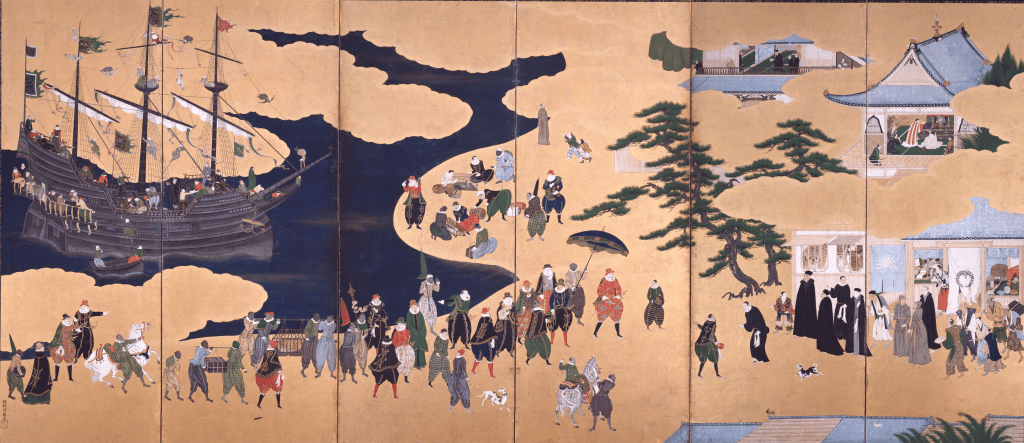
    https://ja.wikipedia.org/wiki/%E7%9F%B3%E5%9E%A3%E5%B1%B1%E5%9F%8E
    https://ja.wikipedia.org/wiki/%E5%BF%8D%E5%9F%8E%E3%81%AE%E6%88%A6%E3%81%84
    https://ja.wikipedia.org/wiki/%E5%BF%8D%E5%9F%8E
    https://ja.wikipedia.org/wiki/%E7%9F%B3%E7%94%B0%E5%A0%A4
    https://ja.wikipedia.org/wiki/%E9%A4%A8%E6%9E%97%E5%9F%8E
    https://ja.wikipedia.org/wiki/%E5%B2%A9%E6%A7%BB%E5%9F%8E
    https://ja.wikipedia.org/wiki/%E6%B5%85%E9%87%8E%E9%95%B7%E6%94%BF
    https://ja.wikipedia.org/wiki/%E9%89%A2%E5%BD%A2%E5%9F%8E
    https://ja.wikipedia.org/wiki/%E9%9F%AE%E5%B1%B1%E5%9F%8E
    https://ja.wikipedia.org/wiki/%E9%95%B7%E6%B5%9C%E5%9F%8E_(%E4%BC%8A%E8%B1%86%E5%9B%BD)
    https://ja.wikipedia.org/wiki/%E6%9D%BE%E4%BA%95%E7%94%B0%E5%9F%8E
    https://en.wikipedia.org/wiki/Toyotomi_Hideyoshi
    https://en.wikipedia.org/wiki/Siege_of_Odawara_(1590)